

Middle Atlantic
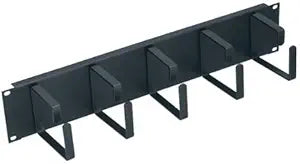
Middle Atlantic HCM2D 2 RU D Ring Horizontal Cable Manager
Two rack units of D-ring cable management that keeps patch cords routed cleanly and bend radius maintained across up to 240 Cat5e cables.
$86.00*
View on Amazon
✓ In Stock on Amazon.com
*Price sourced from Amazon.com. Last updated:Jul 14, 2026.Price and availability are subject to change.
Affiliate Disclosure: Studio Supplies may earn a commission from qualifying purchases made through links on this page, at no additional cost to you. This helps support our editorial team.
Notice a mistake? Let Us Know
Overview
Key Features
2 Ru
3.5
Accommodates up to 240 cat5e cables using the recommended 50 percent fill rate
Item Package Weight: 3.0 pounds
Specifications
Rack Units (RU)
2
Height
3.5 inches
Maximum Cable Capacity (Cat5e)
240 (at 50% fill rate)
Item Package Weight
3.0 pounds
Pros & Cons
👍 Pros
- The D-ring design allows cables to be added, removed, or rerouted at any point without disturbing adjacent bundles — critical for racks that undergo frequent MACs (moves, adds, changes).
- D-ring design allows individual patch cords to be added, removed, or rerouted without disturbing adjacent cables — critical for MACs (moves, adds, changes) in live racks.
- At the recommended 50 percent fill rate, the HCM2D handles up to 240 Cat5e cables across its 2 RU span, making it appropriately sized for high-density patch panel installations.
- A 240-cable Cat5e capacity at 50% fill rate gives substantial headroom for high-density patch environments without requiring multiple managers per rack section.
- The 2U form factor provides more vertical D-ring depth than 1U alternatives, allowing larger cable bundle diameters to maintain proper bend radius.
- Flat black powder coat finish resists corrosion and provides a professional, consistent aesthetic that matches standard rack equipment without painting or treatment.
- Dual mounting compatibility — rack rail or wall — gives this manager deployment flexibility across both full rack frames and wall-mounted structured wiring enclosures.
- Flat black powder coat finish matches standard EIA rack aesthetics and is durable against cable jacket abrasion during maintenance pulls.
- Rack rail or wall mounting versatility makes it usable in both full rack enclosures and open-frame or wall-mount deployments.
- At 3 pounds, the HCM2D adds negligible load to a rack, preserving weight budget for active equipment like switches, patch panels, and UPS units.
👎 Cons
- The 2U height occupies twice the rack real estate of 1U cable managers — in density-critical racks where every unit is allocated, this is a meaningful cost.
- The HCM2D provides horizontal cable management only — vertical cable management between rack sections requires separate Middle Atlantic or third-party vertical managers, adding cost and rack planning complexity.
- D-ring openings, while flexible, do not provide the continuous bend radius protection of a closed finger duct — cables with heavy jacket materials or tight slack loops may press against D-ring edges over time.
- D-ring managers provide no top cover or routing channel, meaning cable bundles are exposed and can shift during aggressive cable pulls in dense environments.
- At 3.0 pounds, the HCM2D adds non-trivial weight to rack sections that are already near floor load limits in high-density data cabinet rows.
- At 2 RU, this manager consumes rack space that may be at a premium in smaller 12U or 18U enclosures where every unit counts.
- No integrated cable tie anchor points are specified — securing bundled runs within the D-rings requires separate hook-and-loop or cable tie accessories.
- No integrated Velcro straps or cable tie-off points are specified — securing cable bundles within the rings requires separate cable ties or straps.
- The open D-ring design provides no strain relief for individual patch cord connections — cables can migrate out of the rings if not secured during rack moves.
- The unit is passive with no labeling provisions built in — cable identification relies entirely on patch cord color coding or externally applied labels, which is an additional workflow step in large deployments.
Frequently Asked Questions
How many Cat5e cables can the HCM2D manage at full capacity?
Middle Atlantic rates the HCM2D to accommodate up to 240 Cat5e cables using the recommended 50% fill rate. Exceeding that fill rate compresses cable bundles and can compromise bend radius compliance, which affects signal integrity in high-density patch environments.
What does the 2 RU designation mean for rack planning?
2 RU (rack units) means this manager occupies 3.5 inches of vertical rack space. When planning rack layout, account for this height above or below your patch panels — the HCM2D is typically mounted immediately adjacent to the patch panel it serves.
How many cables can the HCM2D actually manage?
At the recommended 50 percent fill rate, the HCM2D accommodates up to 240 Cat5e cables. This is an engineering best-practice limit — exceeding it risks reducing airflow, increasing cable stress, and making future adds/moves/changes significantly more difficult.
What is the difference between D-ring cable managers and horizontal lacing bars?
D-ring managers like the HCM2D use raised loops that hold cables in organized bundles while allowing cables to be added or removed from any point along the manager without disturbing adjacent runs. Lacing bars require cables to be tied in, making mid-run changes more disruptive. D-rings are the preferred choice for patch-heavy environments where moves, adds, and changes are frequent.
Does the HCM2D mount on standard 19-inch EIA rack rails?
Yes — the HCM2D is designed for rack rail or wall mounting in standard configurations. It occupies 2 rack units (3.5 inches of vertical space) in a 19-inch rack.
What is the D-ring style, and why does it matter versus a fixed finger duct?
D-rings are open loops that guide cables while allowing easy lateral insertion without threading from one end. Unlike solid finger ducts, D-rings let you add or remove individual patch cords without disturbing adjacent runs — a meaningful advantage in active racks.
Can the HCM2D be wall-mounted or is it rack-only?
Middle Atlantic specifies both rack rail and wall mounting as supported options, giving it flexibility for smaller installations or structured media closets that don't use a full rack frame.
Is the powder coat finish durable enough for data center environments with frequent cable pulls?
The flat black powder coat finish on the HCM2D is a standard data center rack finish — durable against cable jacket abrasion and resistant to chipping under normal rack maintenance conditions. It also matches the finish of most Middle Atlantic and standard EIA rack enclosures.
Can this cable manager be used above or below patch panels, or only in dedicated cable management rows?
The HCM2D is designed to be used in any position within a rack — above, below, or between active equipment. Standard practice is to install a 1U or 2U cable manager between every 1–2U of patch panels to manage horizontal cord runs, though actual placement depends on rack design and cable density.
Does the flat black powder coat finish affect cable friction or installation?
No. The powder coat finish on the HCM2D is applied for corrosion resistance and aesthetics — it does not increase friction against cable jackets. The D-rings themselves are smooth, which protects cable jackets during routing and future reconfiguration.
Related Products


