

Monoprice
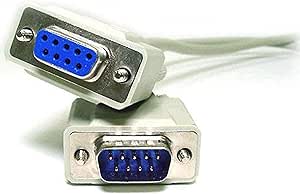
Monoprice 100447 100ft DB9 Serial Extension Cable
★★★★★
Extend any RS-232 serial device run by 100 feet with a straight-wired DB9 male-to-female cable that preserves pin-for-pin continuity.
$24.95*
View on Amazon
✓ In Stock on Amazon.com
*Price sourced from Amazon.com. Last updated:Jul 14, 2026.Price and availability are subject to change.
Affiliate Disclosure: Studio Supplies may earn a commission from qualifying purchases made through links on this page, at no additional cost to you. This helps support our editorial team.
Notice a mistake? Let Us Know
Overview
Key Features
High quality high value Serial (DB9) Straight Extension Cables
A reliable and economical solution for extending your pre-existing serial cables
High quality molded connectors
Beige color
Monoprice continually strives to improve its product line to bring our customers the best products available
Therefore changes may be made to listed specifications without prior notice
Item received may not match photo or specs shown
Specifications
Connector Type
DB9 Male to DB9 Female
Length
100 feet
Wiring
Straight-Through
Pins
9
Connector Construction
High-Quality Molded
Jacket Color
Beige
Interface Standard
RS-232 Serial (DB9)
Pros & Cons
👍 Pros
- 100-foot length covers the distance between a serial host and peripheral in most commercial or industrial floor layouts without requiring a signal repeater
- Straight-through wiring passes all 9 DB9 pins including hardware handshaking lines (RTS/CTS/DTR/DSR), preserving the full RS-232 signal set for devices that use flow control
- Molded connector construction provides factory-quality strain relief at both ends, reducing the connector failure rate under repeated connect/disconnect cycles
- DB9 M/F configuration is the correct connector pairing for extending an existing male-terminated cable to a female-terminated device port
- Monoprice's consistent manufacturing tolerances on molded connectors ensure consistent mating force across the production run without over-tight or loose engagement
👎 Cons
- 100 feet at baud rates above 38400 approaches the practical RS-232 signal integrity limit — installations requiring reliable 115200 baud over this length may need a lower-capacitance cable or active signal booster
- Beige jacket color integrates poorly with modern gray and black infrastructure cabling — visible in clean cable management environments
- Monoprice's specification disclaimer (item received may not match photo or specs) introduces uncertainty about connector pin-out verification without testing each cable on receipt
- Molded construction prevents field repair — a damaged connector at either end requires complete cable replacement rather than a connector swap
- No locking thumbscrews are specified — in vibration-prone industrial environments, the connectors may require additional retention hardware to prevent accidental disconnection
Frequently Asked Questions
Is this cable a straight-through extension or a null modem (crossover) cable?
This is a straight-through extension cable — pin 1 on the male connector maps to pin 1 on the female connector, and so on through all 9 pins. It is intended to extend an existing serial connection, not to create a direct device-to-device link. If you need to connect two DTE devices directly (two computers without a modem), you need a null modem cable, not this extension.
Will this 100-foot cable introduce signal degradation or reliability issues at RS-232 serial speeds?
RS-232 does not have a strict maximum cable length specification — the standard defines signal voltage levels and slew rates, and the practical cable length limit depends on baud rate and cable capacitance. At common industrial and legacy serial rates (9600 baud, 19200 baud), 100 feet is within reliable operating range. At 115200 baud, 100 feet is near the practical limit and may exhibit occasional errors depending on cable quality and load.
Does the molded connector construction prevent field repair if a connector is damaged?
Yes — molded connectors are overmolded at the factory and cannot be disassembled or repaired in the field. If a connector is damaged, the cable must be replaced. The trade-off is that molded construction provides better strain relief than field-terminated connectors, making the cable more durable under repeated plug/unplug cycles.
Is this cable compatible with DB9 connectors on both PC serial ports and industrial serial equipment?
Yes — DB9 is the standard connector for RS-232 serial interfaces on both PC COM ports and the vast majority of industrial serial devices (PLCs, CNC controllers, barcode scanners, label printers, test instruments). The physical connector mates with any standard DB9 receptacle.
Does this cable support hardware flow control signals (RTS/CTS), or does it only pass TX and RX data lines?
A straight-through extension cable passes all 9 DB9 pins, which includes the data lines (TX/RX), ground, and hardware handshaking signals (RTS, CTS, DTR, DSR, DCD, RI). Hardware flow control will function through this cable provided the original device configuration and the extension length are within the RS-232 voltage margin.
Related Products


