



Monoprice
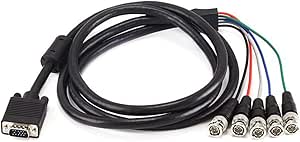
Monoprice 100566 6FT VGA to 5 BNC RGB Video Cable
★★★★★
Double-shielded VGA-to-5BNC construction preserves signal integrity across 6 feet for reliable component video connections to professional monitors and projectors.
$17.99*
View on Amazon
✓ In Stock on Amazon.com
*Price sourced from Amazon.com. Last updated:Jul 14, 2026.Price and availability are subject to change.
Affiliate Disclosure: Studio Supplies may earn a commission from qualifying purchases made through links on this page, at no additional cost to you. This helps support our editorial team.
Notice a mistake? Let Us Know
Overview
Specifications
Cable Type
VGA HD-15 to 5 BNC RGB
Length
6 feet
Color
Black
Shielding
Double shielded
Application
HDTV monitor / component RGB display
Brand
Monoprice
Model
100566
Pros & Cons
👍 Pros
- Double shielding on all five signal conductors suppresses electromagnetic interference, maintaining signal integrity in equipment-dense racks and broadcast environments where RF noise is a genuine concern.
- Five discrete BNC connectors provide individually secured, twist-lock connections at the display end — eliminating the intermittent contact issues that can affect combined connector types over time.
- 6-foot length covers the typical gap between a rack-mounted source and a desktop monitor or nearby projector without excess cable to manage.
- Passive construction means no active components to fail — the cable either works or it doesn't, with no firmware, drivers, or power requirements to troubleshoot.
👎 Cons
- 6 feet is a fixed, short run — installations where the source and display are across a room will require a different cable or an active signal extender, as this cable does not come in longer variants under this model number.
- VGA and 5-BNC are both legacy connection standards; newer displays and graphics cards have largely moved to DisplayPort and HDMI, limiting the compatible hardware pool to older or specialized professional equipment.
- No ferrite cores or additional EMI suppression beyond the double shielding — in extremely interference-heavy environments such as broadcast trucks, premium cables with additional filtering may perform more reliably.
- The BNC connectors require a quarter-turn twist-lock to seat properly; users unfamiliar with BNC connections occasionally seat them without locking, causing intermittent signal loss.
Frequently Asked Questions
What devices on each end of this cable need to be compatible for it to work?
One end terminates in a standard HD-15 (VGA) connector, the other in five BNC connectors (R, G, B, H-sync, V-sync). The source device needs a VGA output — a PC graphics card, a document camera, or a legacy workstation — and the destination needs five discrete BNC inputs labeled for RGB component video. Professional broadcast monitors, high-end projectors, and older engineering-grade displays typically carry these inputs.
Does this cable support HD resolutions or is it limited to standard definition?
The cable's application is listed for HDTV monitor use, and VGA-to-5BNC connections are capable of passing resolutions up to 1920×1200 (WUXGA) and beyond, depending on the signal source. Resolution ceiling is determined by your source device and destination display, not by the cable construction at 6 feet — the double shielding is specifically designed to preserve signal integrity at these higher frequencies.
Will there be signal degradation over the 6-foot length?
At 6 feet, signal degradation is negligible for resolutions up to 1080p on a double-shielded cable of this construction. The double shielding suppresses electromagnetic interference from adjacent power cables and other RF sources, which is the primary cause of ghosting, color bleed, or noise artifacts at VGA signal frequencies.
Can I use this cable in reverse — from a BNC source to a VGA display?
Electrically yes, provided the BNC source is outputting an RGB signal with separate H and V sync on the correct pins. The cable is passive with no signal conversion — it simply connects the conductors. Compatibility depends entirely on matching signal standards between source and destination, not on cable direction.
Related Products


