



Monoprice
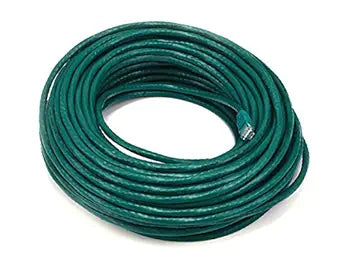
Monoprice 102330 Cat6 100ft Green Ethernet Cable
★★★★★
550MHz Cat6 at 100 feet gives your Gigabit switch the clean, spec-compliant copper path it needs — no CCA compromise, no performance guesswork.
$31.25*
Check availability
*Price sourced from Amazon.com. Last updated:Jul 15, 2026.Price and availability are subject to change.
Affiliate Disclosure: Studio Supplies may earn a commission from qualifying purchases made through links on this page, at no additional cost to you. This helps support our editorial team.
Notice a mistake? Let Us Know
Overview
Key Features
High quality Category 6 (CAT6) patch cables are the solution to your internetworking needs
With a blazing speed of up to 550MHz you can connect to your LAN/WAN segments and networking gear at maximum speed
Also with its superior connector you get a cable that is built for speed and endurance
Monoprice Cat5e and Cat6 cables are made of 24 AWG pure bare copper wire as opposed to copper clad aluminum (CCA) wire and are therefore fully compliant with UL Code 444 and National Electrical Code TIA-568-C
2 fire and safety standards which require pure bare copper wire in Cat5e and Cat6 communications cables
Specifications
Brand
Monoprice
Cable Type
Cat6 Patch Cable
Length
100ft
Color
Green
Max Speed
550MHz
Wire Gauge
24 AWG
Wire Material
Pure Bare Copper
Compliance Standards
UL Code 444, National Electrical Code TIA-568-C.2
Pros & Cons
👍 Pros
- 550MHz bandwidth rating supports 10GbE at runs under 55 meters — this cable won't be the bottleneck if you upgrade to a 10Gbps switch or NIC.
- Pure bare copper conductors meet UL Code 444 and NEC TIA-568-C compliance standards that CCA cables technically fail to satisfy.
- Stranded UTP construction handles repeated flexing and repositioning without conductor fatigue — the right build for a device-to-switch patch cable.
- At 100 feet, this cable covers most within-room and short between-room runs in a single pre-terminated length, eliminating field termination entirely.
- The green jacket provides immediate visual differentiation in multi-cable switch panel environments, simplifying cable management.
👎 Cons
- At 100 feet (approximately 30.5 meters), you're consuming roughly half the Cat6 10GbE distance budget — for longer 10Gbps runs approaching 55 meters, there is minimal margin before Cat6a becomes necessary.
- Stranded construction is not suitable for punch-down termination in keystone jacks or patch panels — this cable should not be used in permanent in-wall infrastructure runs.
- The 100-foot fixed length means you're pulling slack management into your cable run — no custom length option without purchasing bulk cable and field-terminating.
- UTP (unshielded) construction offers no protection against electromagnetic interference in environments with heavy motor loads, fluorescent ballasts, or dense cable trays.
Frequently Asked Questions
What's the real-world difference between Cat6 at 550MHz and Cat5e at 350MHz for a typical office or home network?
For standard Gigabit Ethernet (1000BASE-T), both Cat5e and Cat6 exceed the minimum specification — you won't see a speed difference on a 1Gbps switch. Cat6's advantage is the 550MHz bandwidth headroom, which provides better noise rejection in dense cable runs and is the minimum required standard for 10GbE (10GBASE-T) at runs up to 55 meters. If your infrastructure might handle 10Gbps in the future, Cat6 is the correct choice today.
Does the pure bare copper construction matter for a 100-foot patch cable?
Yes, particularly for PoE applications. Copper-clad aluminum (CCA) wire has higher resistance than pure copper, which means more heat under sustained PoE current loads and potential underperformance in PoE+ (30W) or PoE++ (60W+) deployments. Monoprice's use of pure bare copper also ensures UL Code 444 and NEC TIA-568-C compliance — CCA cables technically fail these standards.
Is stranded or solid conductor better for a 100-foot run between two fixed devices?
This Cat6 cable uses stranded conductors, making it a patch cable — appropriate for runs between a switch and a device where occasional movement or repositioning will occur. Stranded cable handles repeated flexing without conductor fatigue. For in-wall permanent runs, solid conductor bulk cable is preferred, but for device connections at 100 feet, stranded is the correct construction.
Will this cable work with a 10GbE switch or NIC?
At 100 feet (approximately 30.5 meters), this Cat6 cable is within the 55-meter limit for 10GBASE-T over Cat6, so 10GbE is technically supported. For runs approaching or exceeding 55 meters, Cat6a is required to reach the full 100-meter distance at 10Gbps.
Why green — does cable color affect performance?
Cable jacket color has no effect on electrical performance. Color is used for visual cable management — green is a common convention for general-purpose or isolated network segments in structured cabling environments, helping identify cable purpose at a glance in busy switch rooms.
Related Products


