



Monoprice
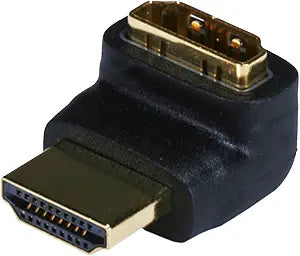
Monoprice 103850 HDMI Port Saver 270-Degree Adapter
★★★★★
A 270-degree HDMI adapter that routes cables away from tight spaces and walls, protecting your device's port from mechanical stress at the connection point.
$5.64*
View on Amazon
✓ In Stock on Amazon.com
*Price sourced from Amazon.com. Last updated:Jul 14, 2026.Price and availability are subject to change.
Affiliate Disclosure: Studio Supplies may earn a commission from qualifying purchases made through links on this page, at no additional cost to you. This helps support our editorial team.
Notice a mistake? Let Us Know
Overview
Key Features
Product Type:Electronic Cable
Item Package Dimension:1.524 cm L X1.905 cm W X3.175 cm H
Item Package Quantity:1
Country Of Origin: China
Specifications
Product Type
Electronic Cable
Item Package Dimension
1.524 cm L X1.905 cm W X3.175 cm H
Item Package Quantity
1
Country Of Origin
China
Pros & Cons
👍 Pros
- The 270-degree angle eliminates the sharp cable bend that occurs when an HDMI cable is plugged into a port near a wall or inside a tight AV cabinet — protecting the port and cable jacket from mechanical fatigue over time.
- As a passive adapter it adds no latency, requires no power, and introduces no active components that could fail — long-term reliability is simply a function of connector contact life.
- The compact form factor fits in tight AV enclosures and behind wall-mounted displays where a straight HDMI cable would be physically unmanageable.
- Using a port saver concentrates connection wear on the adapter rather than the device's integrated HDMI port — a worn adapter costs a few dollars to replace; a worn device port does not.
- The 270-degree orientation solves a cable routing problem that a standard 90-degree adapter cannot address — making it a targeted solution rather than a generic accessory.
👎 Cons
- The adapter adds a connection point in the signal path — in installations where total cable run is already near passive HDMI limits for 4K, the additional interface introduces a potential reliability variable.
- No locking mechanism means the adapter can work loose from the device port when equipment is repositioned or handled — additional cable management is required to hold it in place in mobile setups.
- The specific 270-degree angle is only useful in particular mounting orientations — it has no utility in installations where that cable exit direction is not the problem being solved.
- There is no published bandwidth specification or tested throughput rating — users must verify 4K HDR performance in their specific installation rather than relying on a rated spec.
- As a single-direction adapter, it addresses one cable routing angle only — if your installation requires a different exit direction (left-facing, right-facing), a different adapter is needed.
Frequently Asked Questions
What does 270-degree mean in terms of cable exit direction?
A 270-degree HDMI adapter redirects the cable so it exits parallel to the device surface but facing away from the device — useful when a display or receiver sits close to a wall and a straight cable would press against the wall and create a damaging bend radius at the connector.
Will this adapter pass 4K HDMI signals reliably?
The adapter is passive and supports standard HDMI signal passthrough — its performance ceiling is determined by the cables on both ends. For 4K signals, use certified high-speed cables rated for 18Gbps bandwidth on each side of the adapter. The adapter itself does not degrade signal type.
Does using this adapter introduce measurable signal loss?
As a passive connector the 103850 adds one additional contact interface on each side of the signal path. Within typical passive HDMI cable length limits, the added contact resistance is negligible and does not cause measurable signal degradation in real-world use.
What makes the 270-degree angle different from a standard 90-degree adapter?
A standard 90-degree adapter redirects the cable at a right angle to the port axis — sideways. The 270-degree orientation redirects the cable in the opposite direction, routing it backward or downward along the device surface. This specifically addresses mounting positions where a sideways exit would not clear the installation space.
Does the adapter fit all standard HDMI ports and stay secured reliably?
The adapter uses standard HDMI Type-A male and female connectors and fits any standard Type-A HDMI port. It does not use a locking mechanism, so in high-vibration environments or setups where equipment is frequently moved, additional cable management is needed to prevent the connection from working loose.
Related Products


