



Monoprice
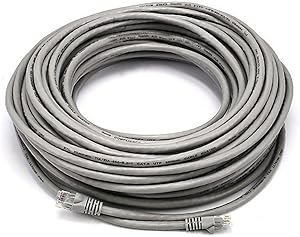
Monoprice 104923 Cat5e Ethernet Patch Cable - 75ft Gray
★★★★★
Reliable Network Connectivity You Can Depend On The Monoprice Cat5e Ethernet Patch Cable offers the ideal combination of value and performance for all your networking needs. Available in various colors and lengths, ensuring a seamless connection in every situation. Conductor Material: 24AWG s...
$29.99*
View on Amazon
✓ In Stock on Amazon.com
*Price sourced from Amazon.com. Last updated:Jul 15, 2026.Price and availability are subject to change.
Affiliate Disclosure: Studio Supplies may earn a commission from qualifying purchases made through links on this page, at no additional cost to you. This helps support our editorial team.
Notice a mistake? Let Us Know
Overview
Reliable Network Connectivity You Can Depend On
The Monoprice Cat5e Ethernet Patch Cable offers the ideal combination of value and performance for all your networking needs. Available in various colors and lengths, ensuring a seamless connection in every situation.
- Conductor Material: 24AWG stranded pure copper
- Contacts: 50µm gold plated (short body)
- Strain Relief: Color matched Snagless boots
- Compliance: UL Code 444 and National Electrical Code TIA-568-C.2
- Length: 75ft
- Color: Gray
Key Features
Unshielded Twisted Pairs (UTP)
350MHz bandwidth
50µm gold plated contacts
Color matched, snagless strain relief boots
Specifications
Cable Type
Cat5e Ethernet Patch Cable
Cable Construction
Unshielded Twisted Pairs (UTP)
Bandwidth
350MHz
Connector Plating
50µm gold plated contacts
Features
Snagless strain relief boots
Length
75ft
Color
Gray
Pros & Cons
👍 Pros
- 75-foot length spans most in-room and cross-room networking scenarios without requiring a switch extension — a single cable run from router to workstation or AP to switch is sufficient.
- 75-foot length covers the most common cross-room and inter-rack runs without requiring cable couplers or intermediate patch points that introduce additional insertion loss and failure modes.
- 75-foot length covers full room-to-room runs in residential and small commercial environments without requiring cable extension or junction boxes.
- Pure bare copper conductors maintain lower resistance per foot than CCA alternatives, preserving Gigabit signal integrity across the full run length.
- Pure bare copper 24AWG conductors maintain rated electrical performance at the full run length, unlike CCA alternatives whose elevated resistance compounds attenuation in longer cable spans where margin matters most.
- 24AWG stranded pure copper conductors meet TIA-568-C.2 compliance, ensuring the cable performs to spec at the full 75-foot run rather than degrading near the length limit.
- 350MHz bandwidth provides genuine headroom over the 100MHz Cat5e floor specification — the cable runs Gigabit with margin, not at the edge of compliance.
- 350MHz bandwidth provides substantial headroom above the 100MHz Gigabit Ethernet requirement, keeping signal integrity intact across the cable's full rated length even in environments with adjacent cable interference.
- TIA-568-C.2 and UL Code 444 compliance provides documented conformance to the governing network cabling standards.
- 350MHz bandwidth rating delivers headroom above the Gigabit minimum, reducing crosstalk sensitivity in environments where the cable shares a bundle with other network runs.
- TIA-568-C.2 and UL Code 444 compliance qualifies the cable for commercial structured cabling installations where certification documentation is required for inspection.
- 50µm gold-plated RJ45 contacts on both ends resist oxidation for the life of the installation — no intermittent connectivity from contact degradation over time.
- Color-matched snagless strain relief boots protect the retaining clip and allow easy identification in a multi-cable environment — gray is a common neutral color for general-purpose networking runs.
- Color-matched snagless boots keep gray color-code designation visible at both patch panel and device termination, supporting organized infrastructure management at a glance.
- Snagless strain relief boot protects the retaining tab across the repeated bend cycles inherent in a 75-foot cable routed through a real environment.
👎 Cons
- At 75 feet, cable management becomes a real consideration — routing, dressing, and securing this length without creating a hazard or interference source adds installation time compared to shorter patch cables.
- At 75 feet, excess cable management becomes a real consideration — if the actual run is shorter, the surplus cable creates a bundle that traps heat and complicates rack organization if not properly managed.
- Stranded construction is not suitable for in-wall or conduit installation — buyers planning a permanent infrastructure run need solid core Cat5e.
- UTP construction offers no shielding — susceptible to interference from electrical sources in close proximity, which can matter in industrial or mixed-use environments with high EMI.
- Stranded conductor construction is not ideal for punch-down termination to keystone jacks or patch panels — solid conductor Cat5e is more reliable in IDC termination applications.
- UTP construction offers no shielding, which can be a limitation in environments with significant EMI — a 75-foot unshielded run has more exposure to interference sources than a short patch cable.
- Stranded construction makes this unsuitable for permanent in-wall or structured wiring use — this is a surface-run or temporary installation cable only.
- Cat5e does not support 10GbE (10GBASE-T) regardless of run length — networks migrating to 10G switching infrastructure will need to replace this cable with Cat6A.
- Cat5e maximum throughput is 1 Gbps — installations planning for 2.5GbE or higher will need to re-pull with Cat6 or Cat6A.
- 75 feet of gray cable in a finished space is a cable management commitment — surface routing will require conduit, cable raceways, or under-carpet trays to maintain a clean installation.
- At 75 feet, this is at the longer end of the patch cable category — if the installation point is not precisely measured before ordering, small miscalculations in needed length are more costly to correct.
- Cat5e's 1Gbps ceiling means this cable won't support future multi-gigabit switching upgrades — a Cat6 or Cat6A cable would future-proof the same run at modest additional cost.
Frequently Asked Questions
Can this cable reliably carry Gigabit Ethernet at 75 feet?
Yes. Cat5e supports Gigabit Ethernet (1000BASE-T) at runs up to 328 feet (100 meters). At 75 feet, this cable operates well within its specified range — attenuation and crosstalk remain well within TIA-568-C.2 compliance margins, and Gigabit performance is fully supported.
Will this cable maintain Gigabit speeds across the full 75-foot length?
Yes. TIA-568-C.2 specifies Cat5e permanent link performance up to 90 meters (approximately 295 feet) for Gigabit Ethernet. At 75 feet, this cable is well within the maximum channel length, and the 350MHz bandwidth rating confirms the cable exceeds the 100MHz floor required for 1000BASE-T with margin to spare.
Can a 75-foot Cat5e cable reliably carry Gigabit Ethernet (1 Gbps)?
Yes. TIA-568 specifies Cat5e for Gigabit Ethernet at runs up to 100 meters (328 feet). A 75-foot run is well within specification, and Monoprice's 350MHz bandwidth rating provides margin above the 100MHz minimum.
What conductor material does the 104923 use, and does it matter at 75 feet?
It uses 24AWG stranded pure bare copper. At 75 feet, conductor quality matters more than at short patch lengths — copper resistance and attenuation increase with length, and CCA cables show higher resistance per foot that can erode Gigabit margin at longer runs.
What does the UL Code 444 and TIA-568-C.2 compliance certification mean for a production installation?
UL 444 covers communications cable construction and fire safety standards — relevant for installations inside wall cavities or above drop ceilings where local code requires UL-listed cable. TIA-568-C.2 compliance means the cable has been validated to industry-standard electrical performance specifications, not just manufacturer self-reporting. For commercial or structured cabling installations, both certifications are frequently required for inspection sign-off.
What does 24AWG stranded pure copper mean for performance versus cheaper alternatives?
24AWG pure copper meets the DC resistance and signal transmission requirements of the Cat5e standard. Stranded construction adds flexibility for routing around obstacles in a real installation. Cables using copper-clad aluminum (CCA) conductors are technically non-compliant with TIA standards and can exhibit higher resistance and signal loss — particularly relevant at longer runs like 75 feet where conductor quality has a measurable impact.
Is this cable suitable for running through walls or under flooring?
This is a stranded-conductor patch cable, not a solid-core structured cabling product. Stranded cables are not recommended for in-wall or plenum-rated installations. For permanent in-wall runs, a solid-core Cat5e or Cat6 cable with the appropriate plenum or riser rating should be used instead.
Is 24AWG stranded copper appropriate for a 75-foot permanent installation run?
Stranded copper is the correct choice for patch cables — it's more flexible and handles repeated movement without work-hardening and eventually fracturing the conductor. For permanent in-wall runs at 75 feet, solid 24AWG Cat5e is technically preferred for lower DC resistance. However, for surface-run or accessible permanent links where the cable won't be pulled through conduit repeatedly, stranded performs within specification.
Is this cable suitable for in-wall or in-conduit installation?
No. Stranded conductors are designed for flexible patch cable use — repeated bending and connection cycles. In-wall installation requires solid core Cat5e, which maintains impedance consistency across fixed runs.
What does "snagless strain relief boot" mean for a 75-foot run?
At 75 feet, the cable is regularly routed around furniture, through cable management channels, and connected/disconnected at both ends. The snagless boot protects the RJ45 retaining clip from breaking during routing and endpoint connection — the most common failure mode of long patch cables in production environments.
Does the gray color coding have a functional role in cable management?
Gray is conventionally used in structured cabling environments to designate specific network segments — voice lines, management VLANs, or inter-switch uplinks, depending on a facility's color scheme standard. The color-matched snagless boots reinforce the color coding at the termination point, keeping the designation visible at the patch panel face.
Does the UTP construction cause any issues in environments with electrical interference?
UTP (unshielded twisted pair) relies on the twist ratio of the conductor pairs to reject common-mode noise — which handles typical office and home environments effectively. In environments with dense EMI sources like industrial motors, high-power lighting fixtures, or large UPS systems, an STP (shielded twisted pair) cable would provide better noise rejection at 75 feet.
What speed ceiling does Cat5e have if I upgrade my switching infrastructure?
Cat5e is rated for Gigabit Ethernet (1Gbps) under TIA-568-C.2. It is not reliably rated for 2.5GbE or 10GbE, which require Cat6 or Cat6A respectively. If your switching infrastructure moves beyond 1Gbps, this cable will need replacement.
What maximum data transfer speeds does this cable support?
Cat5e supports Gigabit Ethernet (1000BASE-T) at up to 1Gbps. It does not support 10GbE (10GBASE-T), which requires Cat6 or Cat6A. For any infrastructure operating at 1GbE switch ports, this cable is fully capable. For 10G-capable switches, this cable becomes the speed-limiting element in the link.
Does this cable meet UL and TIA compliance standards?
Yes. The 104923 is listed as compliant with UL Code 444, National Electrical Code, and TIA-568-C.2 — the current Cat5e transmission standard.
Related Products


