



Monoprice
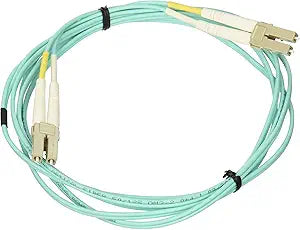
Monoprice 106386 LC/LC Multi-Mode Fiber Optic Cable
★★★★★
Two meters of OM3 50/125 µm LC/LC fiber — the short-reach 10GbE patch cable that eliminates copper's EMI vulnerability in dense equipment racks.
$10.13*$11.99Save 15%
View on Amazon
✓ In Stock on Amazon.com
*Price sourced from Amazon.com. Last updated:Jul 15, 2026.Price and availability are subject to change.
Affiliate Disclosure: Studio Supplies may earn a commission from qualifying purchases made through links on this page, at no additional cost to you. This helps support our editorial team.
Notice a mistake? Let Us Know
Overview
Key Features
Because of its immunity to electronic interference and its greater speeds over longer distances fiber optic cabling has become the conduit of choice for high speed network communications
package height : 1.016 cm
package length : 15.24 cm
package width :14.986 cm
Specifications
Connector Type
LC/LC
Fiber Type
Multi-Mode
Package Height
1.016 cm
Package Length
15.24 cm
Package Width
14.986 cm
Pros & Cons
👍 Pros
- OM3 50/125 µm Corning fiber supports 10GbE at the cable's 2-meter length with effectively zero attenuation — the physics of the fiber are not even remotely challenged at this distance.
- LC/LC duplex connector format is plug-compatible with the entire SFP+ 10GbE ecosystem — no adapters, no media conversion required between any standard 10GbE switch and NIC.
- 2-meter form factor is optimized for same-rack or adjacent-rack connections where a longer cable creates management problems — excess fiber loop is a real failure risk in high-density cabling.
- OFNR-rated jacket meets fire code requirements for in-building installation, ensuring this cable is compliant in structured cabling environments regardless of where a short run is routed.
- Corning fiber construction provides consistent insertion loss and modal bandwidth performance, with less run-to-run variation than commodity fiber from unspecified sources.
👎 Cons
- At 2 meters, there is almost no routing slack — if your equipment moves or your rack layout changes, a 2-meter cable may be too short where a 3-meter cable would have worked, requiring replacement rather than re-routing.
- LC connector ferrules at this price point require inspection and cleaning before installation in high-uptime environments — a contaminated end-face at 10GbE can cause intermittent errors that are difficult to diagnose without a fiber inspection scope.
- Multimode OM3 is incompatible with single-mode OS2 infrastructure — if your facility uses single-mode backbone fiber, this cable requires separate SR transceivers and cannot be used in the same link as your long-haul runs.
- The fixed length and non-field-terminable construction means any physical damage to the connectors or jacket requires full cable replacement.
Frequently Asked Questions
Why use a 2-meter fiber patch cable instead of a short copper Ethernet cable?
At 2 meters, the advantage isn't distance — it's EMI immunity and ground loop elimination. In densely populated equipment racks with switching power supplies, UPS units, and high-current cabling, copper Ethernet picks up interference that fiber is physically immune to. The 2-meter length is ideal for same-rack or adjacent-rack SFP+ connections.
What transceivers does this cable require on each end?
You need SFP+ SR (short-range) transceivers operating at 850 nm, designed for OM3 multimode 50/125 µm fiber. Common examples include the Cisco SFP-10G-SR, Intel E10GSFPSR, or any 10GBASE-SR compliant module. The cable is passive — all active components live in the transceivers.
Can this cable carry 1GbE traffic on 1000BASE-SX equipment?
Yes. OM3 multimode fiber is fully backward compatible with 1GbE and 100 Mb/s multimode applications. The same cable will work with 1000BASE-SX SFP transceivers at 850 nm, though you'd only be using a fraction of the fiber's available bandwidth.
Is 2 meters enough for typical same-rack or top-of-rack switch connections?
Yes for most configurations. A standard 42U rack is approximately 1.87 meters tall — a 2-meter patch cable provides enough length for a top-of-rack switch to a server at the bottom of the same rack, with modest slack for cable management. For cross-rack runs, the 15-meter or 20-meter variants are more appropriate.
What does the OFNR jacket rating permit?
OFNR (Optical Fiber Non-conductive Riser) is UL 1666 listed for vertical runs through building floors and risers. At 2 meters, you're unlikely to be doing riser installation, but the rating confirms the jacket material meets fire-resistance standards for structured cabling environments.
Related Products


