



Monoprice
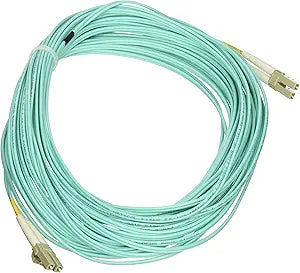
Monoprice 107622 10Gb LC/LC Multi Mode Fiber Optic Cable - 15 Meter
★★★★★
OM3 50/125 µm duplex fiber at 15 meters — runs 10 Gigabit Ethernet at full line rate with zero EMI sensitivity.
$18.77*
View on Amazon
✓ In Stock on Amazon.com
*Price sourced from Amazon.com. Last updated:Jul 15, 2026.Price and availability are subject to change.
Affiliate Disclosure: Studio Supplies may earn a commission from qualifying purchases made through links on this page, at no additional cost to you. This helps support our editorial team.
Notice a mistake? Let Us Know
Overview
Key Features
Because of its immunity to electronic interference and its greater speeds over longer distances fiber optic cabling has become the conduit of choice for high speed network communications
package height : 2.286 cm
package length : 18.034 cm
package width :17.526 cm
Specifications
Cable Type
Fiber Optic
Connectors
LC/LC
Fiber Mode
Multi Mode
Data Rate
10Gb
Length
15 Meter
Package Height
2.286 cm
Package Length
18.034 cm
Package Width
17.526 cm
Pros & Cons
👍 Pros
- OM3-rated 50/125 µm core/cladding supports 10GbE at up to 300 meters, making 15-meter runs operate with massive headroom and no signal integrity concerns.
- Corning optical fiber construction minimizes attenuation and modal dispersion, delivering consistent insertion loss performance across the cable's rated bandwidth.
- Complete EMI immunity eliminates the interference problems that degrade copper runs in electrically noisy environments like equipment rooms with dense power cabling.
- OFNR-rated jacket meets fire safety code requirements for riser installation, eliminating the need to source a separate plenum or riser-rated variant for standard building runs.
- LC/LC duplex connectors are the universal standard for SFP+ 10GbE transceivers — plugs directly into switches, NICs, and media converters without adapters.
👎 Cons
- At 15 meters, this cable is purpose-built for cross-rack or short inter-room runs — it cannot be field-extended or spliced without specialized fusion equipment if your run exceeds the fixed length.
- LC connectors are keyed and fragile compared to copper RJ45; a single damaged ferrule requires full cable replacement rather than a simple re-termination.
- Multimode fiber is not interoperable with single-mode infrastructure — if your facility uses OS1/OS2 single-mode runs, this cable and its required SR transceivers are incompatible with that ecosystem.
- The aqua jacket color is OM3-standard but lacks a secondary outer jacket, making it less suited for environments with heavy foot traffic or cable tray abrasion.
Frequently Asked Questions
What network speeds is this cable rated to support at 15 meters?
This cable is OM3-grade 50/125 µm multimode fiber, rated to carry 10 Gigabit Ethernet (10GbE) at distances up to 300 meters. At 15 meters, you have enormous headroom — 10GbE operates well within OM3's bandwidth-distance product at this length.
Will this cable work with my existing SFP+ transceivers?
Yes, provided your transceivers use LC connectors and are specified for OM3 multimode fiber (look for 850 nm SR optics). The cable's LC/LC duplex connectors are the standard interface for SFP+ short-range multimode transceivers used in 10GbE switches and NICs.
What is the OFNR jacket rating and why does it matter?
OFNR stands for Optical Fiber Non-conductive Riser. It means the cable jacket meets UL 1666 fire safety standards for vertical installation through building floors and risers. If you're running cable between network closets on different floors, this rating is often required by code.
Is this cable compatible with 1GbE or 40GbE equipment?
Yes for 1GbE — OM3 multimode will run 1000BASE-SX without issue. For 40GbE, OM3 supports 40GBASE-SR4 at up to 100 meters, but that requires MPO/MTP connectors, not the LC/LC configuration here. This specific cable is optimized for 10GbE deployments.
What is the core/cladding diameter and why does it matter?
The core is 50 µm and cladding is 125 µm. The 50 µm core (vs. the older 62.5 µm standard) is required for 10GbE OM3 performance — its tighter geometry supports the higher modal bandwidth needed at gigabit speeds over multi-mode fiber.
Related Products


