



Monoprice
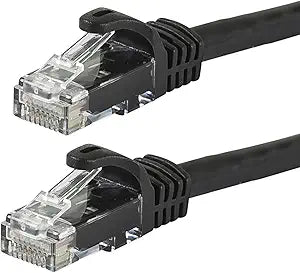
Monoprice 111206 Cat5e Ethernet Cable - 0.5ft Black
★★★★★
Pure bare copper at 350MHz bandwidth in a half-foot run — the right patch cable for tight rack wiring where signal integrity and cable management both matter.
Check availability
Affiliate Disclosure: Studio Supplies may earn a commission from qualifying purchases made through links on this page, at no additional cost to you. This helps support our editorial team.
Notice a mistake? Let Us Know
Overview
Specifications
Brand
Monoprice
Model
111206
Cable Type
Cat5e
Length
0.5 feet
Color
Black
Connector Type
RJ45
Wire Gauge
24AWG
Conductor
Pure Bare Copper
Construction
Stranded
Shielding
UTP (Unshielded Twisted Pair)
Bandwidth
350 MHz
Features
Snagless, Flexboot
Pros & Cons
👍 Pros
- At 0.5ft, this cable solves the specific problem of connecting adjacent rack units cleanly — short enough to eliminate slack loops that create airflow-blocking cable masses inside dense enclosures.
- Pure bare copper conductors provide lower resistance and better signal fidelity than CCA alternatives, which matters in high-cycle patch environments where conductor degradation accumulates over time.
- The 350MHz bandwidth rating gives meaningful headroom above the 100MHz minimum required for Gigabit Ethernet, ensuring compliance even in electrically noisy rack environments.
- Stranded construction allows repeated flexing and reconnection without conductor fatigue — important for patch cables that get moved during reconfigurations.
- Snagless Flexboot connectors protect the RJ45 retention tab in tight multi-cable pulls, reducing connector failure in dense patch panels.
👎 Cons
- UTP (unshielded) construction offers no protection against electromagnetic interference — in racks that mix power and data cabling without separation, shielded Cat5e or Cat6 would be the technically correct choice.
- Cat5e tops out at 1Gbps; if the adjacent equipment in this rack is 10GbE-capable, this cable is a bottleneck by design — Cat6 or Cat6A is required for 10GBASE-T.
- At 0.5ft, there is nearly zero flexibility in positioning — equipment must be physically adjacent for this cable to reach, with no slack for minor repositioning.
- The black colorway, while neutral, offers no color-coded identification benefit in multi-cable racks where cable tracing by color is part of the documentation standard.
Frequently Asked Questions
What is the practical bandwidth ceiling of Cat5e at 350MHz, and does this cable meet it?
Cat5e is rated for 100Mbps at up to 100 meters and supports Gigabit Ethernet (1000BASE-T) across shorter runs. At 0.5 feet, the 350MHz bandwidth specification of this cable is effectively unlimited for any standard Ethernet protocol in use today — signal degradation at this length is negligible. The pure bare copper conductor ensures minimal resistance compared to CCA (copper-clad aluminum) alternatives.
Why choose stranded construction over solid conductor for this application?
Stranded wire is more flexible and fatigue-resistant than solid conductor, which makes it the correct choice for patch cables that are moved, flexed, or repeatedly connected and disconnected. Solid conductor Cat5e is designed for in-wall permanent runs where the cable stays stationary. For a 0.5ft patch cable used on a desk or rack panel, stranded construction extends service life significantly.
What does the snagless / Flexboot connector design prevent in a dense wiring environment?
The Flexboot boot over the RJ45 connector protects the locking tab from catching on adjacent cables or panel edges during installation and removal — a common failure mode in high-density patch panels where pulling one cable snaps the retention clip on another. At 0.5ft, this cable is typically used in rack-to-rack or switch-to-patch-panel scenarios where that clip breakage risk is highest.
Is this cable compatible with PoE (Power over Ethernet) devices?
Yes. Cat5e with 24AWG pure bare copper conductors supports PoE and PoE+ (802.3af and 802.3at) standards without issue. The conductor gauge and pure copper construction handle the current delivery requirements of standard PoE devices reliably.
Will a 0.5ft cable introduce any measurable latency or packet loss compared to a longer cable?
No. At this length, propagation delay is immeasurable in practical terms — well under a microsecond. Any latency in your network is caused by switching, routing, or application overhead, not by 6 inches of Cat5e.
Related Products


