



Monoprice
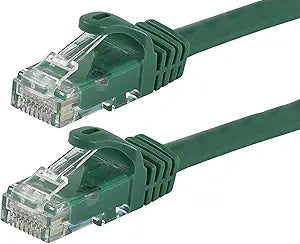
Monoprice 111265 Cat5e Green Ethernet Patch Cable - 1ft
★★★★★
One-foot Cat5e patch cable in pure bare copper — the right tool for tight rack and panel terminations where excess slack is the enemy.
Check availability
Affiliate Disclosure: Studio Supplies may earn a commission from qualifying purchases made through links on this page, at no additional cost to you. This helps support our editorial team.
Notice a mistake? Let Us Know
Overview
Specifications
Length
1 foot
Color
Green
Category
Cat5e
Connector Type
RJ45 Snagless
Wire Type
Stranded, Pure Bare Copper
Wire Gauge
24AWG
Bandwidth
350MHz
Shielding
UTP (Unshielded Twisted Pair)
Pros & Cons
👍 Pros
- 1-foot length eliminates cable slack in rack and patch panel installations, enabling clean cable management without bundling or velcro management of excess
- 350MHz bandwidth rating at this length means essentially zero signal attenuation — the cable operates at maximum Cat5e electrical efficiency
- Pure bare copper conductors ensure full TIA-568 Cat5e compliance, maintaining infrastructure-wide certification standards in professional rack installations
- Snagless RJ45 boot protects the locking tab through repeated patch changes in active network environments
- Stranded 24AWG construction handles the tight bend radii required in dense 1U rack patching without conductor stress
👎 Cons
- 1-foot length is purpose-specific — it is too short to serve as a general-purpose desktop or cross-room cable, limiting its use to rack and panel applications exclusively
- UTP shielding is absent, making this unsuitable for runs near high-voltage or industrial EMI sources (though at 1 foot, this is rarely a practical issue)
- Single green color may complicate color-coded cable management schemes in mixed-service racks where color encodes network segment or VLAN
- Stranded construction has marginally higher per-unit attenuation than solid-core, though at 1 foot this difference is not measurable in any practical test
- No locking tab variant available — in vibration-prone environments, standard RJ45 connectors can work loose without a locking mechanism
Frequently Asked Questions
Why would someone need a 1-foot Ethernet cable specifically?
One-foot patch cables are engineered for structured cabling environments — patch panels, network racks, and switch-to-switch connections — where a longer cable creates unmanageable slack. In a 1U rack with a switch and patch panel mounted adjacent, a 1-foot cable routes cleanly; a 3-foot cable creates a loop that obstructs airflow and complicates future maintenance. The 1-foot length is a deliberate infrastructure choice, not a compromise.
Does a 1-foot Cat5e cable support Gigabit Ethernet?
Yes, fully. Cat5e supports 1000BASE-T at distances up to 100 meters. At 1 foot (approximately 0.3 meters), the cable operates with effectively zero signal attenuation — it is as close to a direct copper connection as a patch cable can be. The 350MHz bandwidth rating is entirely intact at this length.
Is pure bare copper wire necessary at only 1 foot?
At 1 foot, the electrical difference between pure bare copper and copper-clad aluminum is negligible in terms of measured attenuation. However, PBC remains the correct specification for compliance with TIA-568 Cat5e standards. In a rack where dozens of cables are documented and warranted against a specific standard, consistent PBC cabling ensures the infrastructure as a whole meets spec — even if individual short runs would be electrically forgiving of lower-grade materials.
Will this cable work with PoE or PoE+ devices?
Yes. The 24AWG pure bare copper construction supports PoE (802.3af, 15.4W) and PoE+ (802.3at, 30W) current loads without meaningful voltage drop at 1 foot. The cable meets the conductor resistance requirements for both standards.
What does UTP mean and does it matter for a cable this short?
UTP stands for Unshielded Twisted Pair — there is no foil or braid shielding around the conductor pairs. At 1 foot in a typical rack environment, UTP is entirely appropriate; EMI interference requires length to accumulate meaningful effect. Shielded (STP/FTP) cabling is relevant for long runs in electromagnetically noisy industrial environments, not for short patch connections.
Related Products


