



Monoprice
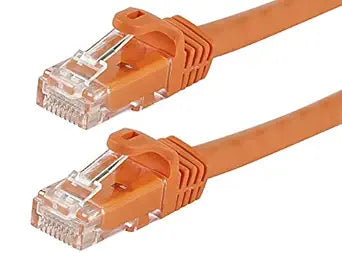
Monoprice 111266 Cat5e Ethernet Patch Cable 1ft Orange
★★★★★
A 1-foot Cat5e patch cable with pure bare copper conductors solves the short-run port-to-device problem cleanly, without cable slack cluttering your rack.
$4.08*
View on Amazon
✓ In Stock on Amazon.com
*Price sourced from Amazon.com. Last updated:Jul 15, 2026.Price and availability are subject to change.
Affiliate Disclosure: Studio Supplies may earn a commission from qualifying purchases made through links on this page, at no additional cost to you. This helps support our editorial team.
Notice a mistake? Let Us Know
Overview
Key Features
Product Type: Computer Add On
Package Quantity: 1
Package Dimensions: 0.6 cms (L) x 11.0 cms (W) x 14.4 cms (H)
Country of Origin: China
Specifications
Cable Type
Cat5e Ethernet Patch Cable
Length
1ft
Color
Orange
Product Dimensions (L x W x H)
0.6 x 11.0 x 14.4 cms
Country of Origin
China
Pros & Cons
👍 Pros
- At 1 foot, this cable eliminates slack entirely in short rack runs between adjacent switches, patch panels, and directly-connected devices — keeping installations visually clean and airflow unobstructed.
- Pure bare copper 24AWG conductors deliver consistent electrical performance and handle PoE current without the resistance increase found in copper-clad aluminum alternatives.
- The orange jacket enables colour-coded cable plants for immediate visual identification of specific VLANs, uplink connections, or device categories without labelling every port.
- 350MHz bandwidth rating comfortably supports full Gigabit Ethernet throughput — the cable is not the bottleneck in any 1G infrastructure.
- Snagless RJ45 connectors protect the locking tab during insertion and removal, which matters more on stiff short cables where connector forces are less forgiving.
👎 Cons
- At 1 foot, routing flexibility is minimal — the cable works only where the two connection points are in near-direct proximity, with no slack for slight positional adjustments.
- Cat5e does not support 10Gbps networking; any infrastructure upgrade to 10GBASE-T will require replacing this and all other Cat5e runs with Cat6A.
- The orange colour, while useful for specific colour-coding schemes, can conflict with cable plants that use orange for a different designated purpose — standardise before purchasing in bulk.
- Stranded conductor construction, while flexible, has marginally higher attenuation than solid-core cable — not relevant at 1 foot, but a consideration if mixing with longer solid-core horizontal runs in a structured cabling environment.
Frequently Asked Questions
What is the maximum data rate this 1-foot cable supports?
Cat5e rated at 350MHz supports Gigabit Ethernet (1000BASE-T) at 1Gbps. At 1 foot, you are operating at roughly 1% of the cable's rated 100-meter channel limit — signal integrity at this length is essentially perfect.
Why use a 1-foot cable instead of a slightly longer cable with slack?
In patch panels and rack-mounted switch environments, excess cable length creates management problems — slack bunches up, blocks airflow, and makes tracing connections harder. A 1-foot cable between adjacent rack-unit devices keeps the installation clean and the cable plant readable.
Is the orange color purely cosmetic, or does it serve a functional purpose?
It's functional in the sense that colour-coded cable plants communicate infrastructure intent at a glance — orange is commonly designated for specific VLANs, uplink ports, or device categories in structured cabling standards. The actual electrical performance is identical regardless of jacket colour.
Will this cable handle PoE or PoE+ without voltage drop issues?
Yes. The pure bare copper conductor handles PoE current loads without the resistance increase that copper-clad aluminum cables exhibit under load. At 1 foot the run length makes voltage drop negligible regardless — but the conductor material matters more on longer runs in the same infrastructure.
Does the snagless design make a practical difference on a 1-foot cable?
Yes, especially in dense patch panels. The snagless boot protects the RJ45 locking tab during insertion and removal — at short cable lengths the stiff geometry of a 1-foot cable means you're applying more lateral force to the connector than on a flexible longer run, making tab protection more relevant, not less.
Related Products


