



Monoprice
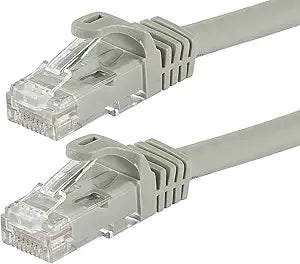
Monoprice 111312 Flexboot Cat5e 30ft Ethernet Cable
★★★★★
Flexboot design and 350MHz bandwidth make this 30-foot Cat5e the no-nonsense patch cable for dense rack installs and tight cable runs.
$8.98*
Check availability
*Price sourced from Amazon.com. Last updated:Jul 14, 2026.Price and availability are subject to change.
Affiliate Disclosure: Studio Supplies may earn a commission from qualifying purchases made through links on this page, at no additional cost to you. This helps support our editorial team.
Notice a mistake? Let Us Know
Overview
Key Features
Unshielded Twisted Pairs (UTP)
350MHz bandwidth
50m gold plated contacts
Color matched, snagless strain relief boots
Specifications
Cable Type
Cat5e Ethernet
Length
30ft
Connector Plating
50m gold plated
Bandwidth
350MHz
Wire Type
Unshielded Twisted Pairs (UTP)
Strain Relief
Color matched, snagless boots
Pros & Cons
👍 Pros
- The Flexboot strain relief on the RJ45 connector is meaningfully thinner than standard boots, making it easier to route and seat cables in densely populated patch panels where space between ports is tight.
- Pure bare copper conductors at 24AWG deliver consistent electrical performance across the cable's full length — no conductivity drop from aluminum-core substitutes.
- 350MHz bandwidth rating provides solid headroom above the Gigabit Ethernet requirement, meaning this cable isn't the limiting factor in a well-built network.
- The snagless design protects the RJ45 locking tab during routing through conduit or cable management channels, reducing the number of broken connectors on the job.
- 50-micron gold-plated contacts resist oxidation over time, keeping contact resistance low across years of use in a patch panel environment.
👎 Cons
- Cat5e is not suitable for 10Gbps infrastructure — if you're building or upgrading to a 10G network, you'll need Cat6A and this cable won't be part of that run.
- At 30 feet, this is an awkward length for tight desktop setups where a 3- or 6-foot cable would produce less slack to manage, and too short for some longer structured wiring runs.
- The gray color, while common in data centers, offers no visual differentiation in a monochrome cable plant — color-coding a mixed infrastructure requires ordering multiple SKUs.
- Stranded conductor construction, while flexible, has marginally higher insertion loss than solid-core cable — relevant only in high-density or long-run installations where you're near the channel limit.
Frequently Asked Questions
What is the maximum throughput this cable supports?
Cat5e at 350MHz bandwidth supports Gigabit Ethernet (1000BASE-T) at up to 1Gbps. For most home and office network infrastructure — NAS, switches, access points, desktop workstations — this is the practical ceiling you'll actually use.
What does the Flexboot design specifically change about installation?
The Flexboot uses a thinner, more flexible strain relief boot around the RJ45 connector instead of the bulky standard boot. This matters in dense patch panels or wall plates where stiff boots make adjacent ports hard to seat or release — the flex boot bends rather than jams.
Is this cable suitable for PoE (Power over Ethernet) devices like access points or IP cameras?
Yes. The 24AWG pure bare copper conductor handles PoE and PoE+ current loads without the voltage drop issues you see in cheaper CCA (copper-clad aluminum) cables. Always verify your PoE budget against the device spec sheet, but the cable itself won't be the weak link.
Will this cable work for 10Gbps networking?
No. Cat5e tops out at 1Gbps for network runs. For 10GBASE-T you need Cat6A at minimum. Over very short distances (under ~45m) some Cat6 implementations claim 10G support, but Cat5e is not rated for it and shouldn't be deployed in a 10G infrastructure.
Does the 30-foot length introduce any latency or signal degradation?
At 30 feet (roughly 9 meters), you are well within Cat5e's 100-meter channel limit. Signal degradation at this length is negligible — the 350MHz bandwidth rating gives you ample headroom for clean Gigabit transmission without any active components.
Related Products


