



Monoprice
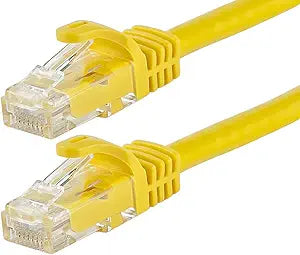
Monoprice 111349 Cat5e Ethernet Patch Cable - Yellow 50ft
★★★★★
Fifty feet of 350MHz Cat5e stranded copper at a price point that makes running proper cable throughout your rack, desk, or office a no-brainer.
$11.48*
Check availability
*Price sourced from Amazon.com. Last updated:Jul 15, 2026.Price and availability are subject to change.
Affiliate Disclosure: Studio Supplies may earn a commission from qualifying purchases made through links on this page, at no additional cost to you. This helps support our editorial team.
Notice a mistake? Let Us Know
Overview
Key Features
Product Type: Computer Add On
Package Quantity: 1
Country Of Origin: China
Package Dimensions: 4.572 cms (L) x 19.558 cms (W) x 21.59 cms (H)
Specifications
Category
Cat5e
Length
50 feet
Bandwidth
350MHz
Conductor
Stranded Copper
Connectors
Snagless RJ45
Color
Yellow
Model
111349
Pros & Cons
👍 Pros
- The 350MHz bandwidth rating exceeds the Cat5e minimum specification of 100MHz, providing margin above baseline that supports stable Gigabit performance even with minor connector imperfections or patch panel degradation over time.
- Stranded copper construction ensures the cable withstands repeated flexing and repositioning without conductor fatigue — essential for a 50-foot run that will be routed around furniture, cable management, or server racks.
- Snagless RJ45 connectors protect the locking tab from breakage during installation and removal in dense cable environments, extending the cable's usable life in rack and patch panel deployments.
- The 50-foot length covers long desktop-to-switch runs, room-to-room floor-level routing, or connecting wall plates across a home office or small server environment without requiring a repeater or switch.
- Yellow jacket color simplifies cable identification in multi-cable environments, reducing the time spent tracing connections during troubleshooting.
👎 Cons
- Cat5e tops out at 1Gbps — if your switches and NICs already support 2.5GbE or 10GbE, this cable becomes the bottleneck and a Cat6 or Cat6A run would be required to utilize that bandwidth.
- At 50 feet, the stranded construction introduces marginally higher attenuation than a solid-core cable of the same length — negligible for Gigabit but a consideration if you are pushing the limits of Cat5e at distance.
- The yellow jacket color, while useful for identification in some environments, limits flexibility in aesthetics-conscious installations where cable color-coding is already established with a different scheme.
- No shielding (STP/FTP) means this cable is susceptible to electromagnetic interference in environments with high RF noise — near large UPS units, fluorescent lighting ballasts, or industrial equipment.
Frequently Asked Questions
What is the actual maximum throughput of Cat5e, and does 50 feet of cable length affect it?
Cat5e supports up to 1Gbps at 100MHz over runs up to 100 meters (328 feet). At 50 feet, you are well within spec for Gigabit Ethernet — cable length is not a bottleneck here. The 350MHz bandwidth rating on this Monoprice cable exceeds the 100MHz minimum Cat5e spec, providing additional headroom above the baseline standard.
Will this cable work for PoE (Power over Ethernet) applications like IP cameras or access points?
Cat5e supports PoE and PoE+ (802.3af/at) at standard wattages. The stranded copper construction of this cable is suitable for PoE patch cable runs. Note that for permanent in-wall PoE installations, solid-core Cat5e is typically preferred — stranded cables like this are optimized for patch cable use where flexibility matters.
Is stranded or solid core better for a 50-foot desktop/rack patch run?
Stranded copper is the correct choice for patch cables — exactly what this cable is. Stranded wire handles repeated bending and movement without the internal conductor fatigue that can fracture solid-core wire over time. The 50-foot length is also at the upper end of what you'd use as a patch cable; for permanent structured cabling runs inside walls, solid-core solid-run installation is preferred.
Does the snagless boot on the RJ45 connectors actually make a difference in rack environments?
Yes, meaningfully so. The snagless boot protects the locking tab from being sheared off when routing cables through dense patch panels and cable management arms. In a rack with 24+ cables in motion, standard RJ45 tabs break frequently — snagless boots prevent that failure mode and make cable swaps faster.
Related Products


