



Monoprice
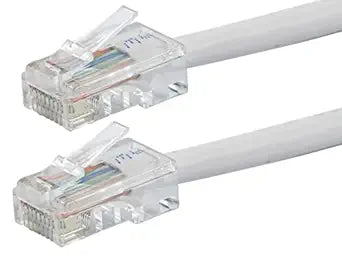
Monoprice 113096 Cat5e Ethernet Patch Cable - 0.5ft White
★★★★★
Pure bare copper conductors and 350MHz bandwidth in a half-foot form factor — the patch cable that eliminates the slack penalty in tight rack builds.
$5.36*
Check availability
*Price sourced from Amazon.com. Last updated:Jul 14, 2026.Price and availability are subject to change.
Affiliate Disclosure: Studio Supplies may earn a commission from qualifying purchases made through links on this page, at no additional cost to you. This helps support our editorial team.
Notice a mistake? Let Us Know
Overview
Key Features
24AWG stranded, pure bare copper conductors
350MHz bandwidth
No protective plug retaining clip covers
Unshielded Twisted Pair (UTP) Category 5e Ethernet cable
Specifications
Cable Type
Cat5e Ethernet Patch Cable
Length
0.5 ft
Color
White
Conductor Material
24AWG stranded, pure bare copper
Bandwidth
350 MHz
Shielding
Unshielded Twisted Pair (UTP)
Plug Retaining Clip Covers
None
Pros & Cons
👍 Pros
- 24AWG pure bare copper conductors deliver lower DC resistance than CCA alternatives, which matters for PoE current delivery and signal integrity on active links.
- 350MHz bandwidth spec provides margin above the Gigabit Ethernet requirement, ensuring the cable won't be the limiting factor in a 1GbE infrastructure.
- 0.5-foot length eliminates cable slack in patch panels and top-of-rack switch connections, reducing airflow obstruction and cable management complexity.
- ZEROboot connector design allows fast, snag-free patching and unpatching in densely populated panels without a hook tool.
👎 Cons
- No protective boot means the RJ45 clip is exposed and can be accidentally depressed in environments with heavy cable movement, potentially causing intermittent disconnections.
- 0.5-foot length is purpose-built for patch panel-to-switch hops — it has no practical use for endpoint connections, limiting its application to specific rack scenarios.
- UTP construction provides zero shielding against EMI, making this cable unsuitable for runs near high-voltage power conduits, fluorescent lighting ballasts, or industrial motor equipment.
- Cat5e tops out at 1Gbps — if your infrastructure is moving toward 2.5GbE or 10GbE switching, this cable won't support those speeds regardless of other upgrades.
Frequently Asked Questions
Does Cat5e at 350MHz bandwidth support Gigabit Ethernet, or is it limited to Fast Ethernet?
Cat5e at 350MHz is fully rated for Gigabit Ethernet (1000BASE-T). The 350MHz bandwidth spec exceeds the 100MHz minimum required for GbE, giving this cable meaningful headroom over the Category 5e baseline spec.
What does the ZEROboot design mean practically when patching a dense rack?
ZEROboot means there is no protective boot over the RJ45 connector clip. In a dense 48-port patch panel or switch, standard booted connectors snag on adjacent cables during removal. The ZEROboot design allows clean one-handed extraction without a hook tool — a genuine time-saver during MACs (moves, adds, changes).
Is pure bare copper conductors a meaningful distinction over copper-clad aluminum (CCA) at 0.5 feet?
Yes, even at short lengths. CCA conductors have higher resistance and lower conductivity than pure copper, which affects signal integrity and heat dissipation under sustained load. For PoE applications — IP phones, APs, cameras — pure copper is the correct specification and what IEEE 802.3af/at standards assume.
Can this cable be used for PoE (Power over Ethernet) devices?
Yes. The 24AWG pure bare copper conductors meet the current-carrying requirements for PoE (802.3af, up to 15.4W) and PoE+ (802.3at, up to 30W). Verify your switch's PoE budget, not the cable, for higher-wattage PoE++ devices.
Related Products


