



Monoprice
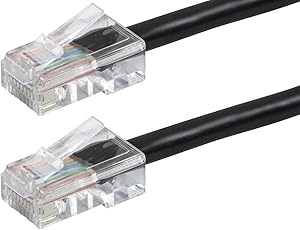
Monoprice 113104 2ft Cat5e Ethernet Patch Cable Black
★★★★★
Pure copper conductors and a ZEROboot profile give this 2ft Cat5e patch cable the low-resistance, low-bulk performance that structured cabling and patch panel work demands.
$3.62*
View on Amazon
✓ In Stock on Amazon.com
*Price sourced from Amazon.com. Last updated:Jul 15, 2026.Price and availability are subject to change.
Affiliate Disclosure: Studio Supplies may earn a commission from qualifying purchases made through links on this page, at no additional cost to you. This helps support our editorial team.
Notice a mistake? Let Us Know
Overview
Key Features
Unshielded Twisted Pair (UTP) Category 5e Ethernet cable
24AWG stranded, pure bare copper conductors
350MHz bandwidth
No protective plug retaining clip covers
Specifications
Cable Type
Cat5e Ethernet Patch Cable
Connector Type
RJ45
Design
ZEROboot (no plug retaining clip)
Wire Type
Stranded, Pure Bare Copper
AWG
24AWG
Bandwidth
350MHz
Shielding
UTP (Unshielded Twisted Pair)
Length
2 ft
Color
Black
Model
113104
Pros & Cons
👍 Pros
- 350MHz bandwidth delivers headroom above Cat5e minimums, supporting clean Gigabit throughput even in electrically noisy rack environments
- Pure bare copper 24AWG conductors ensure TIA-568 compliance and lower resistance versus CCA alternatives that undercut on material costs
- At 2ft, the cable length is ideal for switch-to-switch, panel-to-panel, or panel-to-switch hops without excess cable creating management overhead
- ZEROboot connector allows dense seating in patch panels where standard boot bulk would otherwise force wider port spacing
- Stranded construction resists conductor fatigue during the repeated repositioning that active cable plants require
- Black colorway integrates cleanly into rack environments that use color-coded cable management schemes
👎 Cons
- UTP construction is not appropriate for high-EMI environments — industrial installations or facilities with significant RF interference require shielded cable
- Cat5e is a bandwidth ceiling at 1Gbps; any future migration to 10GbE switching fabric requires replacing this cable with Cat6A or higher
- The ZEROboot design, while ideal for density, leaves the latch clip exposed — aggressive cable pulling without proper technique can break the clip over time
- At 2ft, the cable is purpose-limited to short hops within a rack or between immediately adjacent equipment; longer runs require a different length
Frequently Asked Questions
What does the ZEROboot design mean for this cable, and in what environments is it most useful?
ZEROboot indicates the RJ45 connector has no protective plastic boot over the latch clip. This reduces connector profile in high-density patch bays and tight rack enclosures where standard boots create spacing problems. If you're working in 1U rack environments or populating a 48-port patch panel, the difference in seating and release ease is significant compared to booted connectors.
Does Cat5e at 350MHz support Gigabit Ethernet reliably?
Yes — 1000BASE-T (Gigabit Ethernet) requires 100MHz minimum; this cable's 350MHz rating provides substantial overhead above that threshold. At 2 feet, signal degradation is negligible, making this cable capable of sustaining full Gigabit throughput without signal integrity concerns.
Why specify 24AWG stranded copper rather than solid-core for a patch cable?
Stranded conductors are the correct choice for any cable that will be moved, repositioned, or flexed. Solid-core wire is optimized for static in-wall runs and will develop micro-fractures in the conductors if bent repeatedly. At 24AWG with stranded construction, this cable handles regular use in active environments without conductor degradation.
What is the practical difference between this cable and a cheaper unbranded Cat5e cable?
The critical variable is conductor material. Many budget Cat5e cables use copper-clad aluminum (CCA) wire, which has higher resistance and is not TIA-568 compliant. This Monoprice cable uses 100% pure bare copper, ensuring it meets spec. In short runs like 2ft, differences may not be obvious under normal loads, but CCA cables can cause issues when infrastructure is tested to standard or when marginal signal conditions exist.
Is UTP shielding adequate, or should I use shielded cable in my installation?
UTP is adequate for most office, data center, and home network environments where power cables and EMI sources are managed at a reasonable distance from data cabling. Shielded cable (STP/FTP) is required in industrial environments, near high-voltage lines, or in MRI/RF-intensive facilities. For standard rack infrastructure, UTP Cat5e at this length is the correct choice.
Related Products


