



Monoprice
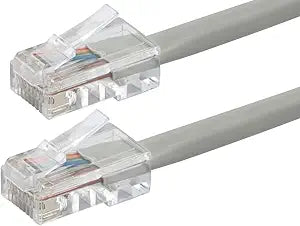
Monoprice 113114 Zeroboot Cat5e Ethernet Patch Cable 3ft
★★★★★
ZeroBoot connectors and pure bare copper conductors make this 3ft Cat5e patch cable the right choice for dense rack and switch connections.
$3.88*
Check availability
*Price sourced from Amazon.com. Last updated:Jul 15, 2026.Price and availability are subject to change.
Affiliate Disclosure: Studio Supplies may earn a commission from qualifying purchases made through links on this page, at no additional cost to you. This helps support our editorial team.
Notice a mistake? Let Us Know
Overview
Key Features
Unshielded Twisted Pair (UTP) Category 5e Ethernet cable
24AWG stranded, pure bare copper conductors
350MHz bandwidth
No protective plug retaining clip covers
Specifications
Cable Type
Unshielded Twisted Pair (UTP) Cat5e
Length
3ft
Color
Gray
Conductor
24AWG stranded pure bare copper
Bandwidth
350MHz
Connector
RJ45 ZeroBoot (no retaining clip cover)
Shielding
UTP (none)
Brand
Monoprice
Model
113114
Pros & Cons
👍 Pros
- Pure bare copper 24AWG conductors deliver full Cat5e electrical performance, including reliable PoE operation where CCA substitutes would introduce resistance-related failure modes.
- 350MHz bandwidth rating exceeds the 100MHz Cat5e minimum, providing measurable crosstalk and return loss margin even in dense switch environments.
- ZeroBoot connector eliminates snag points during cable routing and removal in high-density patch panels without sacrificing the RJ45 locking tab.
- 3ft length minimizes cable slack precisely — ideal for rack-mounted equipment where standard 6ft cables create airflow-blocking loops.
- Gray color coding is a neutral default that integrates into mixed-color cable management schemes without visual conflict.
👎 Cons
- 3ft fixed length offers no flexibility — connections requiring even 4ft of run require a different SKU entirely.
- UTP construction provides no electromagnetic shielding; installations near inverters, fluorescent ballasts, or other EMI sources require shielded STP/FTP cable instead.
- Stranded conductor construction is correct for patch use but unsuitable for permanent in-wall or in-conduit installation, where solid-core cable is the appropriate specification.
- ZeroBoot connectors, while optimized for rack density, are more prone to accidental disconnection in consumer environments where cables are frequently handled.
Frequently Asked Questions
Why use a 3ft patch cable instead of a longer one?
Length is a measurable factor in cable management quality. A 3ft cable generates significantly less slack than a 6ft or 10ft cable in short-hop connections — switch-to-patch-panel, server-to-switch, or desktop-to-wall-outlet runs. Excess slack increases airflow obstruction in racks and makes cable identification harder. Use the shortest cable that reaches cleanly.
Does the ZeroBoot design affect the physical retention of the RJ45 connector?
The ZeroBoot design removes the protective boot cover but retains the standard RJ45 locking tab. The connector still clicks and locks into ports normally. What is eliminated is the rubberized jacket around the tab — this prevents the cable from snagging adjacent cables when pulled in tight spaces, while maintaining positive lock.
Is 350MHz bandwidth overkill for a 3ft patch cable?
No — bandwidth rating reflects the cable's electrical performance ceiling, not just its physical length. Even at 3ft, a cable with poor conductor quality or inadequate twist ratios can introduce reflections and crosstalk that degrade Gigabit performance. The 350MHz rating confirms this cable meets full Cat5e electrical spec regardless of its short length.
Will this cable work with Cat6 or Cat6A switches and ports?
Yes. Cat5e is backward and forward compatible with Cat6 and Cat6A ports at the physical connector level — all use standard RJ45. You will be limited to Cat5e performance (1Gbps at the relevant distances), but the cable will mate and function correctly in higher-spec ports.
Is pure bare copper conductors a specification I should care about?
Yes, particularly for patch cables used in PoE environments. Copper-clad aluminum (CCA) cables — a common cost-cutting substitute — have higher resistance than solid copper, which causes voltage drop and heat buildup in PoE runs. Pure bare copper maintains resistance within the 802.3af/at specification and is required for reliable PoE device operation.
Related Products


