



Monoprice
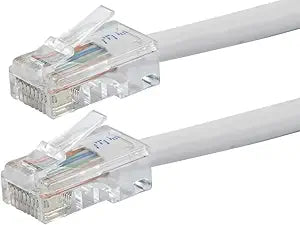
Monoprice 113186 Zeroboot Cat5e Ethernet Cable 75ft
★★★★★
A 75-foot pure copper Cat5e run that maintains Gigabit integrity across the full TIA-568 channel length without the attenuation penalty of CCA alternatives.
$21.76*
Check availability
*Price sourced from Amazon.com. Last updated:Jul 15, 2026.Price and availability are subject to change.
Affiliate Disclosure: Studio Supplies may earn a commission from qualifying purchases made through links on this page, at no additional cost to you. This helps support our editorial team.
Notice a mistake? Let Us Know
Overview
Key Features
Made of 24AWG stranded, pure bare copper conductors
Monoprice Ethernet cables are made of 100% pure bare copper wire, as opposed to copper clad aluminum (CCA) wire, & are therefore fully compliant with UL Code 444 & National Electrical Code TIA-568-C.2 fire and safety standards
350MHz bandwidth | No protective plug retaining clip covers
50m gold plated contacts
Specifications
Brand
Monoprice
Model
113186
Cable Type
Cat5e Ethernet Patch Cable (UTP)
Length
75 feet
Wire Gauge
24AWG stranded
Conductor Material
100% pure bare copper
Bandwidth
350MHz
Connector Type
RJ45
Contact Plating
50µm gold plated
Color
White
Shielding
UTP (Unshielded Twisted Pair)
Compliance
UL Code 444, TIA-568-C.2
Design
ZEROboot snagless
Pros & Cons
👍 Pros
- At 75 feet, the 350MHz bandwidth rating keeps attenuation well within Cat5e spec limits, delivering reliable Gigabit Ethernet with solid noise margin at a length that budget CCA cables begin to show degraded performance.
- Pure bare copper conductors comply with UL 444 and TIA-568-C.2, ensuring the cable is rated for PoE and PoE+ current loads across the full 75-foot run without thermal risk.
- Stranded 24AWG construction provides the flexibility needed to route a 75-foot cable through tight spaces, around corners, and across cable management trays without crimping or conductor damage.
- 50µm gold-plated RJ45 contacts maintain consistent contact resistance and resist oxidation at both termination points — important for a cable that may be semi-permanently installed and rarely disconnected.
- White jacket color simplifies visual cable management and differentiation in multi-cable rack or wall environments where color coding is used for network segmentation.
👎 Cons
- Stranded conductors exhibit higher attenuation per meter than solid conductors — for permanent in-wall installations at this length, solid-core bulk cable is the more technically correct choice even though stranded will still function within spec.
- The snagless ZEROboot design exposes the RJ45 locking tab — on a 75-foot cable that is infrequently disconnected, this is low risk, but the unprotected tab is more vulnerable during initial installation and routing.
- At 75 feet, the cable's mass and stiffness require careful routing to avoid sharp bends that could exceed the cable's minimum bend radius and cause internal conductor stress over time.
- No shielding (UTP) makes this cable susceptible to EMI crosstalk in installations routed near electrical conduit, power strips, or fluorescent ballasts — in high-EMI environments, shielded Cat5e (STP) would be more appropriate.
- Cat5e caps at 1 Gigabit Ethernet — networks being upgraded to 10GbE over copper will require Cat6A replacement cables.
Frequently Asked Questions
At 75 feet, does this cable approach any performance limits for Gigabit Ethernet?
No. TIA-568 specifies a maximum channel length of 100 meters (328 feet) for Cat5e Gigabit Ethernet. At 75 feet (~23 meters), this cable operates at roughly 22% of the distance limit, leaving substantial headroom for attenuation and insertion loss. Gigabit link establishment at this length is reliably consistent under normal conditions.
Why does the 24AWG pure copper construction matter more at longer cable runs?
Attenuation increases with cable length. At 75 feet, the difference between pure bare copper and copper-clad aluminum conductors becomes more measurable — CCA's higher resistivity contributes greater signal attenuation per meter, which accumulates over longer runs and can reduce noise margin for Gigabit Ethernet. Pure copper maintains lower attenuation across the run and is required for full compliance with TIA-568-C.2.
Is this cable suitable for PoE devices at 75 feet?
Yes. The pure bare copper construction is the key factor for PoE safety — copper's lower resistance means less heat generated under the sustained current draw of PoE (15.4W) and PoE+ (30W) devices. CCA cables are not recommended for PoE runs at any length due to elevated resistive heating. At 75 feet, this cable handles standard PoE and PoE+ loads within safe thermal margins.
Is stranded or solid conductor better for a 75-foot run, and which is this cable?
This cable uses stranded 24AWG conductors, which are optimized for flexibility and patch cable use. Stranded cable is appropriate for equipment-to-equipment connections and runs up to approximately 100 feet. For in-wall or plenum structured cabling runs in this range, solid-conductor bulk cable is preferred for lower attenuation. For a 75-foot patch or equipment run with expected physical movement or routing flexibility, stranded is the correct choice.
Will this cable work with 10/100 Ethernet switches alongside Gigabit devices on the same network?
Yes. Cat5e is backward compatible with 10BASE-T and 100BASE-TX. The cable will auto-negotiate to the highest speed supported by both connected devices — Gigabit where available, Fast Ethernet (100Mbps) where not. No configuration is required.
Related Products


