



Monoprice
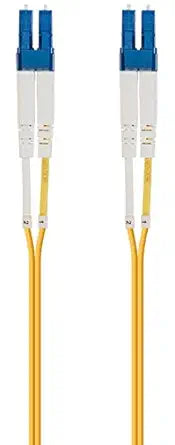
Monoprice 138451 Fiber Optic Cable LC/UPC-LC/UPC 3 Meter
★★★★★
A factory-terminated, bend-insensitive single-mode duplex LC/UPC fiber patch cable that delivers full 10G/40G/100G throughput with insertion loss tested to EIA/TIA 604-2 standards.
$6.42*
Check availability
*Price sourced from Amazon.com. Last updated:Jul 14, 2026.Price and availability are subject to change.
Affiliate Disclosure: Studio Supplies may earn a commission from qualifying purchases made through links on this page, at no additional cost to you. This helps support our editorial team.
Notice a mistake? Let Us Know
Overview
Key Features
Meets eia/TIA 604-2 with ceramic ferrule for high speed cabling networks
Good repeatability and interchange
Cable printing helps clarify and recognize different cables
Zirconia ceramic ferrule optimum accessibility and RL
Bend insensitive fiber cable shows great performance on resilience. Factory terminated and tested for insertion loss, Return loss, and end face
Specifications
Cable Type
Fiber Optic
Connector Type
LC/UPC-LC/UPC
Cable Length
3 Meter
Ferrule Material
Ceramic
Standards Compliance
EIA/TIA 604-2
Fiber Type
Bend Insensitive
Pros & Cons
👍 Pros
- G657A1 bend-insensitive fiber maintains insertion loss specifications at tight bend radii — directly applicable to dense data center cable management environments where routing through congested cable trays would compromise standard fiber performance.
- Factory-terminated and individually tested for insertion loss, return loss, and end face quality means each cable ships with verified optical performance rather than relying on field termination consistency, which reduces troubleshooting variables in new infrastructure deployments.
- Zirconia ceramic ferrule technology achieves the physical contact quality and return loss performance needed for high-speed digital networking without the variability of lower-grade polymer ferrule alternatives.
- The duplex LC/UPC configuration covers the connector standard used by the vast majority of 10G, 40G, and 100G SFP+/QSFP+/QSFP28 transceivers and patch panels — correct for the broadest range of modern data center and enterprise switching equipment.
- Cable printing on the jacket allows identification and tracing in dense cable environments without requiring physical end-to-end tracing — a practical cable management benefit in populated data center racks.
👎 Cons
- At 3 meters, this cable is suited only for intra-rack or adjacent-rack patching — longer infrastructure runs or inter-row connections require a different length, and single-mode patch cables are typically sold in fixed length increments rather than custom cuts.
- Single-mode fiber requires coherent laser transceivers (SFP+, QSFP+, BiDi laser) and is not compatible with short-range multimode OM3/OM4 transceivers that use LED or VCSEL sources — purchasing the wrong fiber type for a multimode switch infrastructure is a common and costly configuration error.
- The PVC jacket limits this cable's suitability for plenum-rated (air-handling) space installations, where fire code requires a CMP-rated (plenum) jacket rather than standard PVC — a specific compliance requirement for above-ceiling or raised-floor routing in commercial facilities.
- LC connectors have smaller, more delicate ferrule and latch mechanisms than SC connectors — they are more susceptible to damage from improper handling and require careful insertion and extraction technique in high-density patch panels where connector visibility is limited.
- No bend radius indicator markings or pull-tension specifications are provided in the product listing — installers working to a strict structured cabling standard will need to reference the G657A1 specification directly rather than relying on labeled cable data.
Frequently Asked Questions
What transmission speeds does this LC/UPC single-mode cable support?
Single-mode fiber with LC/UPC connectors supports 10G, 40G, and 100G Ethernet across compatible SFP+, QSFP+, and QSFP28 transceivers. Single-mode fiber's narrower core (typically 9 micron) uses a coherent laser source, not LED, which eliminates modal dispersion and allows the cable to carry high-bandwidth signals over long distances — though at 3 meters, this cable is optimized for intra-rack or cross-patch connections rather than long-haul runs.
What is the difference between LC/UPC and LC/APC connectors, and does this cable use the correct type for my equipment?
UPC (Ultra Physical Contact) connectors have a flat-polished end face and typically achieve return loss of -55dB or better. APC (Angled Physical Contact) connectors use an 8-degree angled polish for return loss of -60dB or better — preferred for analog signal applications like CATV. UPC is the standard for digital data networking applications including Ethernet, SAN, and data center patching. If your transceivers or patch panels specify LC/UPC or simply "LC," this cable is the correct connector type.
What does "G657A1 bend-insensitive" fiber mean for data center cabling?
G657A1 is an ITU-T fiber standard that specifies enhanced macro-bend insensitivity — the fiber maintains its optical performance specifications at smaller bend radii than standard G652 single-mode fiber. In practical data center terms, this means you can route this cable through tight cable trays, around tight corners, and in dense cable management paths without the insertion loss increase that would occur with standard fiber at the same bend radius. At 3 meters, routing flexibility is a real consideration.
What insertion loss and return loss performance can I expect from this cable?
Monoprice specifies this cable as factory terminated and tested to EIA/TIA 604-2 standards, which covers insertion loss and return loss specifications for LC connectors. The zirconia ceramic ferrule used in this connector type achieves optimum physical contact and is specified to meet the RL (return loss) performance requirements of the standard. Exact tested insertion loss values per cable are typically available from the test report shipped with the cable or on request.
Is a 3-meter length appropriate for intra-rack and top-of-rack connections?
Yes. Three meters comfortably covers most intra-rack and adjacent-rack patch connections in standard equipment rack configurations — a 1U patch panel to a 1U transceiver in the same rack typically requires 1-2 meters; cross-rack patching in an adjacent rack in a hot-aisle/cold-aisle layout typically fits within 3 meters. For longer runs between racks or between rows, 5, 7, or 10-meter options would be appropriate.
Related Products


