



Monoprice
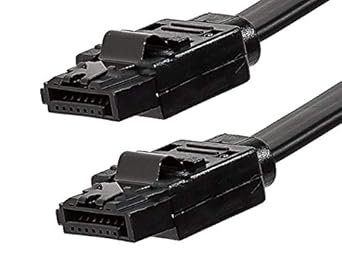
Monoprice 140407 SATA 6Gbps Locking Latch Cable 10-Pack
★★★★★
Ten locking-latch SATA III cables that max out your 6 Gbps bandwidth and stay seated through vibration, cable pulls, and every chassis swap.
$23.38*
View on Amazon
✓ In Stock on Amazon.com
Price history
*Price sourced from Amazon.com. Last updated:Jul 15, 2026.Price and availability are subject to change.
Affiliate Disclosure: Studio Supplies may earn a commission from qualifying purchases made through links on this page, at no additional cost to you. This helps support our editorial team.
Notice a mistake? Let Us Know
Overview
Key Features
Data transfer speeds of up to 6 Gbps.
Each end features a straight connector with an attached locking latch.
With an attached locking latch to ensure that your connections do not come loose due to movement or vibration.
Provides maximum speeds from your SATA system, up to 6 Gbps when used with equivalent devices and controllers.
Note that SATA 6 Gbps cables are backwards compatible and can be used with SATA 3 Gbps and SATA 1.5 Gbps devices. However, the data transfer of the SATA subsystem will be limited to that of the slowest device. So, for example, if a SATA 6 Gbps cable is connected to a SATA 3 Gbps drive and a SATA 1.5 Gbps controller, the drive will be limited to a transfer rate of 1.5 Gbps.
Specifications
Model
Monoprice 140407
Cable Length
1.5 feet (18 inches)
Connector Type
Straight, both ends
Locking Latch
Yes, both connectors
Data Transfer Rate
Up to 6 Gbps (SATA III)
Compatibility
SATA Revision 3.0, backwards compatible with SATA 3 Gbps and 1.5 Gbps
Color
Black
Quantity
10-pack
Pros & Cons
👍 Pros
- Locking latch provides mechanical retention that standard SATA connectors lack, preventing disconnection from vibration or cable tension.
- Full SATA III spec supports up to 6 Gbps throughput — no bottleneck introduced by the cable itself.
- Ten-pack pricing makes these cost-effective for NAS builds, server refreshes, or stocking a workshop.
- Backwards compatibility with SATA I and II means one cable type works across a mixed drive inventory.
- Straight-connector design on both ends suits standard motherboard and drive bay orientations.
👎 Cons
- 1.5-foot length is short for full-tower builds where SATA ports and drive bays are far apart — longer runs require a different cable.
- Both ends are straight only; no right-angle option in this pack, which limits routing flexibility in cramped or side-mounted bays.
- Black color with no length markings makes cable identification difficult in dense, multi-drive builds without additional labeling.
- Locking latch adds slight extraction resistance — requires deliberate press-and-pull to disconnect, which can be awkward in tight spaces.
Frequently Asked Questions
Do these cables actually cap out at 6 Gbps, or is that a theoretical ceiling?
6 Gbps (SATA III) is the interface ceiling — roughly 600 MB/s real-world throughput. Whether you hit it depends on your drive and controller both being SATA III. These cables won't be your bottleneck; a SATA II drive or controller will be.
What happens if I connect a SATA III cable to a SATA II drive?
The connection negotiates down to the slowest device in the chain. A SATA III cable on a SATA II (3 Gbps) drive gives you 3 Gbps. On a SATA I controller, you're capped at 1.5 Gbps. The cable is backwards compatible — it won't cause errors, just lower throughput.
What does the locking latch actually prevent?
The latch engages a retention tab on the SATA port, mechanically securing the connector against accidental disconnection. In server chassis with heavy cable runs or environments with vibration (NAS towers, rack-mounted systems), unlatched cables can work loose over time. These don't.
Are both ends straight connectors, or is one angled?
Both ends are straight. If your drive bay has clearance issues — drives mounted horizontally close to the chassis wall — you may prefer a right-angle connector instead. Plan your cable routing before installing.
Is 18 inches (1.5 ft) long enough for a full-tower build?
For most ATX mid-tower builds with a bottom-mounted PSU and SATA ports near the top of the board, 1.5 ft is tight. It works cleanly in mATX and ITX cases and for motherboard SATA ports close to the drive bays. Measure your run before buying if you're working in a full-tower.
Related Products


