



Monoprice
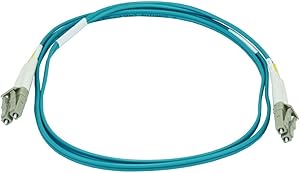
Monoprice 141218 Fiber Optic Cable 7 Meter LC/LC OM3
★★★★★
OM3 aqua-jacket LC/LC duplex fiber delivers certified 10GbE throughput at 7 meters with Corning glass at the core.
$16.89*
View on Amazon
✓ In Stock on Amazon.com
*Price sourced from Amazon.com. Last updated:Jul 14, 2026.Price and availability are subject to change.
Affiliate Disclosure: Studio Supplies may earn a commission from qualifying purchases made through links on this page, at no additional cost to you. This helps support our editorial team.
Notice a mistake? Let Us Know
Overview
Key Features
LC/LC
50/125 Type
MultiMode
10GB
Corning
Specifications
Brand
Monoprice
Model
141218
Cable Type
Fiber Optic, Duplex
Connectors
LC to LC
Fiber Type
OM3 Multimode
Fiber Size
50/125 µm
Data Rate
10Gb Ethernet
Length
7 Meter
Construction
Duplex
Jacket Color
Aqua (TIA-598 OM3 standard)
Fiber Manufacturer
Corning
Pros & Cons
👍 Pros
- Corning OM3 fiber core meets ≥2000 MHz·km EMB specification, ensuring 10GbE link stability that uncertified generic fiber may not reliably deliver.
- 7-meter length covers the most common intra-rack and cross-rack patch distances in standard 42U rack configurations without excess slack.
- LC/LC duplex connector format is the universal standard for 10GbE SFP+ infrastructure — compatible with virtually every enterprise and prosumer switch on the market.
- Aqua jacket color coding follows the TIA-598 OM3 standard, enabling correct fiber type identification at a glance during datacenter cable management and troubleshooting.
- 10Gb rated specification eliminates the bandwidth ceiling imposed by Cat6a copper runs, with zero susceptibility to electromagnetic interference in dense server environments.
👎 Cons
- LC connectors are small-form and fragile compared to SC — a dropped connector onto a hard floor is more likely to chip the ferrule on LC than on larger connector formats, requiring careful handling.
- Multimode fiber cannot be used with single-mode LR or ER transceivers, meaning this cable is strictly limited to short-range 850nm SR optics — an important constraint if your transceiver inventory is mixed.
- No locking latch mechanism on the LC connectors means cables can be accidentally disconnected in high-density patch panels with adjacent port activity.
- At 7 meters, this is a fixed length — if your rack-to-rack distance is 8 or 10 meters, you'll need a different SKU; there's no coiling tolerance built in.
Frequently Asked Questions
Will this OM3 cable support 10 Gigabit Ethernet, and at 7 meters is there any signal degradation concern?
Yes — OM3 50/125 multimode fiber is rated for 10GbE (IEEE 802.3ae) at distances up to 300 meters. At 7 meters, you are operating at roughly 2% of the rated distance ceiling, which means insertion loss is negligible. Signal integrity at this length is a non-issue; the limiting factor in your link will be the SFP+ transceivers and switch ports, not the cable.
What transceivers are compatible with this cable for 10GbE SFP+ connections?
This cable requires SR (short range) SFP+ transceivers on both ends — specifically 850nm multimode SFP+ modules, which are the standard for OM3 fiber links. LR (long range) 1310nm transceivers are designed for single-mode fiber and will not work with this multimode cable. Most enterprise and prosumer switch vendors (Cisco, Juniper, Arista, MikroTik, Ubiquiti) offer compatible 850nm SR SFP+ modules.
Can this cable be used for 40GbE or 100GbE applications?
OM3 fiber supports 40GbE (40GBASE-SR4) and 100GbE (100GBASE-SR10) but those standards use MPO/MTP connectors, not LC. This cable's LC/LC connector format limits it to 10GbE applications in standard deployments. For 40G or 100G over LC, you would need OM4 or OM5 fiber with appropriate breakout configurations.
The cable uses Corning fiber — what does that mean for performance vs generic fiber?
Corning is the industry reference for fiber glass quality. Corning OM3 glass has tightly controlled bandwidth characteristics (specifically Effective Modal Bandwidth, EMB, rated at ≥2000 MHz·km) that directly affect 10GbE link stability. Generic fiber may not meet EMB tolerances, which can cause bit errors at higher utilization. In short, the Corning designation confirms the fiber meets the optical specification it's rated for, not just the connector dimensions.
Related Products


