



Monoprice
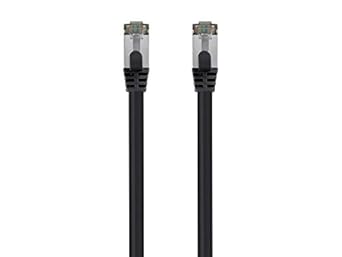
Monoprice Cat8 S/FTP 2GHz 40Gbps Ethernet Cable
★★★★★
40Gbps throughput and 2GHz bandwidth over pure copper — Cat8 cabling that won't bottleneck 10G or 25G infrastructure.
$10.32*$10.38Save 0%
View on Amazon
✓ In Stock on Amazon.com
*Price sourced from Amazon.com. Last updated:Jul 15, 2026.Price and availability are subject to change.
Affiliate Disclosure: Studio Supplies may earn a commission from qualifying purchases made through links on this page, at no additional cost to you. This helps support our editorial team.
Notice a mistake? Let Us Know
Overview
Key Features
Superior Performance: Monoprice Entegrade Cat8 Cables can deliver up to 40Gbps data transfer speeds.
Up to 2GHz Bandwidth: Entegrade Cat8 Ethernet Network Cables feature up to 2GHz bandwidth using standard copper conductors and RJ45 connectors.
Future Proof: Monoprice's Entegrade Cat8 Cables are an excellent, future proof solution for current and upcoming generations of active 10G and up to 40G networks.
Conductor Material: Pure Bare Copper
26 AWG
Specifications
Category
Cat8
Shielding
S/FTP (Screened/Foiled Twisted Pair)
Data Transfer Speed
Up to 40Gbps
Bandwidth
Up to 2GHz
Conductor Material
Pure Bare Copper
Wire Gauge
26 AWG
Connector
RJ45
Pros & Cons
👍 Pros
- 40Gbps rated throughput and 2GHz bandwidth capacity future-proof short-run connections for 10G, 25G, and 40G network upgrades.
- Pure bare copper conductors ensure reliable signal integrity and lower resistance compared to copper-clad aluminum alternatives.
- S/FTP double-layer shielding — individual foil per pair plus overall braid — minimizes EMI and crosstalk at high frequencies.
- Standard RJ45 connectors maintain full backward compatibility with existing Cat5e through Cat7 infrastructure.
- 26 AWG gauge provides a thinner, more flexible cable that routes easily in rack environments and tight patch panel spaces.
👎 Cons
- Cat8 specification limits 40Gbps performance to 30-meter maximum runs — insufficient for building-length horizontal cabling.
- S/FTP shielding requires proper grounding at both ends to be effective; without grounded jacks or patch panels, the shielding can introduce noise rather than reduce it.
- 26 AWG conductors are less durable than 23 AWG for permanent installation or repeated handling in high-traffic cable trays.
- The thicker shielding layers increase cable stiffness compared to unshielded Cat6 patch cables, making very tight bend radii difficult.
- Premium over Cat6a pricing is only justified if endpoints actually support speeds above 10Gbps — most current consumer and prosumer hardware does not.
Frequently Asked Questions
Do I need special hardware to take advantage of Cat8 speeds?
Yes. To reach the full 25GBASE-T or 40GBASE-T speeds this cable supports, both your NIC and switch must have matching multi-gigabit ports. On standard 1G or 2.5G hardware, the cable will work perfectly but won't exceed what the endpoints support — the cable itself is not the bottleneck.
Is this cable compatible with standard RJ45 ports and existing network equipment?
Yes. Cat8 uses standard RJ45 connectors and is backward compatible with Cat5e, Cat6, Cat6a, and Cat7 equipment. You can use it in any Ethernet RJ45 port — it will simply negotiate at the speed the connected hardware supports.
What does S/FTP shielding mean in practice?
S/FTP means each of the four twisted pairs is individually foil-wrapped (Foiled Twisted Pair), and the entire cable bundle is wrapped in an additional braided shield (Screened). This double-layer shielding provides strong protection against electromagnetic interference (EMI) and crosstalk, which is critical for maintaining signal integrity at 2GHz frequencies over copper.
What maximum run length does Cat8 support at 40Gbps?
The Cat8 specification supports 40Gbps speeds at distances up to 30 meters (approximately 98 feet). Beyond that length, signal attenuation at 2GHz frequencies will degrade performance. For longer runs at high speed, fiber optic connections are the appropriate alternative.
Is 26 AWG conductor gauge a concern for performance?
26 AWG is thinner than the 23 AWG commonly found in Cat6a patch cables, which makes this Cat8 cable more flexible and easier to route in tight spaces. For patch cable lengths (under 30m), 26 AWG pure bare copper delivers full rated performance. It would not be suitable for in-wall permanent installation runs where thicker gauge is preferred for durability and signal margin.
Related Products


