MSI

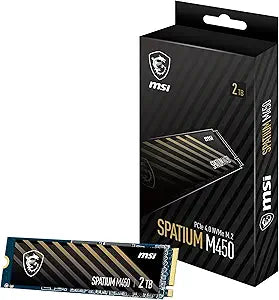
MSI SPATIUM M450 PCIE 4.0 NVME M.2 2TB SSD

4.4 (20 reviews)
2TB SSDPCIe Gen4

PCIe Gen4 sequential reads of 3600MB/s make the MSI SPATIUM M450 2TB a genuine throughput upgrade for gaming rigs and content workstations bottlenecked on storage bandwidth.

$129.99*
Check availability

*Price sourced from Amazon.com. Last updated:Jul 14, 2026.Price and availability are subject to change.

Affiliate Disclosure: Studio Supplies may earn a commission from qualifying purchases made through links on this page, at no additional cost to you. This helps support our editorial team.

Notice a mistake? Let Us Know

Overview

The MSI SPATIUM M450 is a PCIe Gen4 NVMe M.2 2280 SSD built to the NVMe 1.4 standard, targeting gaming and professional storage workloads where both sequential throughput and raw capacity matter. The headline numbers — 3600MB/s sequential read and 3000MB/s sequential write — represent near-saturation of PCIe Gen4 x4 interface bandwidth, and the 2TB configuration delivers this throughput at a capacity tier that consolidates what would previously have required multiple drives into a single M.2 slot. NVMe 1.4 compliance is not cosmetic: host-controlled thermal management directly improves sustained performance behavior under prolonged sequential operations, reducing the frequency and severity of thermal throttling events compared to NVMe 1.3 drives under similar load conditions. The 3300 TBW endurance rating places the drive well above any realistic consumer or prosumer write workload ceiling.

The M450 2TB is the right drive for builders and upgraders stepping up from Gen3 NVMe or SATA-based systems and targeting a meaningful, measurable throughput improvement. The performance gain is most visible in storage-intensive workflows — large-asset game loading, video project file imports, backup operations, and content creation pipelines where large sequential reads are frequent. For standard OS and application responsiveness, the performance gain over a quality Gen3 NVMe drive is less perceptible, as random I/O behavior dominates those use cases. The drive ships without a heatsink; pairing it with a motherboard-integrated M.2 heatsink is the recommended configuration for any build where the M.2 slot has limited airflow exposure. For AMD Ryzen 5000/7000 or Intel 12th Gen and newer platforms with Gen4-capable M.2 slots, the SPATIUM M450 2TB is a specification-honest, competitive storage upgrade.

Key Features

PCIe Gen4 interface and complies with the NVMe 1.4 standard

Sequential Read speeds up to 3600MB/s and Write speeds up to 3000MB/s

Up to 3300 TBW

Built-in data security and error-correction capabilities

up to 450MB/s Write speed

Specifications

Brand
MSI
Model
SPATIUM M450
Capacity
2TB
Interface
PCIe Gen4 x4, NVMe 1.4
Form Factor
M.2 2280
Sequential Read
Up to 3600MB/s
Sequential Write
Up to 3000MB/s
Endurance (TBW)
Up to 3300 TBW
Data Security
Built-in error correction
Heatsink Included
No

Pros & Cons

👍 Pros

  • 3600MB/s sequential read via PCIe Gen4 saturates the available interface bandwidth on Gen4-capable platforms, eliminating the storage layer as a throughput bottleneck for sequential operations
  • 2TB capacity on a single M.2 2280 module consolidates storage without occupying additional drive bays or M.2 slots in the build
  • 3300 TBW endurance rating across the 2TB model effectively removes write endurance as a planning concern for consumer and professional workloads
  • NVMe 1.4 compliance enables host-controlled thermal management, improving sustained performance efficiency over NVMe 1.3 drives under extended workloads
  • Built-in error correction reduces uncorrectable read error risk during sustained high-throughput sequential operations

👎 Cons

  • No heatsink included — sustained sequential workloads in thermally constrained M.2 slot environments risk thermal throttling without passive or active cooling
  • PCIe Gen4 rated speeds require a Gen4 M.2 slot — Gen3 systems operate the drive at Gen3 bandwidth limits, diminishing the performance premium of the Gen4 specification
  • 3000MB/s sequential write speed, while competitive, is asymmetric to the read speed — write-heavy workloads such as direct video capture will see lower throughput than sequential reads suggest
  • No bundled drive cloning or migration software — transitioning from an existing drive requires a third-party utility, adding a setup step for system migration use cases
  • Heatsink absence in the retail package means builders who lack a motherboard-integrated M.2 solution must source an aftermarket heatsink separately to operate at consistent rated speeds

Frequently Asked Questions

Yes — PCIe Gen4 NVMe drives are backward compatible with Gen3 M.2 slots. However, the drive is limited to Gen3 bandwidth in that configuration, reaching approximately 3500MB/s sequential read rather than the rated 3600MB/s. To fully utilize the M450's specified Gen4 throughput, the host M.2 slot must support PCIe Gen4.
NVMe 1.4 introduces host-controlled thermal management and enhanced power management states. For end-users, this means more efficient power draw and better thermal behavior under sustained sequential workloads compared to NVMe 1.3 drives — reducing the likelihood of thermal throttling during extended high-throughput operations.
Sequential read speed governs large file operations — loading open-world game levels, importing multi-gigabyte video project files, and transferring large archives. For OS boot time and application launch responsiveness, 4K random I/O metrics are the more relevant benchmark, where the M450 also performs competitively. The 3600MB/s figure matters most in production and creative workflows involving large file movement.
TBW (Terabytes Written) measures cumulative write capacity before reliability concerns emerge. At 3300 TBW, a user writing 50GB per day would reach the rated endurance limit in approximately 180 years. For consumer and prosumer workloads, drive endurance is not a practical concern — the 3300 TBW rating is well above any realistic use-case ceiling.
No heatsink is included in the retail package. Under sustained sequential workloads in warm M.2 slot environments, a heatsink reduces thermal throttling risk. Most current motherboards include an integrated M.2 heatsink that fits the M450 — check your board's specifications. Aftermarket M.2 heatsinks are widely available if the motherboard solution is absent or insufficient.