



NVIDIA
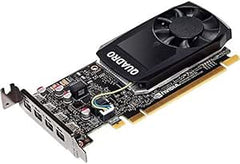
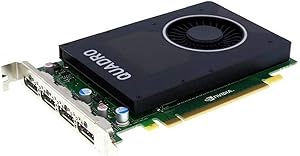
NVIDIA 641329912096 Quadro M2000 4GB GPU Renewed
The Quadro M2000 drives four simultaneous 4K DisplayPort outputs on a 75W bus-powered profile built for professional CAD and visualization workstations.
$85.00*
View on Amazon
✓ In Stock on Amazon.com
*Price sourced from Amazon.com. Last updated:Sep 16, 2026.Price and availability are subject to change — details.
Affiliate Disclosure: As an Amazon Associate, Studio Supplies earns from qualifying purchases made through links on this page, at no additional cost to you. This helps support our editorial team.
Notice a mistake? Let Us Know
Overview
Specifications
Model
Quadro M2000
Memory
4GB
Condition
Renewed
Similar Products
Other products from the same family that visitors often consider:
Frequently Asked Questions
Does the Quadro M2000 require a supplemental PCIe power connector, and what PSU capacity does my workstation need?
No — the Quadro M2000 operates entirely from the PCIe 3.0 x16 slot with a 75W TGP, requiring no 6-pin or 8-pin supplemental power connector. A standard workstation or desktop PSU with a x16 PCIe slot can power this card without modification, making it compatible with small form factor and entry workstations with modest power supplies.
What is the maximum resolution supported across all four DisplayPort 1.2 outputs simultaneously?
Each of the four DisplayPort 1.2 outputs supports up to 4096x2160 at 60Hz. Running all four simultaneously at 4K is within the M2000's display engine capability, making it a workstation multi-display solution for financial analysis, video monitoring walls, and multi-screen CAD environments.
Is the 4GB GDDR5 with a 128-bit memory bus a bottleneck for modern professional visualization workloads?
The 128-bit bus is narrower than the 256-bit bus on the Quadro M4000 and above, which limits peak memory bandwidth. For CAD (SolidWorks, AutoCAD, CATIA) and moderate 3D visualization workloads, the GDDR5 bandwidth is adequate. It becomes a bottleneck for large scene rendering (Autodesk VRED, Siemens NX with complex surface models) and high-resolution real-time rendering where texture bandwidth is the constraint.
What is the difference between a Quadro M2000 and a consumer GeForce GPU in a professional workflow?
Quadro drivers are certified by ISVs (Independent Software Vendors) for professional applications including AutoCAD, SolidWorks, Maya, and 3ds Max. This certification means these applications run in validated, tested configurations that consumer GeForce drivers do not support. ECC memory error correction, OpenGL hardware acceleration, and sustained driver stability under long-session professional rendering are Quadro-specific capabilities.
As a renewed (refurbished) GPU, what is the risk profile for the Quadro M2000 in a production workstation?
Renewed GPUs introduce lifecycle uncertainty — GPU die degradation is not externally visible, and GDDR5 modules may have undergone significant thermal cycling. For mission-critical production use, evaluate the return policy and warranty terms carefully. In lower-stakes deployments (secondary workstations, display walls, CAD stations doing 2D/light 3D work), the M2000's low heat output (75W) means thermal wear is moderate relative to high-TDP gaming GPUs.
Related Products


