PreSonus

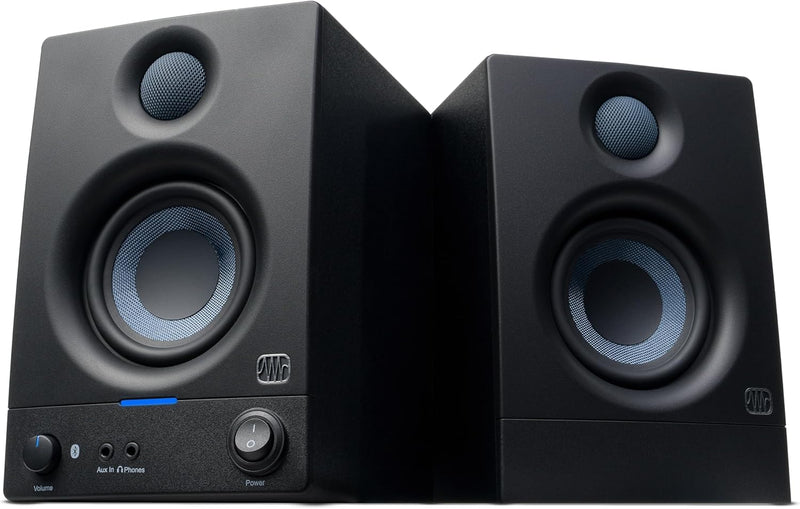
PreSonus Eris 3.5BT Bluetooth Studio Monitors

4.6 (25119 reviews)
25W50WBLUETOOTH 5.0

Professional studio monitors with Bluetooth 5.0, 50W Class A/B power, and room-tuning controls — all in a compact desktop package.

$129.99*
In Stock on Amazon.com
View on Amazon

*Price sourced from Amazon.com. Last updated:Jun 20, 2026.Price and availability are subject to change.

Affiliate Disclosure: Studio Supplies may earn a commission from qualifying purchases made through links on this page, at no additional cost to you. This helps support our editorial team.

Notice a mistake? Let Us Know

Overview

The PreSonus Eris 3.5BT studio monitors pack professional-grade audio into a compact desktop form factor, delivering 50 watts of Class A/B dual amplification split evenly at 25 watts per speaker. The 3.5-inch woven composite woofers produce a tight, controlled low end that feels substantial for their size, while the 1-inch silk-dome tweeters provide smooth, detailed high-frequency response with a wide listening sweet spot — so you don't have to sit in one precise position to hear an accurate stereo image. This combination makes them equally capable for critical music production work and everyday media playback.

Connectivity is a standout strength of the Eris 3.5BT. Bluetooth 5.0 handles wireless streaming from phones, tablets, and laptops, while the rear-panel 1/4-inch TRS balanced inputs serve professional audio interfaces and the RCA inputs connect consumer electronics like turntables or TV audio outputs. A front-panel 1/8-inch aux input handles quick phone or laptop connections, and the adjacent headphone output with built-in amplifier lets you switch to private monitoring instantly. The rear-panel high- and low-frequency acoustic tuning controls allow you to compensate for room characteristics and speaker placement, ensuring accurate sound whether the monitors sit on a desk, bookshelf, or studio stands. An auto-engaging power saver mode after 40 minutes of idle time adds a practical energy-saving touch.

Key Features

HONEST. Eris 3.5BT near field studio monitors deliver studio-quality, accurate sound perfect for music production, hi-fi audio listening, or multimedia reference.

EXPRESSIVE. Clear, accurate audio with a big low end — Eris 3.5BT's woven-composite woofers’ weave and nature result in tight bass that you can feel, as well as cleaner overall sound.

POWERFUL. Compact speakers that pack a punch — 50 Watts of Class AB dual amplification (25W per side) provide all the volume and loudness you want without sacrificing tonal balance or audio clarity.

BLUETOOTH 5.0 WIRELESS CONNECTIVITY. Ultra-reliable Bluetooth 5.0 delivers seamless integration with your other devices while flexible wired connection options ensure easy compatibility with virtually any monitoring setup – so you can plug in, pair up, and get to work without missing a beat.

ULTRA-WIDE LISTENING SWEET SPOT. The natural high-frequency response of the 1-inch low-mass, silk-dome transducers (tweeters) provide superior stereo imaging from nearly any listening angle.

ALL THE CONNECTIONS YOU NEED. ¼-inch TRS balanced inputs on the back panel for professional audio devices, unbalanced RCA inputs for consumer electronics, plus a convenient front-panel ⅛-inch TRS stereo aux input for your phone.

PRECISION-TUNE TO YOUR ROOM. High- and low-frequency tuning controls allow you to customize your audio output for your ears, room size, and speaker orientation. Whether on a desk, bookshelf, or next to a turntable or record player, Eris 3.5BT's produce clear, room-filling sound.

QUICK-SWITCH TO HEADPHONES. The easy-access front panel headphone output and built-in headphone amplifier allow for plug-and-play headphone media reference when needed.

ADD MORE LOW END. The 50W, 8-inch companion Eris Sub 8BT studio subwoofer delivers a massive low-frequency boost and Bluetooth connectivity to your Eris 3.5BT’s, creating a powerful 2.1 speaker system.

POWER SAVER MODE. Power-saving mode auto engages after 40 minutes of idle time.

Specifications

Total Power
50W Class A/B (25W per speaker)
Woofer
3.5-inch woven composite
Tweeter
1-inch (25mm) silk-dome, ultra-low mass
Bluetooth
5.0
Balanced Inputs
1/4-inch TRS (rear panel)
Unbalanced Inputs
RCA (rear panel)
Aux Input
1/8-inch TRS stereo (front panel)
Headphone Output
1/8-inch TRS (front panel) with built-in amplifier
Acoustic Tuning
High-frequency and low-frequency controls
Power Saver
Auto-engages after 40 minutes idle
Brand
PreSonus
Model
Eris 3.5BT

PreSonus Eris 3.5BT Studio Monitors — Editorial Review & Independent Findings

The PreSonus Eris 3.5BT is the Bluetooth-equipped variant of PreSonus's entry-tier desktop studio monitor — a pair of small-format active near-fields with a 3.5-inch woofer and 1-inch silk-dome tweeter per cabinet. Per PreSonus's official Eris 3.5BT product page, each cabinet houses 25 W of Class A/B amplification (50 W total per pair), with RCA, balanced quarter-inch TRS, and stereo 3.5 mm aux inputs plus Bluetooth 5.0 wireless input — distinguishing the 3.5BT from the base Eris E3.5 model. The acoustic-tuning controls offer ±6 dB HF shelving at 10 kHz and ±6 dB LF shelving at 100 kHz for room compensation. The findings below aggregate published coverage from independent pro-audio publications.

Sound on Sound's Take

Per Sound on Sound's PreSonus Eris 3.5 BT review, the monitor delivers a frequency response of 80 Hz to 20 kHz, with a 2.8 kHz passive crossover between the woofer and tweeter, achieving peak SPL of 98 dB at 1 meter. The publication documents the input flexibility (RCA + TRS + 3.5 mm aux + Bluetooth) as a meaningful advantage at the price tier — typical entry-tier monitors offer one or two inputs, not all four. The acoustic-tuning shelving controls on the rear are functionally similar to what Sound on Sound has reviewed on larger Eris models, scaled to the 3.5-inch driver tier.

What MusicRadar Specifically Calls Out

MusicRadar's Eris 3.5BT review characterizes the monitor as "a compact pair that delivers decent sound, and with plenty of connectivity is ideal for music, multimedia and home use." The publication identifies the most important reviewer-attributed limitation: "the low mids are subdued, which is very obvious when you A/B against larger nearfields — certainly something to bear in mind if you're using these to mix or master." This is the key editorial framing for the entire 3.5-inch monitor category: at this driver size, the low-frequency extension is fundamentally physics-limited; for critical mix and master work, a 5-inch or larger near-field is the appropriate tier.

What 3.5-Inch Monitors Are Genuinely Good At

Per MusicTech's coverage of the Eris series, the 3.5-inch tier sits in a distinct category from the larger 5-inch and 8-inch Eris models — the smaller drivers are appropriate for desktop near-field reference monitoring (1.5-3 ft listening distance), multimedia post-production reference, podcast and YouTube editing, and as a secondary system pair for cross-referencing mixes prepared on larger systems. The Bluetooth-on-3.5BT capability adds general media playback use (streaming from a phone for break-time listening) without taking up another USB or analog source on the desk.

Where the Eris 3.5BT Specifically Fits

  • Home-studio producers in a constrained desk-space environment who want active near-fields with consumer-friendly Bluetooth input alongside professional balanced TRS connectivity
  • Podcasters and YouTube creators editing voice content where reference accuracy in the speech-frequency band matters more than sub-bass extension
  • Secondary cross-reference system for producers who do their primary mix on a 5-inch or larger system — small-driver monitors expose mid-range imbalances that larger monitors can mask
  • Multimedia / mixed-use desktops where the monitor doubles as music playback (Bluetooth from phone), professional reference (TRS from audio interface), and casual TV / film audio (RCA from media device)
  • Music students and learners who want active monitoring at a low entry price before committing to a larger near-field investment

Honest Cons from Independent Coverage

  • Low-mid subdued response. Per MusicRadar's review, the low mids are visibly subdued when A/B'd against larger near-fields. For critical mix or master work, this is a real limitation. Buyers should plan to cross-reference mixes on headphones (Sony MDR-7506, Beyerdynamic DT 770 Pro 80 ohm) and additional listening environments
  • 3.5-inch woofer caps low-frequency extension at 80 Hz. Per Sound on Sound's review, the spec is 80 Hz to 20 kHz. Sub-bass content below 80 Hz is reproduced primarily through harmonics rather than fundamentals — a 5-inch Eris E5 (50 Hz extension) or a subwoofer pairing addresses this for users who need accurate sub-bass reference
  • Peak SPL of 98 dB at 1 meter is appropriate for desktop near-field listening but not for tracking-room playback distances. The Eris 3.5BT is designed for ear-distance-1-meter monitoring, not room-filling reference
  • Bluetooth 5.0 input is a convenience, not a reference path. The Bluetooth codec adds latency and lossy compression versus the wired TRS input. Critical reference work should use the wired connection
  • Plastic construction at the entry price point. The cabinet construction is plastic (not MDF), which is typical of the entry tier and contributes to lower cabinet resonance damping than higher-tier monitors. The trade-off keeps the price point accessible

Where Buyers Should Look Elsewhere

  • Critical mix and master work — step up to PreSonus Eris E5 / Eris E8 (or competing Yamaha HS5 / HS8, JBL 305P MkII / 308P MkII, Adam Audio T5V / T7V) with larger woofers, MDF cabinets, and lower frequency extension
  • Sub-bass-critical work (EDM, hip-hop, electronic production) — add a dedicated subwoofer (PreSonus Temblor T8 or competing Adam Sub7) to address frequencies below the Eris 3.5BT's 80 Hz floor, or step directly to 8-inch near-fields
  • Larger listening distances (tracking rooms, group listening) — 5-inch or 8-inch near-fields deliver higher peak SPL and better off-axis dispersion for distances beyond 3 feet
  • USB-direct connection from computer — Eris 3.5BT requires an audio interface or USB-DAC; for users who want speaker-direct USB input, the Mackie CR3-X BT (USB) or Audioengine A2+ (USB) are sibling options

Sources & Citations

  1. PreSonus, "Eris 3.5BT Studio Monitor product page," presonus.com (accessed 2026-05-18)
  2. Sound on Sound, "PreSonus Eris 3.5 BT," soundonsound.com (accessed 2026-05-18)
  3. MusicRadar, "PreSonus Eris 3.5BT review," musicradar.com (accessed 2026-05-18)
  4. MusicTech, "PreSonus Eris Series Review," musictech.com (accessed 2026-05-18)

Last verified: 2026-05-18

Now that you've seen the details — ready to take a closer look?

View on Amazon

Pros & Cons

👍 Pros

  • 50W Class A/B amplification delivers loud, clear sound with strong low end from a compact 3.5-inch form factor
  • Bluetooth 5.0 plus three wired input options provide flexible connectivity for virtually any source device
  • High- and low-frequency tuning controls let you dial in the sound for your specific room and placement
  • Front-panel headphone output with built-in amp allows instant private monitoring
  • Woven composite woofers produce tight, controlled bass that belies the small driver size

👎 Cons

  • 3.5-inch woofers have limited low-frequency extension so bass-heavy genres may need the optional Eris Sub 8BT
  • Bluetooth streaming introduces latency that makes it unsuitable for real-time monitoring during recording
  • No digital inputs such as optical or USB for direct computer audio connections
  • Compact size means limited max volume before distortion in larger rooms

Frequently Asked Questions

Yes, the Eris 3.5BT monitors are designed to deliver accurate, uncolored sound reproduction suitable for music production, mixing, and multimedia reference work.
Bluetooth 5.0 provides convenient wireless playback for casual listening, but for critical mixing and production work, the wired TRS balanced or RCA inputs will deliver the best audio fidelity.
The high- and low-frequency adjustment controls on the rear panel let you compensate for your room's acoustics, speaker placement on desks or shelves, and personal listening preferences.
Yes, there is a front-panel 1/8-inch TRS headphone output with a built-in headphone amplifier, so you can quickly switch to private monitoring without disconnecting anything.
No, one speaker is the powered (active) unit containing the amplifier, and the second speaker connects to it with the included speaker cable. Only the active speaker needs a power connection.