



PreSonus
PreSonus SL-1602 USB StudioLive 16-Channel Digital Mixer
USB 2.0
Elevate Your Sound with the PreSonus StudioLive 16.0.2 USB Digital Mixer The PreSonus StudioLive 16.0.2 USB is a compact, powerful digital mixer designed for both live performance and studio recording. It offers extensive signal processing, a built-in USB interface, and intuitive software integr...
$916.39*$1,099.99Save 16%
View on Amazon
✓ In Stock on Amazon.com
*Price sourced from Amazon.com. Last updated:Aug 29, 2026.Price and availability are subject to change — details.
Affiliate Disclosure: As an Amazon Associate, Studio Supplies earns from qualifying purchases made through links on this page, at no additional cost to you. This helps support our editorial team.
Notice a mistake? Let Us Know
Overview
Elevate Your Sound with the PreSonus StudioLive 16.0.2 USB Digital Mixer
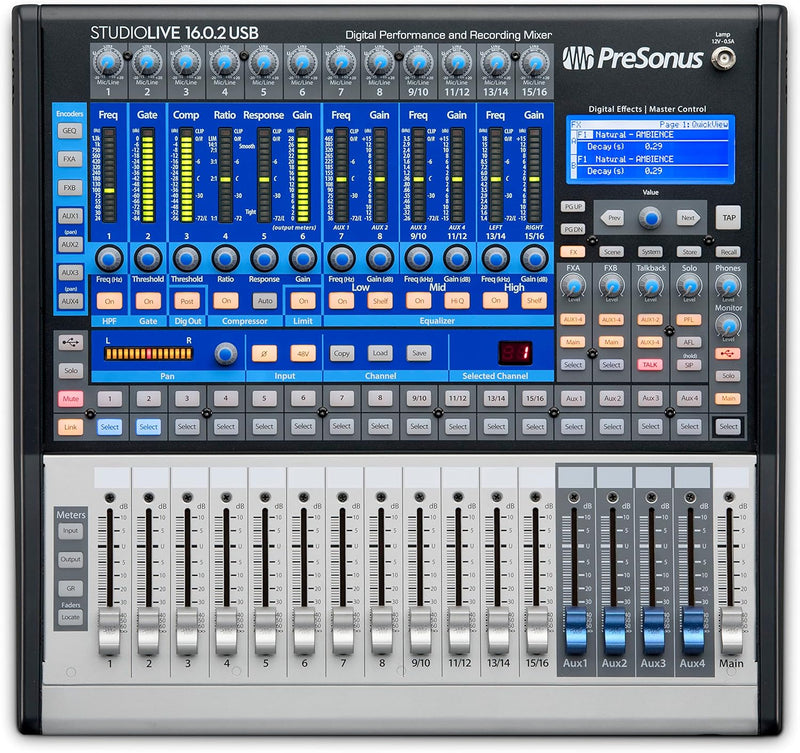
The PreSonus StudioLive 16.0.2 USB is a compact, powerful digital mixer designed for both live performance and studio recording. It offers extensive signal processing, a built-in USB interface, and intuitive software integration, making it perfect for bands, small venues, and project studios.
Specifications:
- Channel Inputs: 16 (8 mono, 4 stereo) with 60 mm faders
- Mic Preamps: 12 Class A XMAX solid-state (12 channels + talkback)
- Auxiliary Buses: 4 (pre/post-fader send)
- FX Buses: 2 internal
- Effects Processors: 2 stereo 32-bit digital
- EQ: 3-band semi-parametric EQ on all channels and buses
- Graphic EQ: Stereo, 31-band on the main bus
- USB Interface: 18-in/16-out USB 2.0 (24-bit/44.1 kHz and 48 kHz)
- Software: PreSonus Studio One Artist DAW, Capture live-recording software, UC Surface mixer-control software, QMix-UC aux-control software
Key Features
16 channel inputs (8 mono and 4 stereo channel inputs with 60 mm faders (12 faders)
12 Class A XMAX solid-state mic preamplifiers (12 channels + talkback)
4 auxiliary buses (pre/post-fader send) and 2 internal FX buses
2 stereo 32-bit digital effects processors
Fat Channel signal processing on all channels and buses, with 3-band semi-parametric EQ, compressor, downward expander, and limiter
Stereo, 31-band graphic EQ on the main bus
18-in/16-out USB 2.0 audio interface (24-bit/44.1 kHz and 48 kHz) records all channels and main L/R mix
Scene and individual settings store and recall
MIDI I/O: control main and effects output levels, recall effects presets and Scenes, and serve as a MIDI interface
Software library includes PreSonus Studio One Artist DAW and Capture live-recording software for Mac and Windows and UC Surface mixer-control software for Mac, Windows, and iPad. QMix-UC touch wireless aux-control software for iPhone, iPod touch, and Android are also available free.
Specifications
Channel Inputs
16 (8 mono, 4 stereo)
Faders
12 x 60 mm
Mic Preamps
12 x Class A XMAX solid-state
Auxiliary Buses
4
Internal FX Buses
2
Digital Effects Processors
2 stereo 32-bit
Channel Processing
Fat Channel (3-band semi-parametric EQ, compressor, downward expander, limiter)
Main Bus EQ
Stereo 31-band graphic EQ
Audio Interface
18-in/16-out USB 2.0
Audio Resolution
24-bit/44.1 kHz and 48 kHz
Control Features
Scene and individual settings store/recall, MIDI I/O
Included Software
PreSonus Studio One Artist DAW, Capture live-recording software, UC Surface, QMix-UC
Frequently Asked Questions
How many input channels does the PreSonus SL-1602 USB StudioLive mixer have?
The PreSonus SL-1602 mixer offers 16 channel inputs, consisting of 8 mono and 4 stereo channels, each with 60 mm faders.
What kind of mic preamplifiers are included with this mixer?
This mixer is equipped with 12 Class A XMAX solid-state mic preamplifiers, located on 12 channels plus the talkback channel.
Does the mixer have built-in effects?
Yes, the PreSonus SL-1602 includes 2 stereo 32-bit digital effects processors, along with 2 internal FX buses.
What kind of signal processing is available on each channel?
All channels and buses feature Fat Channel signal processing, which includes a 3-band semi-parametric EQ, compressor, downward expander, and limiter.
Can this mixer record audio to a computer?
Absolutely, it functions as an 18-in/16-out USB 2.0 audio interface, allowing you to record all channels and the main L/R mix at 24-bit/44.1 kHz and 48 kHz.
What software comes bundled with the StudioLive 16.0.2?
The mixer includes a software library featuring PreSonus Studio One Artist DAW, Capture live-recording software for Mac and Windows, and UC Surface mixer-control software for Mac, Windows, and iPad, plus QMix-UC for mobile devices.
Related Products


