

QNAP
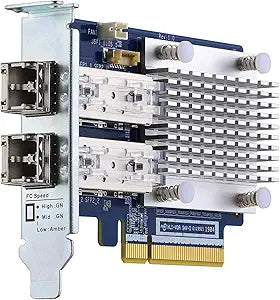
QNAP QXP-32G2FC 32G Fibre Channel Expansion Card
PCIe Gen3
Unleash High-Speed Connectivity with the QNAP QXP-32G2FC Fibre Channel Expansion CardThe QNAP QXP-32G2FC is a high-performance Fibre Channel expansion card designed to deliver ultra-fast data transfer rates. Equipped with dual ports and SFP+ transceivers, this card enables seamless connectivity f...
$1,499.00*
View on Amazon
✓ In Stock on Amazon.com
*Price sourced from Amazon.com. Last updated:Jun 04, 2026.Price and availability are subject to change.
Affiliate Disclosure: Studio Supplies may earn a commission from qualifying purchases made through links on this page, at no additional cost to you. This helps support our editorial team.
Notice a mistake? Let Us Know
Overview
Unleash High-Speed Connectivity with the QNAP QXP-32G2FC Fibre Channel Expansion Card
The QNAP QXP-32G2FC is a high-performance Fibre Channel expansion card designed to deliver ultra-fast data transfer rates. Equipped with dual ports and SFP+ transceivers, this card enables seamless connectivity for demanding storage environments.
Specifications
- Ports: Dual-port
- Interface: PCIe Gen3 x8
- Transmission Rates: Fibre Channel 32/16/8 GB/s (up to 28. 05 GB/s per port)
- Form Factor: Low-profile PCIe Card 10. 68 x 6. 89 cm (4. 20 x 2. 71 inches)
Key Features
Dual-port 32GB Gen 6 fiber Channel expansion card with SFP+ transceivers
Pcie interface: PCIe Gen3 x8
Transmission rates: fiber Channel 32/16/8 GB/s (up to 28. 05 GB/s per port)
Form Factor: low-profile PCIe Card 10. 68 x 6. 89 cm (4. 20 x 2. 71 inches)
Specifications
Number of Ports
Dual-port
Fibre Channel Generation
Gen 6
Fibre Channel Speed
32GB
Transceivers Included
SFP+
PCIe Interface
PCIe Gen3 x8
Transmission Rates
32/16/8 GB/s
Max Transfer Rate Per Port
28.05 GB/s
Form Factor
Low-profile PCIe Card
Dimensions
10.68 x 6.89 cm (4.20 x 2.71 inches)
Pros & Cons
👍 Pros
- Features dual-port 32GB Gen 6 Fibre Channel for robust and high-bandwidth data connectivity
- Includes SFP+ transceivers, ensuring compatibility and immediate usability for Fibre Channel connections
- Utilizes a PCIe Gen3 x8 interface, providing a high-speed connection to the host system for optimal performance
- Offers flexible transmission rates of 32/16/8 GB/s, adapting to various network environments and device capabilities
- Achieves impressive data transfer speeds of up to 28.05 GB/s per port, suitable for demanding storage applications
- Designed with a low-profile PCIe card form factor, allowing for installation in space-constrained server chassis
👎 Cons
- Requires a PCIe Gen3 x8 slot, meaning older systems with slower PCIe generations may not fully utilize its potential
- The specialized Fibre Channel interface and SFP+ transceivers may require specific infrastructure and expertise for deployment
- The low-profile form factor might necessitate a specific bracket type depending on the server chassis or workstation
- Transmission rates are dependent on the connected Fibre Channel network, so maximum speeds are not guaranteed without compatible infrastructure
- Primarily designed for Fibre Channel environments, making it less versatile for standard Ethernet-based networks
Frequently Asked Questions
What is the purpose of SFP+ transceivers included with this card?
The SFP+ transceivers are included to enable the physical connection between the Fibre Channel card and the Fibre Channel network cables, allowing for immediate deployment and operation.
Is this Fibre Channel card compatible with all PCIe slots?
This card requires a PCIe Gen3 x8 interface, meaning it will physically fit into x8 or x16 slots, but its performance may be limited if installed in older generation PCIe slots.
Can this card be used in a standard desktop PC for network connectivity?
This QNAP QXP-32G2FC is a specialized Fibre Channel expansion card, designed for high-speed storage networking, and is not typically used for standard Ethernet-based network connectivity in a desktop PC.
What are the benefits of the 32GB Gen 6 Fibre Channel?
The 32GB Gen 6 Fibre Channel provides significantly higher bandwidth and lower latency compared to previous generations, which is crucial for demanding applications like virtualization, database storage, and large-scale data backup.
Will this card improve my general internet speed?
No, this Fibre Channel expansion card is designed for storage area networks (SANs) and high-speed data transfer between servers and storage, not for improving general internet speed to your home or office.
Related Products


