



QNAP
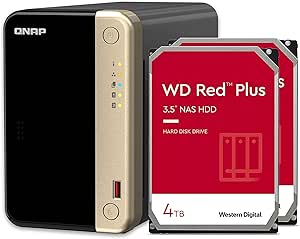
QNAP TS-264-8G-24W-US 2 Bay NAS with 4TB WD Red Plus RAID1
★★★★★
8GB DDR424WUSB 3.2
8GB RAM, dual 2.5GbE, and RAID 1 out of the box — this NAS is ready to protect and serve the moment you plug it in.
$579.00*
Check availability
*Price sourced from Amazon.com. Last updated:Jul 14, 2026.Price and availability are subject to change.
Affiliate Disclosure: Studio Supplies may earn a commission from qualifying purchases made through links on this page, at no additional cost to you. This helps support our editorial team.
Notice a mistake? Let Us Know
Overview
Key Features
2 x 4TB WD Red Plus drives pre-installed and pre-configured with RAID 1
Quad-core Intel Celeron N5105/N5095 4-core/4-thread burst up to 2.9 GHz with 8GB DDR4 RAM
Dual 2.5GbE (2.5G/1G/100M) ports accelerates file sharing across teams and devices or streamline large file transfers
Dual M.2 PCIe Gen3x2 NVMe SSD slots enable cache acceleration or SSD storage pools for improved performance
Multiple USB 3.2 Gen 2 ports (type-A) with up to 10Gb/s transfer speeds, allowing compatibility with newer, faster USB drives/expansion enclosures for transferring large media files
Centrally store and organize personal or family photos, music, and videos
Effortlessly backup your Windows Computers with QNAP’s NetBak Replicator software and Mac computers with Time Machine
Securely access your Files from anywhere with MyQNAPCloud
Specifications
Drive Capacity
2 x 4TB WD Red Plus
RAID Configuration
RAID 1 (pre-configured)
Processor
Quad-core Intel Celeron N5105/N5095 (4-core/4-thread, burst up to 2.9 GHz)
RAM
8GB DDR4
Ethernet Ports
Dual 2.5GbE (2.5G/1G/100M)
M.2 SSD Slots
Dual PCIe Gen3x2 NVMe
USB Ports
Multiple USB 3.2 Gen 2 (Type-A)
USB Transfer Speed
Up to 10Gb/s
Pros & Cons
👍 Pros
- Quad-core Celeron N5105/N5095 bursting to 2.9 GHz handles transcoding and container workloads without the thermal throttling typical of ARM-based NAS units at this price point.
- Dual 2.5GbE ports deliver up to 625 MB/s aggregate throughput via link aggregation, eliminating the network bottleneck that caps 1GbE NAS units at ~115 MB/s real-world.
- Ships pre-configured with RAID 1 and WD Red Plus drives rated for 24/7 NAS operation at 180 TB/year workload — zero setup time to a protected array.
- Dual M.2 PCIe Gen3x2 NVMe slots add a cache or SSD tier without consuming the HDD bays, a hardware capability absent from most 2-bay competitors.
- USB 3.2 Gen 2 Type-A ports at 10 Gb/s support fast external expansion enclosures, giving the unit a real upgrade path beyond its 2-bay limit.
👎 Cons
- M.2 slots run PCIe Gen3x2, capping at ~1,000 MB/s per slot — NVMe drives rated for Gen3x4 or Gen4 will be bottlenecked and won't reach their rated sequential speeds.
- 2-bay configuration caps raw capacity at whatever drive size you install; no hot-swap or drive-count expansion path without external enclosures.
- 8GB RAM is non-trivially limited when running multiple QNAP Container Station apps simultaneously — heavy virtual machine workloads will exhaust available memory.
- The 24W power adapter is included but rated conservatively; third-party high-RPM drives or simultaneously loaded NVMe SSDs may push the unit close to that power envelope.
Frequently Asked Questions
What does RAID 1 actually mean for my data in practice?
RAID 1 mirrors your data across both 4TB WD Red Plus drives simultaneously. If one drive fails, your data is fully intact on the second. You get 4TB of usable storage, not 8TB — the second drive is purely redundancy, not capacity.
Can I expand beyond 8TB of raw storage later?
The TS-264 is a 2-bay unit, so you're limited to two drives. However, the dual M.2 PCIe Gen3x2 NVMe slots let you add SSD storage pools or cache tiers independently of the HDD bays. For capacity beyond 8TB raw, you'd need a USB 3.2 Gen 2 expansion enclosure connected via one of the Type-A ports.
Will the 8GB of DDR4 RAM be enough for running apps and containers?
For core NAS functions — file sharing, backup, media serving, and light virtualization — 8GB is adequate headroom. QNAP's QTS OS reports it as expandable (check your specific board revision), but running multiple heavy containers simultaneously will push that limit.
What does "dual 2.5GbE" mean for file transfer speeds?
Each 2.5GbE port maxes out at 312 MB/s theoretical throughput, nearly 2.5x a standard gigabit connection. With link aggregation across both ports, you can push closer to 625 MB/s — meaningful when transferring large media libraries or doing multi-user simultaneous access.
Does the NVMe M.2 slot work as a primary storage pool or only as cache?
Both. The dual M.2 PCIe Gen3x2 slots support either SSD caching (to accelerate HDD read/write) or a fully independent NVMe storage pool. The Gen3x2 interface caps at roughly 1,000 MB/s per slot — not full Gen3x4 NVMe speeds, but well ahead of the HDD tier it's accelerating.
Related Products


