



QNAP
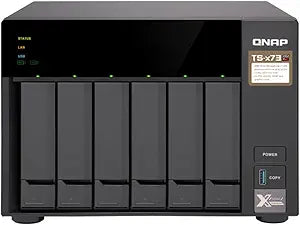
QNAP TS-673-8G-US 6-Bay NAS 10G-Ready
The TS-673's AMD quad-core processor and dual PCIe slots make it the 6-bay NAS that grows into 10GbE and GPU-accelerated 4K transcoding as your workflow demands it.
Check availability
Affiliate Disclosure: As an Amazon Associate, Studio Supplies earns from qualifying purchases made through links on this page, at no additional cost to you. This helps support our editorial team.
Notice a mistake? Let Us Know
Overview
Key Features
Mad RX-421ND 2. 13. 4 GHz, 8GB DDR4 RAM, 6x 2. 5"/3. 5" + 2x M. 2 2280/2260 SATA 6GB/s drives, 4x GbE LAN, optional 10GbE Pie expansion
Two Pie Gen3 x4 Slots support QM2 cards, 10GbE adapters, or wireless network cards
Supports the NVIDIA GeForce GT1030 Graphics card, allowing for 4K video transcoding and output
Dual M. 2 SATA 6 Gb/s SSD slots allow for setting up caching or storage pools, improving file access efficiency
Scalable storage supporting virtualization, containerized apps, centralized storage, backup, sharing, and disaster recovery
Specifications
Processor
AMD RX-421ND 2.1~3.4 GHz
RAM
8GB DDR4 RAM
Drive Bays
6x 2.5"/3.5" + 2x M.2 2280/2260 SATA 6Gb/s
Ethernet Ports
4x GbE LAN
PCIe Slots
Two PCIe Gen3 x4
Optional Expansion
10GbE PCIe expansion
Graphics Card Support
NVIDIA GeForce GT1030
Storage Features
Dual M.2 SATA 6 Gb/s SSD slots, Scalable storage, Qtier auto-tiering technology
Frequently Asked Questions
What does "10G-Ready" actually mean on the TS-673 — does it come with a 10GbE port?
The four onboard GbE ports are the base network configuration; 10GbE is not included at purchase. "10G-Ready" means the unit has two PCIe Gen3 x4 slots that accept QNAP's QM2 or 10GbE expansion cards — a meaningful distinction. Budget for the expansion card separately if 10GbE is required from day one.
Does the TS-673 support GPU-accelerated 4K video transcoding?
Yes — QNAP supports the NVIDIA GeForce GT1030 in one of the PCIe slots, enabling hardware-accelerated 4K transcode and HDMI output via the GPU. This offloads transcoding work from the CPU, making a practical difference for Plex or QNAP's own video station under multi-stream load.
What is the M.2 slot configuration and can it run NVMe drives?
The TS-673 includes two M.2 2260/2280 slots — but these are SATA 6Gb/s, not NVMe. Maximum M.2 drive throughput is capped at the SATA ceiling (~600MB/s theoretical, ~550MB/s practical). The slots are intended for SSD caching or additional storage pools, not as primary high-speed storage via PCIe lanes.
How much RAM is installed and what's the realistic upgrade ceiling?
Ships with 8GB DDR4 in a single SODIMM slot. The TS-673 supports up to 64GB DDR4, and the upgrade path is straightforward — standard SODIMM form factor. For virtualization workloads or containerized applications running several simultaneous services, moving to 16GB or 32GB is a practical early upgrade.
What RAID configurations are supported across the 6 drive bays?
The TS-673 supports RAID 0, 1, 5, 6, 10, 50, 60, JBOD, and Single configurations across its six 2.5"/3.5" SATA bays. RAID 6 with six drives provides two-drive fault tolerance — the most resilient configuration — while RAID 5 gives a single-drive safety net with better usable capacity efficiency.
Related Products
