



QNAP
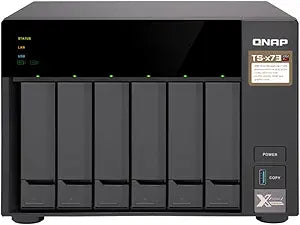
QNAP TS-673-8G-US 6-Bay NAS Server 10G-Ready
4K4GB DDR4PCIe Gen3
Quad-core AMD processor and dual PCIe Gen3 x4 slots give this 6-bay NAS the headroom to grow from file server to 4K transcoding appliance.
Check availability
Affiliate Disclosure: As an Amazon Associate, Studio Supplies earns from qualifying purchases made through links on this page, at no additional cost to you. This helps support our editorial team.
Notice a mistake? Let Us Know
Overview
Key Features
AMD RX-421ND 2.1~3.4 GHz, 4GB DDR4 RAM, 4x 2.5"/3.5" + 2x M.2 2280/2260 SATA 6Gb/s drives, 4x GbE LAN, optional 10GbE PCIe expansion
Two PCIe Gen3 x4 slots support QM2 cards, 10GbE adapters, or wireless network cards
Supports the NVIDIA GeForce GT1030 graphics card, allowing for 4K video transcoding and output
Dual M.2 SATA 6 Gb/s SSD slots allow for setting up caching or storage pools, improving file access efficiency
Qtier auto-tiering technology and SSD caching enable 24/7 optimized storage efficiency
Specifications
Processor
AMD RX-421ND 2.1~3.4 GHz
RAM
8GB DDR4 RAM
Drive Bays
4x 2.5"/3.5" + 2x M.2 2280/2260 SATA 6Gb/s
Ethernet Ports
4x GbE LAN
PCIe Slots
Two PCIe Gen3 x4
Optional Expansion
10GbE PCIe expansion
Graphics Card Support
NVIDIA GeForce GT1030
Features
Qtier auto-tiering technology, SSD caching
Frequently Asked Questions
Can the TS-673 reach 10GbE speeds, and what hardware does that require?
The TS-673 ships with 4x Gigabit Ethernet ports but no built-in 10GbE. Achieving 10GbE requires installing a compatible 10GbE PCIe NIC into one of the two PCIe Gen3 x4 slots — QNAP's QXG-10G1T or QXG-10G2T cards are validated options. This is a deliberate design choice that lets you buy 10G capability only when your network infrastructure actually supports it.
What is the maximum RAM this NAS can address, and does more RAM meaningfully improve performance?
The TS-673-8G-US ships with 8GB DDR4 (not 4GB as the feature list notes — the description is authoritative at 8GB), expandable up to 64GB. Increasing RAM beyond 8GB provides measurable benefit in two scenarios: running multiple VMs or containers simultaneously via the QTS virtualization layer, and improving metadata caching for large NAS environments with millions of files.
How do the dual M.2 SATA SSD slots function — storage or cache only?
The two M.2 2260/2280 SATA 6Gb/s slots can be used either as dedicated SSD caching pools (accelerating HDD array read/write performance) or as independent storage volumes. QNAP's Qtier auto-tiering can also incorporate them into a tiered storage pool that automatically migrates hot data to the SSDs and cold data to HDDs — a meaningful real-world efficiency gain for mixed workload environments.
Does the TS-673 support 4K video transcoding natively?
Not natively. 4K transcoding requires installing a compatible NVIDIA GeForce GT 1030 graphics card into one of the PCIe slots — the AMD RX-421ND CPU alone lacks the GPU acceleration needed for smooth 4K transcode. The GT 1030 is specifically validated by QNAP for this purpose. Purchasing and installing the GPU is an additional cost and step not included in the base unit.
Is the AMD RX-421ND processor a limiting bottleneck for heavy NAS workloads?
For most NAS use cases — simultaneous SMB/NFS shares, iSCSI targets, surveillance recording, and container apps — the RX-421ND at up to 3.4GHz turbo is not the bottleneck; network throughput and storage I/O typically constrain first. The processor becomes the constraint in CPU-bound tasks: software-based video transcoding without GPU assist, heavy encryption overhead, or running multiple resource-intensive VMs simultaneously.
Related Products
