



QNAP
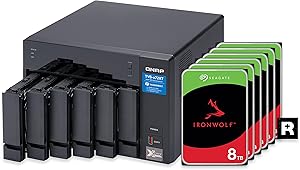
QNAP TVS-672XT-i3-8G-68S 40TB 6-Bay Thunderbolt 3 NAS RAID 5
40TB RAID 5 pre-configured on Thunderbolt 3 with a 10GbE port — this NAS ships ready to ingest 4K video at wire speed.
$4,598.00*
Check availability
*Price sourced from Amazon.com. Last updated:Aug 28, 2026.Price and availability are subject to change — details.
Affiliate Disclosure: As an Amazon Associate, Studio Supplies earns from qualifying purchases made through links on this page, at no additional cost to you. This helps support our editorial team.
Notice a mistake? Let Us Know
Overview
Key Features
Six 8TB Seagate IronWolf drives pre-installed and pre-configured with RAID 5. Hassle Free!
Hassle-free plug and play setup
IronWolf drives include a robust three- year Rescue Data Recovery Services plan
Intel Core i3-8100t 4-Core 3. 1 GHz Processor architecture: 64-bit Graphics: Intel UHD Graphics 630
8 GB SODIMM DDR4 (Max 64GB)
2 x Thunderbolt 3 ports
1 x 10GBase-T RJ45, supporting 10G/5G/2. 5G/1G/100M
Specifications
Model
TVS-672XT-i3-8G-68S
Processor
Intel Core i3-8100T, 4-Core, 3.1 GHz
Graphics
Intel UHD Graphics 630
Memory
8GB SODIMM DDR4 (expandable to 64GB)
Drive Bays
6
Installed Drives
6 x 8TB Seagate IronWolf
Raw Capacity
48TB
Usable Capacity (RAID 5)
~40TB
RAID Configuration
RAID 5 (pre-configured)
Thunderbolt Ports
2 x Thunderbolt 3
Network Port
1 x 10GBase-T RJ45 (10G/5G/2.5G/1G/100M)
Frequently Asked Questions
What is the actual usable storage capacity after RAID 5 overhead on the six 8TB drives?
RAID 5 across six drives sacrifices one drive's worth of capacity for parity, yielding approximately 40TB usable from 48TB raw. One drive can fail completely without data loss; recovery time after a failed drive replacement will depend on drive rebuild speed across the remaining five IronWolf spindles.
What throughput does the Thunderbolt 3 interface deliver compared to standard GbE?
Thunderbolt 3 provides up to 40Gbps of bidirectional bandwidth per port, compared to 1Gbps for standard GbE. In practice, NAS sequential read/write performance will be bottlenecked by the RAID array throughput before saturating Thunderbolt 3, but the interface eliminates the network stack as a bottleneck entirely — it appears as a direct-attached device to the connected host.
Can the 8GB of DDR4 RAM be expanded, and does it affect NAS performance?
Yes — the TVS-672XT supports up to 64GB via its SODIMM slots. The pre-installed 8GB is adequate for basic file-sharing operations, but heavy simultaneous Thunderbolt + 10GbE throughput, VM storage, or SSD caching workloads benefit from additional memory. Cache hit rates improve measurably with more RAM allocated to QNAP's internal caching engine.
Does the 10GbE port share bandwidth with the Thunderbolt 3 ports, or are they independent?
The 10GBase-T RJ45 port and the two Thunderbolt 3 ports are independent interfaces on this platform. The 10GbE port supports auto-negotiation down to 100M, making it compatible with legacy switches while delivering full 10G throughput on appropriate infrastructure. Both Thunderbolt and 10GbE can be active simultaneously.
What does the Intel UHD Graphics 630 GPU enable on this NAS?
The integrated GPU enables QNAP's hardware transcoding features — real-time on-the-fly video transcoding for Plex, QNAP's own multimedia station, and 4K HDMI output for direct display connection. It does not contribute to storage throughput but significantly reduces CPU load during video streaming workloads.
Related Products
