


SanDisk
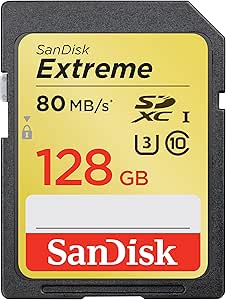
SanDisk SDSDXN-128G-G46 Extreme 128GB SDXC Card UHS-I U3
4KUHD1080p
U3-rated 60MB/s writes and UHS-I bus performance keep the SanDisk Extreme 128GB ahead of the buffer on continuous 4K UHD capture.
Check availability
Affiliate Disclosure: As an Amazon Associate, Studio Supplies earns from qualifying purchases made through links on this page, at no additional cost to you. This helps support our editorial team.
Notice a mistake? Let Us Know
Overview
Key Features
Performance/speed: Up to 80MB/s read & 60MB/s write
Ideal for advanced cameras, DSLRs and HD camcorders
Seamless 4K UHD and Full HD(1080p)video
Durable and reliable
Specifications
Capacity
128GB
Form Factor
Full-size SDXC
Bus Interface
UHS-I
Speed Class
U3 (V30)
Read Speed
Up to 80MB/s
Write Speed
Up to 60MB/s
Video Compatibility
4K UHD, Full HD (1080p)
Frequently Asked Questions
What does UHS-I U3 mean, and why does it matter for video recording?
UHS-I defines the card's bus interface — a theoretical maximum of 104MB/s over the SD slot. U3 is the minimum sustained write speed class at 30MB/s, but this card achieves a specified 60MB/s write — double the U3 floor. That sustained write headroom is what prevents dropped frames during continuous 4K UHD recording, where the data stream consistently demands above 30MB/s.
Will this card work in cameras and devices that use older SD standards like UHS-II slots?
Yes, but only at UHS-I speeds. UHS-I and UHS-II are backwards compatible — this card will function in UHS-II slots, but will not benefit from the faster UHS-II bus. Conversely, placing this card in a UHS-I slot is its native environment and will achieve its rated speeds.
Is 128GB enough capacity for 4K UHD video production?
At typical 4K UHD bitrates of 60–100Mbps for consumer cameras, 128GB holds approximately 2–3 hours of continuous 4K footage. For DSLRs shooting in compressed formats, capacity is higher. For professional raw or high-bitrate cinema formats, 128GB fills faster and may require multiple cards per session.
What does the 80MB/s read speed mean for offload and workflow?
At 80MB/s sequential read, transferring 128GB of footage to a workstation over a fast UHS-I card reader takes roughly 27 minutes. This is a meaningful improvement over budget cards that read at 20–30MB/s, which would require over an hour for the same transfer — a practical difference for production workflows on tight turnarounds.
Is this card compatible with smartphones or tablets that have a microSD slot?
No. This is a full-size SDXC card. It is not compatible with microSD slots. An SD-to-microSD adapter is required for devices that use the smaller form factor.
Related Products

