



SanDisk
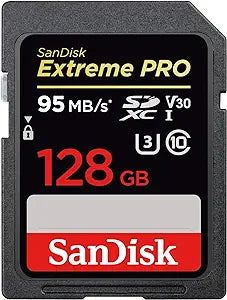
SanDisk SDSDXXG-128G-GN4IN 128GB Extreme PRO SDXC UHS-I Card
4KUHD
95MB/s reads and V30 video speed class make this 128GB card the practical ceiling for UHS-I SD performance in 4K shooting workflows.
$79.99*
Check availability
*Price sourced from Amazon.com. Last updated:Sep 07, 2026.Price and availability are subject to change — details.
Affiliate Disclosure: As an Amazon Associate, Studio Supplies earns from qualifying purchases made through links on this page, at no additional cost to you. This helps support our editorial team.
Notice a mistake? Let Us Know
Overview
Key Features
Ideal for professionals looking to maximize post-production workflow
Read speeds of up to 95MB/s; write speeds of up to 90MB/s
UHS speed Class 3 (U3) and UHS video speed Class 30 (V30) for 4K UHD video
Shock-proof, temperature-proof, waterproof, and x-ray-proof
Lifetime limited Warranty
Specifications
Capacity
128GB
Card Type
SDXC
Read Speed
Up to 95MB/s
Write Speed
Up to 90MB/s
UHS Speed Class
U3
UHS Video Speed Class
V30
Video Resolution Support
4K UHD
Durability Features
Shock-proof, temperature-proof, waterproof, x-ray-proof
Warranty
Lifetime limited Warranty
Frequently Asked Questions
Does this card support 4K UHD video recording without frame drops?
Yes — the V30 (Video Speed Class 30) rating guarantees a minimum sustained write speed of 30MB/s, which is the threshold 4K UHD video recording requires to prevent buffer drops at typical bitrates. The card's rated 90MB/s write speed provides considerable headroom above that floor.
What's the practical difference between UHS-I and UHS-II for a working photographer?
UHS-I operates on a single-row pin interface with a theoretical maximum of 104MB/s; UHS-II doubles the interface with a second row and can exceed 300MB/s. This card runs at UHS-I speeds, meaning cameras with UHS-II slots will operate it at UHS-I speeds — functional, but not extracting full UHS-II capability. If your camera is UHS-I-only, this card is at or near the interface ceiling.
How does the 95MB/s read speed affect post-production workflow?
Read speed determines how fast files transfer from card to workstation. At 95MB/s, a full 128GB card transfers in roughly 22-23 minutes via a USB 3.0 reader. UHS-II readers or USB-C readers won't accelerate this card beyond its UHS-I ceiling, so pairing it with a fast card reader matters only to the point of matching UHS-I bandwidth.
Is the environmental durability rating (waterproof, shockproof, etc.) meaningful for field use?
SanDisk's durability claims are tested to defined standards — waterproofing covers immersion up to a specified depth, shockproofing covers drop heights, and X-ray protection covers airport security equipment. These aren't marketing qualifiers; they represent real-world scenarios the card has been validated against, making this a reasonable choice for outdoor and travel shooting.
What RAID or backup strategy is recommended given the card's 128GB capacity?
128GB at high-resolution RAW or 4K video fills faster than photographers expect — roughly 1,000-1,300 RAW files from a 24MP camera, or 45-60 minutes of 4K footage at 100Mbps. The lifetime limited warranty covers manufacturing defects but not data recovery. Dual-slot cameras shooting to two cards simultaneously remain the safest field redundancy strategy.
Related Products


