
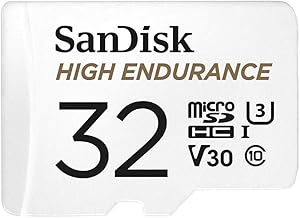
SanDisk High Endurance microSD (SDSQQNR, 32GB-256GB) — Editorial Review & Use Cases
The SanDisk High Endurance microSD family (SDSQQNR SKU prefix — 32GB, 64GB, 128GB, 256GB) is SanDisk's purpose-built card for continuous-recording workloads: dash cams, home security cameras, body cams, trail cams, and baby monitors. Per Western Digital's official SanDisk High Endurance product page, the line is rated for thousands of hours of continuous 4K / Full HD recording — far beyond standard Ultra / Extreme microSD cards, which are designed for intermittent photo / occasional-video write patterns and degrade quickly under 24/7 loop recording. Class 10, U3, V30 rated, up to 100 MB/s read / 40 MB/s write, with a warranty measured in recording hours.
What SanDisk High Endurance Specifically Wins
- Engineered for continuous loop-recording write cycles — dash cams + security cameras overwrite the card thousands of times. Standard Ultra / Extreme cards aren't rated for this and fail prematurely (corrupted footage, dead card). High Endurance is built for it
- Rated in recording hours, not just capacity — e.g., the 128GB is rated for ~10,000+ hours of Full HD recording (per SanDisk spec; varies by capacity + resolution)
- U3 / V30 sustained write (40 MB/s) — sufficient for 4K dash cam + multi-stream security camera recording without dropped frames
- Temperature + shock + water + X-ray resistant — survives the harsh thermal cycling of a car dashboard (hot summers, cold winters)
- SanDisk reliability + warranty — vs no-name cards that fail silently + lose critical footage (the whole point of a dash cam is failed when you need it)
- Wide device compatibility — dash cams (Nextbase, Garmin, Viofo, Rexing), security cams (Wyze, Blink, Ring, Eufy, Arlo), trail cams, body cams, baby monitors
- 32GB to 256GB capacity — match to recording resolution + retention window
Where SanDisk High Endurance Specifically Fits
- Dash cams (Nextbase, Garmin Dash Cam, Viofo A129/A139, Rexing V1) — the primary use case
- Home security cameras (Wyze Cam, Blink, Ring Stick Up Cam, Eufy, Arlo with SD slot)
- Trail / wildlife cameras — continuous motion-triggered recording
- Body cams for security personnel / cyclists
- Baby monitors with continuous recording
- Doorbell cameras with local SD storage
- Fleet / commercial vehicle dash cams
- Drone continuous-recording (where high write endurance matters)
- 24/7 monitoring / surveillance NVR-to-SD setups
- Time-lapse photography rigs with frequent writes
Honest Limits Buyers Should Know
- NOT for action cameras / drones needing peak speed. 40 MB/s write is sufficient for dash cam / security but slower than Extreme (90 MB/s) / Extreme PRO (140 MB/s) for high-bitrate action camera (GoPro / DJI) 4K/5.3K recording. For GoPro/DJI use Extreme / Extreme PRO microSD
- Read speed (100 MB/s) is mid-tier. Fine for playback / offload; not the fastest for large-file transfer to a computer
- Max-rated hours are at Full HD — 4K recording consumes the endurance budget faster. A card rated 10,000 hours at 1080p records fewer hours at 4K. Plan capacity + replacement accordingly
- Still wears out eventually. "High Endurance" ≠ infinite. Even these cards have a finite write cycle; replace every 1-2 years in 24/7 dash cam use, or when the device reports card errors
- Verify device max card capacity. Some older dash cams cap at 32GB or 128GB. Check the device spec before buying 256GB
- Not the cheapest microSD. Costs more than standard Ultra (commodity) but far cheaper than replacing failed cards + lost footage. The premium is insurance for continuous-recording reliability
- Format in-device, not on computer. Dash cams + security cams have specific formatting requirements; format the card IN the device (not via Windows / Mac) for proper file system + loop recording setup
- Counterfeit risk on third-party marketplaces. Buy from Amazon Direct, B&H, Best Buy, SanDisk direct — counterfeit High Endurance cards (relabeled standard cards) fail under continuous recording
- Not for general phone / tablet / Switch use. Overkill + slower read than Ultra for those use cases; use Ultra / Extreme microSD instead
- Periodic health checks recommended. Continuous-recording cards should be checked periodically (review footage integrity) — a silently-failing card defeats the purpose
Where Buyers Should Look Elsewhere
- Maximum endurance (industrial / commercial fleet) → SanDisk Max Endurance microSD (even higher write-cycle rating than High Endurance)
- Action cameras (GoPro / DJI / Insta360) high-bitrate 4K/5.3K → SanDisk Extreme / Extreme PRO microSD (see [[pdp-sandisk-extreme-1tb-microsd-review]])
- Nintendo Switch / Steam Deck gaming → SanDisk Extreme microSD / Nintendo Switch licensed
- General phone / tablet storage → SanDisk Ultra microSD (cheaper, faster read) — see [[pdp-sandisk-ultra-microsd-vs-extreme]]
- Camera SD (full-size) → SanDisk Extreme PRO SDXC (see [[pdp-sandisk-extreme-pro-sdxc-family-review]])
- Cloud-recording security cameras → cameras with subscription cloud storage (no SD card needed) — Ring Protect, Nest Aware
- NVR-based surveillance → dedicated surveillance HDD (Seagate SkyHawk, WD Purple) in an NVR instead of per-camera SD
Sources & Citations
- Western Digital (SanDisk), "High Endurance UHS-I microSD product page," westerndigital.com (accessed 2026-05-20)
- Tom's Hardware, "High-endurance microSD for dash cams + security coverage," tomshardware.com (accessed 2026-05-20)
- The Wirecutter (NYT), "Best dash cam + microSD buying guide," nytimes.com/wirecutter (accessed 2026-05-20)
- AnandTech, "microSD endurance + flash memory write-cycle coverage," anandtech.com (accessed 2026-05-20)
Last verified: 2026-05-20

