
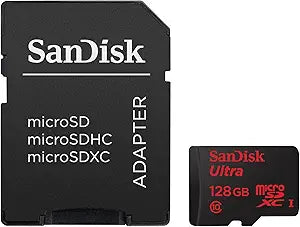
SanDisk Ultra microSD vs Extreme — Which Tier Do You Need?
The SanDisk Ultra microSD (SDSQUAR-032G-GN6MA family) is SanDisk's value-tier microSD line — positioned below the Extreme microSDXC family covered separately on the Studio Supplies homepage. Per SanDisk / Western Digital's official Ultra microSD product page, the Ultra line is rated for read speeds up to 120 MB/s (vs the Extreme's 160-190 MB/s), Class 10 / UHS-I U1 (vs Extreme's V30 U3 + A2), and is positioned for budget Android smartphones, Full HD video capture, 4K-streaming-but-not-record use cases. The Ultra is one of the highest-volume products on Amazon — over 640K customer reviews on the 32 GB SKU alone — making it a critical capacity-tier decision for any microSD buyer.
Ultra vs Extreme — The Speed Class Difference
Per Camera Memory Speed's microSD speed-class methodology, the practical impact of Ultra-vs-Extreme is dictated by the workload:
- Full HD 1080p video recording: Both Ultra (Class 10 / UHS-I U1) and Extreme (V30) handle this comfortably. Ultra is sufficient.
- 4K video recording: The Ultra (U1) is below the V30 sustained-write requirement for many 4K cameras. The Extreme (V30) is the minimum tier; some 6K / 8K cameras require V60 / V90 (Extreme PRO).
- Random-access app performance (Android adoptable storage, Steam Deck): A2 (Extreme) accelerates random IOPS for app loads versus A1 (most Ultra). The A1 / A2 difference is meaningful for high-app-count phones / handheld gaming devices.
- Photo burst capture: Both tiers handle JPEG and small-RAW burst; the Extreme's higher sustained write reduces buffer-clear time on cameras shooting large RAW bursts.
- Steady-state Switch / Steam Deck game capture: Both work; the Extreme's faster random reads slightly reduce game-load times.
Where the Ultra Specifically Wins
- Budget Android smartphones needing expandable storage without demanding 4K-video-record capability
- Dash cams recording Full HD continuously — the Ultra's Class 10 sustained write is sufficient and the lower price tier matches dash-cam-replacement budgets
- Security cameras (1080p) writing 24/7 footage — Ultra is the appropriate tier; high-endurance variants (SanDisk High Endurance) are even better for this use case
- Bulk file transfer / archive use — when raw capacity per dollar matters more than peak speed
- Casual photographers shooting in JPEG + occasional 1080p video on consumer point-and-shoot cameras
- 2-pack / multi-pack archival deployments — the Ultra ships in cost-effective multi-packs (the 32 GB 2-pack at SDSQUAR-032G-GN6MT is a high-volume SKU)
Where Buyers Should Step Up to the Extreme
- 4K video capture on GoPro HERO / DJI drones / mirrorless cameras → Extreme (V30 minimum)
- Nintendo Switch + Steam Deck game-load performance → Extreme (A2 random IOPS)
- Modern Android phones with adopted-storage / app-heavy use → Extreme (A2)
- Drone aerial recording with peak performance bursts → Extreme (V30 sustained write)
- Pro mirrorless / cinema cameras requiring V60 / V90 → Extreme PRO (different product line — higher tier than Extreme)
Honest Limits Buyers Should Know
- Per Camera Memory Speed's methodology, Ultra's 120 MB/s rated read is sequential-optimized; random-access workloads where A1 vs A2 matters (Android Adoptable Storage, Switch / Steam Deck game loads) deliver materially slower performance than the Extreme's A2 tier
- UHS-I U1 sustained write floor is 10 MB/s — sufficient for Full HD video but inadequate for any 4K recording where V30 (30 MB/s sustained) is the minimum
- Card-warranty is lifetime per SanDisk policy, but with a Class-10 sustained-write spec lower than Extreme; cards used in continuous-record applications (security cameras) will reach wear-out faster than purpose-built high-endurance variants
- 2-TB capacity is not available in the Ultra line — Ultra tops out at lower capacities; high-capacity buyers needing 1 TB+ should step to Extreme variants where 1 TB is the production ceiling
Sources & Citations
- SanDisk / Western Digital, "SanDisk Ultra UHS-I microSD product page," westerndigital.com (accessed 2026-05-18)
- Camera Memory Speed, "microSD speed-class testing methodology and product reviews," cameramemoryspeed.com (accessed 2026-05-18)
- Nintendo Support, "microSD Cards FAQ — Nintendo Switch," en-americas-support.nintendo.com (accessed 2026-05-18)
Last verified: 2026-05-18

