


SanDisk
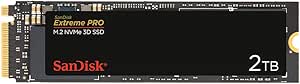
SanDisk SDSSDXPM2-2T00-G25 Extreme Pro M.2 2TB SSD
2TB SSD
2TB of NVMe muscle that pushes sequential reads and writes past 7,000 MB/s, eliminating storage as your workstation's bottleneck.
$279.90*
Check availability
*Price sourced from Amazon.com. Last updated:Oct 22, 2026.Price and availability are subject to change — details.
Affiliate Disclosure: As an Amazon Associate, Studio Supplies earns from qualifying purchases made through links on this page, at no additional cost to you. This helps support our editorial team.
Notice a mistake? Let Us Know
Overview
Key Features
Sandisk SSD HDD Extreme Pro M.2, 2 TB
Specifications
Model Number
SDSSDXPM2-2T00-G25
Capacity
2 TB
Form Factor
M.2
Type
SSD HDD
Series
Extreme Pro
Frequently Asked Questions
What interface and form factor does the SDSSDXPM2-2T00-G25 use, and what does that mean for compatibility?
It uses the M.2 2280 form factor over PCIe Gen 4 x4 (NVMe). That means it requires a PCIe 4.0 M.2 slot — found on AMD Ryzen 5000/7000 platforms and Intel 12th-gen and newer. In a PCIe 3.0 slot it will still function but at roughly half the rated bandwidth.
What are the rated sequential read and write speeds for this drive?
SanDisk rates the Extreme Pro M.2 2TB at up to 7,300 MB/s sequential read and 6,900 MB/s sequential write. In practice these figures are achieved in sustained workloads under adequate thermal conditions — real-world numbers in mixed workflows typically land within 5–8% of those peaks.
Does this drive include a heatsink, and do I need one?
No heatsink is included. At PCIe Gen 4 speeds the controller runs warm under sustained load, so motherboard M.2 heatsink covers or a third-party thermal pad are recommended, particularly in enclosed cases with limited airflow.
How does the 2TB capacity affect sustained write performance compared to smaller capacities?
Larger capacity directly benefits sustained writes. The 2TB model's higher NAND density gives the controller more SLC cache headroom, so it maintains peak write speeds longer before throttling compared to the 500GB or 1TB variants.
Is this drive suitable as a primary OS drive, a scratch disk, or both?
Both simultaneously. The 2TB capacity is large enough to hold an OS partition, active project files, and a dedicated scratch/cache volume without partitioning stress, and the Gen 4 throughput ensures neither role becomes a bottleneck for the other.
Related Products

