



Seagate
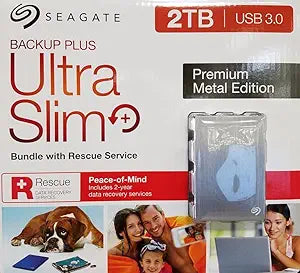
Seagate Backup Plus Portable 2TB USB 3.0 Drive
Two terabytes of portable backup over USB 3.0 with AES 256-bit hardware encryption — the Seagate Backup Plus puts serious capacity in a pocket-sized form factor.
$99.98*
Check availability
*Price sourced from Amazon.com. Last updated:Oct 21, 2026.Price and availability are subject to change — details.
Affiliate Disclosure: As an Amazon Associate, Studio Supplies earns from qualifying purchases made through links on this page, at no additional cost to you. This helps support our editorial team.
Notice a mistake? Let Us Know
Overview
Specifications
Capacity
2TB
Interface
USB 3.0
Form Factor
2.5-inch portable
Power
Bus-powered (USB, no adapter required)
Encryption
AES 256-bit with password protection
Factory Format
NTFS (Windows)
Brand
Seagate
Model
Backup Plus Portable
Frequently Asked Questions
What are the real-world USB 3.0 transfer speeds for this drive, and what interface bottleneck should I expect?
USB 3.0 tops out at 5 Gbps theoretical, and the Backup Plus Portable's spinning platter mechanism is the actual bottleneck — expect sequential read speeds of 120–130 MB/s and writes in the 100–120 MB/s range under ideal conditions. USB 3.0's bandwidth is not the limiting factor here; the 5,400 RPM HDD mechanism is. On a USB 2.0 port you'll see that drop to 25–40 MB/s.
Does the Seagate Backup Plus 2TB require an external power source?
No — the drive is bus-powered via USB, drawing power directly from the host port. It works with standard USB 3.0 and USB 2.0 ports without a separate power adapter. Some older or lower-power USB hubs may not supply adequate current — if the drive fails to mount, try connecting directly to a USB port on the computer rather than through a hub.
What is the real-world transfer speed over USB 3.0, and how does it compare to USB 2.0?
USB 3.0 provides a theoretical 5Gbps bandwidth ceiling. The actual throughput of this portable hard drive is limited by the spinning 2.5-inch platter inside — typical sequential read/write speeds for 2.5-inch 5400RPM HDDs are 100-130MB/s. USB 2.0 caps at 480Mbps (roughly 60MB/s peak), so USB 3.0 fully removes the interface as a bottleneck, letting the drive run near its mechanical ceiling.
Does the drive require an external power source, or is it fully bus-powered via USB?
The Backup Plus Portable is fully bus-powered from a single USB connection — no AC adapter required. This is standard for 2.5-inch portable HDDs at 2TB capacity. One edge case: on older laptops or USB hubs with marginal power delivery, the drive may fail to spin up reliably. Use a direct USB port connection, not a passive hub, if you encounter spin-up issues.
What is the AES-256 encryption implementation — hardware or software-based, and does it work across operating systems?
The product listing describes AES-256-bit encryption with password protection. Seagate's portable drive encryption is typically implemented via their Seagate Toolkit software rather than a hardware encryption chip. This means encryption functionality is OS-dependent — verify cross-platform support if you intend to access encrypted data on both Windows and macOS without reinstalling the software.
How does the AES 256-bit encryption work — is it always on or optional?
The AES 256-bit encryption with password protection is a software-managed feature — when enabled through the included software, the drive requires a password before mounting. If you haven't set up password protection, the drive mounts without it. Note that hardware-encrypted drives require their management software on the host system to authenticate; losing the password means losing access to encrypted data.
Is this drive compatible with both Windows and Mac?
The Seagate Backup Plus is formatted for Windows (NTFS) from the factory. It will work on Mac after reformatting the drive to exFAT or Mac OS Extended, though reformatting erases all existing data. Seagate also provides Mac-compatible firmware/software that can make the drive function cross-platform in some configurations.
Is this drive formatted out of the box for Windows or macOS, and what file system does it use?
Seagate portable drives typically ship formatted as exFAT or NTFS depending on configuration. If formatted NTFS, macOS can read but not natively write to the drive without third-party drivers. ReFormat to exFAT for native read/write compatibility across Windows and macOS without additional software.
What is the physical shock tolerance of this drive, and is it suitable for regular travel in a backpack?
The Backup Plus Portable uses a 2.5-inch spinning platter mechanism, which has lower shock tolerance than an SSD — physical impact while the drive is spinning (actively reading/writing) carries a real risk of data loss or head crash. It is suitable for regular travel when transported powered off and in a padded pocket, but do not confuse its portable form factor with ruggedness. Avoid operating it while walking or in vibration-heavy environments.
Can this drive survive being transported daily in a bag, and how durable is it?
As a 2.5-inch portable HDD, the Backup Plus is designed for portable use and features a degree of shock resistance during travel when the drive is not actively spinning. However, it contains spinning magnetic platters — it is not rated for drop protection like SSD-based alternatives. Avoid impacts and jostling while the drive is actively reading or writing data.
Related Products
