

Seagate
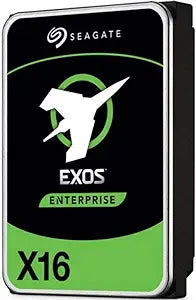
Seagate Exos X16 14TB Internal Hard Drive SATA III
The Seagate Exos X16 14TB packs enterprise-class helium-sealed reliability and SATA III throughput into a 3.5" drive engineered for continuous, high-density storage workloads.
$190.91*$205.00Save 6%
Check availability
*Price sourced from Amazon.com. Last updated:Oct 23, 2026.Price and availability are subject to change — details.
Affiliate Disclosure: As an Amazon Associate, Studio Supplies earns from qualifying purchases made through links on this page, at no additional cost to you. This helps support our editorial team.
Notice a mistake? Let Us Know
Overview
Key Features
Large Storage Capacity: 14TB internal hard drive provides ample digital storage capacity for your desktop computer.
Fast Data Transfer: SATA III interface enables high-speed data transfer for quick file sharing and loading.
Durable and Reliable: Seagate Exos X16 hard drive uses advanced mechanical design for long-lasting performance.
Compact and Portable: 3.5-inch form factor allows for easy installation in your desktop computer.
Easy Setup: Pre-installed Seagate software makes setting up and managing your hard drive simple and straightforward.
Specifications
Capacity
14TB
Interface
SATA III (6 Gbps)
Form Factor
3.5 inches
Recording Technology
CMR (Conventional Magnetic Recording)
RPM
7200
Sustained Data Transfer Rate
~261 MB/s (sequential)
Workload Rating
550TB/year
MTBF
2.5 million hours
Model
ST14000NM001G
Brand
Seagate
Frequently Asked Questions
What is the sustained sequential read/write speed of the Exos X16 14TB on a SATA III connection?
The Seagate Exos X16 is rated for sustained data transfer rates of approximately 261 MB/s sequential read, which is competitive for a high-capacity CMR hard drive and sits near the SATA III effective ceiling for spinning media. This is the throughput you'll see during large sequential reads — streaming video archives or large backup jobs — rather than random I/O, where the spinning mechanism's seek time becomes the bottleneck.
Is the Seagate Exos X16 14TB designed for consumer desktops or enterprise/NAS environments?
The Exos X16 is an enterprise-class drive built for 24/7 operation in servers, NAS enclosures, and data centers. It is rated for 550TB/year workload — roughly 10x the duty cycle of a consumer desktop drive. It will work in a consumer desktop, but it's sized and priced for environments that demand continuous uptime and high write volumes.
What interface does the Exos X16 use, and how does it connect to a standard desktop?
The ST14000NM001G uses a standard SATA III (6Gb/s) interface with a 3.5" form factor. It connects directly to any desktop motherboard or NAS unit with a SATA III port and 3.5" drive bay — no adapters required. Maximum sustained transfer rate from the drive itself is typically in the 250–260MB/s range, which is the mechanical bottleneck, not the SATA interface.
Is the Exos X16 compatible with consumer desktop motherboards and NAS enclosures, or does it require enterprise hardware?
The SATA III interface is a universal standard — the Exos X16 14TB is electrically and mechanically compatible with any consumer desktop motherboard or NAS enclosure that has a 3.5-inch SATA III bay. Enterprise origin does not impose hardware requirements. Some NAS-specific models include firmware optimizations for RAID environments; verify model suffix (NM001G for standard SATA) against your NAS compatibility list if running vibration-heavy multi-drive configurations.
Does the Exos X16 use CMR (conventional magnetic recording) or SMR (shingled magnetic recording)?
The Exos X16 uses CMR (Conventional Magnetic Recording) — not SMR. This is a critical distinction for NAS and RAID use: SMR drives are slow and unreliable during RAID rebuilds due to rewrite zone management overhead. CMR provides consistent write performance throughout the drive's capacity, which is the correct specification for any parity RAID array or high-write workload.
Does this drive use CMR or SMR recording technology?
The Exos X16 uses Conventional Magnetic Recording (CMR). CMR delivers predictable, consistent write performance under sustained load — unlike SMR (Shingled Magnetic Recording), which throttles write speeds during cache overflow. For NAS RAID arrays, media servers, and write-intensive workflows, CMR is the appropriate choice.
What is the rated MTBF, and how does that translate to real-world reliability expectations?
Seagate rates the Exos X16 at 2,500,000 hours MTBF (Mean Time Between Failures) — a statistical measure indicating this class of drive is engineered for years of continuous operation. This does not mean individual drives never fail, but the Exos X16 has a significantly lower annualized failure rate than consumer drives in data center tracking studies.
What is the rated MTBF and workload rating for this drive, and what does that mean for real-world reliability?
The Seagate Exos X16 is rated for a 2.5 million-hour MTBF and a 550TB/year workload rating. The workload rating is particularly meaningful: consumer NAS-grade drives (Red, IronWolf) are typically rated at 180–300TB/year, while the Exos's 550TB/year rating means it can absorb roughly twice the write workload without operating outside its design envelope — directly relevant for media servers, backup targets, and surveillance storage under continuous write load.
Is the pre-installed Seagate software referenced in the listing a meaningful tool, or can it be ignored?
Seagate's included utility (typically SeaTools or Seagate Toolkit) provides drive health diagnostics and basic management. For enterprise or NAS deployments, it is largely superseded by the NAS OS's built-in drive management tools or direct S.M.A.R.T. monitoring via third-party software. The utility is optional — the drive functions completely without it installed.
Does the Exos X16 run hotter or louder than a standard desktop drive?
Yes on both counts — enterprise drives generate more heat than consumer-class drives under sustained load, and the Exos X16 is audible during heavy read/write activity. Ensure adequate chassis airflow in any enclosure. It is not a silent drive for a quiet home environment but operates within expected parameters for enterprise hardware.
Related Products
