Shure

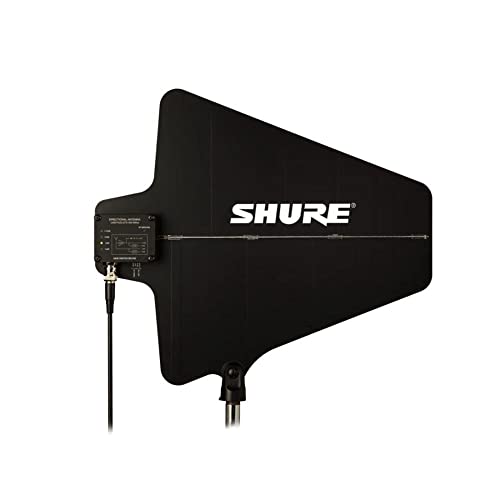
Shure UA874WB Active Directional Antenna Wideband

A single wideband active antenna that blankets 470–900 MHz, eliminating the need for separate antennas across every Shure wireless system generation in your rack.

$450.00*
In Stock on Amazon.com
View on Amazon

*Price sourced from Amazon.com. Last updated:Jul 14, 2026.Price and availability are subject to change.

Affiliate Disclosure: Studio Supplies may earn a commission from qualifying purchases made through links on this page, at no additional cost to you. This helps support our editorial team.

Notice a mistake? Let Us Know

Overview

The Shure UA874WB is a wideband active directional antenna engineered for professional wireless microphone system deployments. Its 470–900 MHz frequency range is the specification that defines its value proposition: rather than purchasing separate antennas tuned to specific frequency bands as systems are added to a rig, the UA874WB operates across the entire practical UHF wireless microphone spectrum in a single unit. The "active" designation means the antenna incorporates an internal low-noise amplifier that provides gain to compensate for coaxial cable attenuation — a critical feature in any installation where the antenna must be positioned 50 or more feet from the receiver rack, which is standard practice in theatrical, house-of-worship, and live touring environments. Power is delivered via bias voltage through the signal coax, eliminating an additional cable run to the antenna position.

In practice, the UA874WB is deployed in pairs — one covering stage left, one stage right — and fed into a Shure UA221 or UA845 antenna distribution system that splits the signal to multiple receivers. This architecture allows a two-antenna investment to serve an entire multi-channel wireless rig, with directional rejection providing meaningful RF interference suppression in the crowded 470–900 MHz spectrum. The helical directional design requires deliberate aiming toward the transmitter coverage zone, which demands more physical installation care than a passive omnidirectional paddle but returns a noticeably cleaner RF environment as a result. This antenna is the correct solution for any professional who has outgrown omnidirectional antennas and needs reliable multi-receiver performance in a challenging RF environment.

Key Features

UA874WB Wideband Antenna

Specifications

Model
Shure UA874WB
Type
Active Directional Antenna
Frequency Range
470–900 MHz
Antenna Design
Helical directional
Amplification
Active (integrated LNA)
Power Source
Bias voltage via coax (from receiver or distribution unit)
Compatible Systems
Shure ULXD, UR4, AXIENT Digital, UHF-R, BLX (within frequency range)
Distribution Compatibility
UA221, UA845

Pros & Cons

👍 Pros

  • 470–900 MHz wideband coverage eliminates the need for multiple frequency-specific antennas across different Shure wireless system generations in a shared rack.
  • Integrated LNA compensates for coax cable signal loss, maintaining usable RF signal levels across long cable runs that would attenuate a passive antenna's output below receivable thresholds.
  • Directional helical design rejects off-axis RF interference, improving signal-to-noise ratio in RF-congested venues compared to omnidirectional paddle antennas.
  • Bias-tee power via coax eliminates the need for a separate power cable, simplifying cable management in tight rack and stage deployments.
  • Compatible with Shure's UA221 and UA845 distribution systems, enabling a single antenna to feed an entire multi-receiver wireless microphone rig.

👎 Cons

  • Directional beamwidth requires precise physical aiming — small misalignment in large venues can create coverage shadows that a wider omnidirectional antenna would not produce.
  • Bias voltage dependency means the antenna is non-functional if connected to a receiver or distribution unit that does not supply the correct bias current, with no visual failure indicator.
  • The helical form factor is bulkier and less discrete than a standard paddle antenna, creating mounting challenges on crowded stage or truss structures with limited clearance.
  • Wideband coverage from 470–900 MHz does not extend to 2.4 GHz GLXD or UHF+ systems outside that range — not a universal solution for mixed-generation wireless deployments including newer digital systems.
  • No gain specification is published in the consumer-facing listing, making it difficult to calculate system link budget and cable loss tolerance without consulting Shure's technical documentation directly.

Frequently Asked Questions

The UA874WB covers 470–900 MHz, making it compatible with Shure's ULXD, UR4, BLX, GLXD (2.4 GHz excluded), AXIENT Digital, and older UHF-R systems that operate within that frequency window. The wideband design means a single antenna covers most modern Shure RF deployments without frequency-specific hardware.
Active means the UA874WB contains an integrated low-noise amplifier (LNA) that boosts received RF signal before it travels down the coax cable to the receiver. This compensates for cable loss — critical when you're running 50+ feet of coax in a venue antenna distribution setup. Passive antennas lose signal with cable length; active antennas maintain signal integrity across that run.
Yes. The antenna is powered via bias voltage supplied through the coax cable from a compatible Shure receiver or antenna distribution unit (such as the UA221 or UA845). No separate power supply or cable is required — the signal path and power path share the same coax.
The UA874WB uses a helical directional design with a relatively narrow beamwidth. It should be aimed at the performing area or the zone where transmitters will be active. In large venues, a two-antenna configuration — one per side of stage — provides full coverage with overlap at center stage for redundancy.
Yes. The UA874WB is designed to feed into Shure's UA221 passive splitter or UA845 active distribution amplifier, allowing a single antenna to serve up to four or eight receivers simultaneously. This is the standard deployment model in multi-channel live sound and broadcast environments.