



Synology
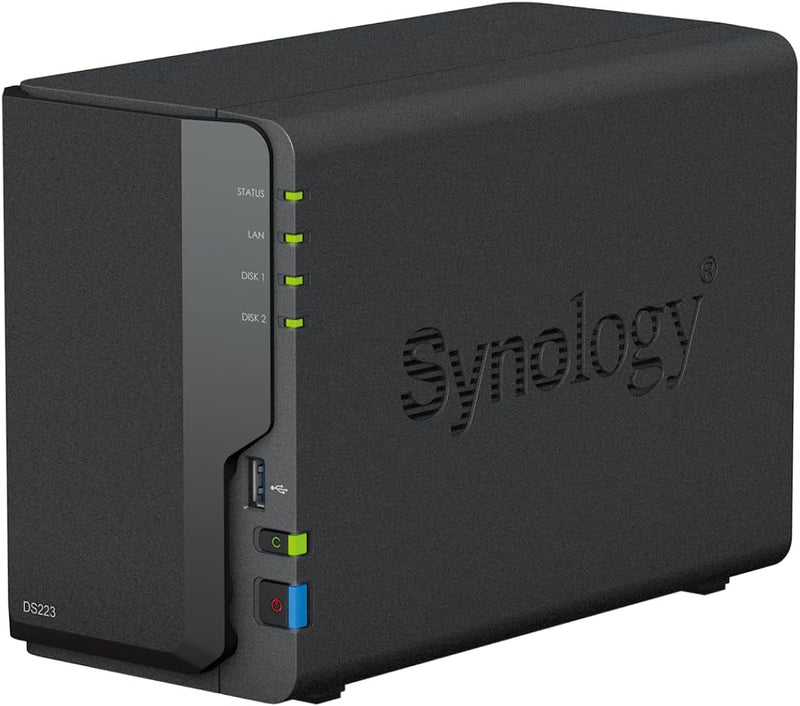
Synology DS223 DiskStation 2-Bay NAS
★★★★★
2 GB DDR42GB RAMUSB 3.2
A quad-core NAS that turns two drives into your own private cloud — fast enough for home streaming, solid enough for small office backup.
$310.38*
Check availability
*Price sourced from Amazon.com. Last updated:Jun 21, 2026.Price and availability are subject to change.
Affiliate Disclosure: Studio Supplies may earn a commission from qualifying purchases made through links on this page, at no additional cost to you. This helps support our editorial team.
Notice a mistake? Let Us Know
Overview
Key Features
CPU Model Realtek RTD1619B 4-core 1.7 GHz
System Memory 2 GB DDR4 non-ECC
1x RJ-45 1GbE LAN-Port, 3x USB 3.2 Gen 1 Port
Data management platform for home and small office
Synology DS223, 2GB RAM, 1x Gb LAN
Specifications
CPU
Realtek RTD1619B, 4-core, 1.7 GHz
System Memory
2 GB DDR4 non-ECC (not expandable)
Drive Bays
2
LAN Port
1x RJ-45 1GbE
USB Ports
3x USB 3.2 Gen 1
Form Factor
Desktop NAS
Pros & Cons
👍 Pros
- The Realtek RTD1619B quad-core processor handles concurrent users and background tasks — transcoding, backup jobs, and package services — without the sluggishness common in cheaper single or dual-core NAS units.
- DSM's software ecosystem is mature and well-documented, with packages for Plex, surveillance, cloud sync, and backup tools that extend the hardware's usefulness well beyond simple file storage.
- Three USB 3.2 Gen 1 ports allow direct attachment of external drives for one-time migration, local backup, or UPS communication.
- 2 GB DDR4 is adequate for the DS223's target workload — home media serving and small-office file sharing — without the cost overhead of ECC memory a larger deployment would require.
- Synology's track record for long-term DSM updates means the DS223 is likely to receive software support and security patches well beyond its physical lifespan.
👎 Cons
- The non-ECC RAM means single-bit memory errors won't be detected or corrected — acceptable for a home NAS but worth noting if data integrity under heavy sustained load is a priority.
- A single 1GbE port limits peak throughput and offers no link aggregation or failover redundancy without a network switch investment.
- Two bays cap your expansion path — when both slots are full, growing storage requires replacing existing drives rather than adding new ones.
- 2 GB of non-expandable RAM becomes a meaningful constraint if you run several DSM packages simultaneously (Plex transcoding, surveillance, active sync jobs all competing for the same pool).
- No built-in 2.5GbE or 10GbE — buyers who already have a faster network switch cannot take advantage of that infrastructure.
Frequently Asked Questions
What drives are compatible with the DS223, and how much raw storage can it hold?
The DS223 accepts two 3.5-inch SATA HDDs or 2.5-inch SSDs — Synology's compatibility list is the authoritative source, but most major WD, Seagate, and Toshiba NAS-grade drives are supported. Maximum usable capacity depends on drive size; in a mirrored (RAID 1) configuration you get the capacity of one drive as protected storage.
Can the DS223's RAM be upgraded beyond the stock 2 GB?
No — the 2 GB DDR4 is soldered to the board and cannot be expanded. For most home and light small-office workloads this is sufficient, but it is a ceiling worth understanding if you plan to run many Synology packages simultaneously.
Does the single 1GbE port create a bottleneck for file transfers?
Yes, for sequential throughput: 1GbE caps theoretical transfer speed at ~125 MB/s, which in practice means real-world speeds of 80–110 MB/s depending on drive configuration. For streaming media or routine backup this is plenty; for large-scale daily video ingest it is the primary constraint.
What operating system does the DS223 run, and how is it managed?
It runs Synology's DiskStation Manager (DSM) — a browser-based OS with a desktop-style interface. Management is handled entirely through a web browser; no client software is required for basic administration.
Is the DS223 compatible with Time Machine for Mac backups?
Yes — DSM supports Apple Time Machine natively as a backup destination, making it straightforward to set up automatic Mac backups over your local network.
Related Products


