



Thermaltake
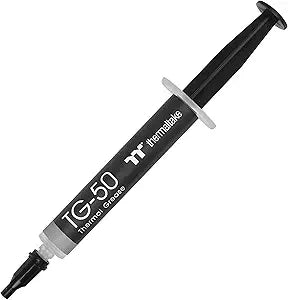
Thermaltake CL-O024-GROSGM-A TG-50 High-Performance CPU/GPU Thermal Compound
Diamond-powder thermal conductivity at 8.0 W/m·K, a stencil for consistent coverage, and a full cleaning kit make the TG-50 a complete installation solution, not just a paste.
View price on Amazon
Affiliate Disclosure: As an Amazon Associate, Studio Supplies earns from qualifying purchases made through links on this page, at no additional cost to you. This helps support our editorial team.
Notice a mistake? Let Us Know
Overview
Key Features
[High Performance] Contains diamond powder for higher heat transfer providing a thermal conductivity of 8.0 W/m-k.
[All-In-One Application Kit] Includes tools to clean, prep, and install fresh thermal compound to your hardware.
[Easy to Apply] Specially formulated to easily spread over the included honeycomb stencil for consistent compound application, providing a neat and well-covered CPU.
[Sustainability and Safety] The TG-50 is a non-electrically conductive compound eliminating risk of short circuit and offers a longer lifespan minimizing dry-out or cracking.
Specifications
Brand
Thermaltake
Model
CL-O024-GROSGM-A (TG-50)
Thermal Conductivity
8.0 W/m·K
Thermal Impedance
0.035°C·in²/W
Viscosity
47 Pa·s
Density
2.9 g/cm³
Net Weight
4g
Color
Gray
Electrically Conductive
No
Included Accessories
Honeycomb stencil, cleaning tools
Frequently Asked Questions
What does 8.0 W/m·K thermal conductivity mean compared to typical budget compounds?
Budget compounds commonly rate between 3.5–6.0 W/m·K. The TG-50's 8.0 W/m·K rating — achieved via diamond powder filler — transfers heat more efficiently across the interface layer, which translates to lower steady-state CPU temperatures under sustained load compared to lower-conductivity pastes.
Is the TG-50 electrically conductive? What happens if it contacts motherboard traces?
No — the TG-50 is explicitly non-electrically conductive. Accidental overspread onto capacitors or VRM components adjacent to the CPU socket will not cause a short circuit, making it safer to apply than metallic (liquid metal) compounds.
What does the honeycomb stencil do and how does it affect coverage consistency?
The stencil masks the CPU IHS and guides compound spread into a uniform layer across the heat spreader surface. This eliminates the guesswork of dot/line/spread methods and ensures consistent coverage — particularly useful for large IHS surfaces on HEDT or server CPUs where manual spread often leaves uncovered areas.
How much compound is in the package and how many applications does 4g cover?
At 4 grams total weight, the TG-50 provides enough material for approximately 4–8 standard desktop CPU applications depending on die size, with larger HEDT/server IHS surfaces consuming more per application. The included stencil helps minimize waste.
Does the TG-50 dry out or crack over time and how does that affect CPU temperatures?
Thermaltake specifies the TG-50 resists dry-out and cracking over its service life — these degradation modes are the primary cause of thermal interface performance loss over time. A compound that cracks creates microscopic air pockets at the interface, significantly increasing thermal resistance. The TG-50's formulation is engineered to maintain contact integrity across thermal cycles.
Related Products


