TP-Link

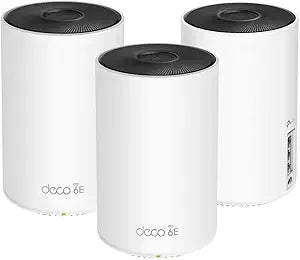
TP-Link DECO AXE5300 Wi-Fi 6E Tri-Band Mesh System

4.3 (148 reviews)

Wi-Fi 6E's 6 GHz band eliminates the congestion that throttles 6E-capable devices — the Deco AXE5300 puts tri-band mesh coverage across 7,200 sq. ft. without compromise.

View price on Amazon
Affiliate Disclosure: Studio Supplies may earn a commission from qualifying purchases made through links on this page, at no additional cost to you. This helps support our editorial team.

Notice a mistake? Let Us Know

Overview

The TP-Link Deco AXE5300 is a tri-band Wi-Fi 6E mesh system built around the 802.11ax standard's extension into the 6 GHz spectrum. The AXE5300 designation represents the combined theoretical throughput across three simultaneous radio bands: 2.4 GHz for legacy device compatibility and range, 5 GHz for mid-tier clients and mesh backhaul, and 6 GHz for Wi-Fi 6E-capable devices that can take advantage of the newly allocated, uncongested spectrum. The system is rated to cover up to 7,200 sq. ft. — a figure achievable in practice through multi-node deployment, where additional Deco nodes extend coverage while communicating with each other over a dedicated backhaul channel rather than sharing bandwidth with client traffic.

The AXE5300 is built for homes and small offices that have accumulated a device density where 5 GHz congestion has become a real performance ceiling — smart home ecosystems, multiple simultaneous 4K streams, and work-from-home setups with video conferencing on multiple concurrent devices. Each node's three Gigabit Ethernet ports enable wired device connections and, critically, wired backhaul between nodes for installations where Ethernet runs are feasible — a configuration that significantly improves mesh performance over wireless backhaul alone. WPA3 encryption is supported natively, and TP-Link's Deco app provides centralized management including parental controls, device prioritization, and firmware updates. The system is positioned squarely at the prosumer home networking segment: capable enough for power users, approachable enough for anyone comfortable with a smartphone app.

Key Features

TP-LINK DECO XE5300 - AXE5300 TRI-BAND MESH WIFI 6E SYSTEM - 3 PACK

Specifications

Brand
TP-Link
Model
DECO AXE5300
Wi-Fi Standard
802.11ax (Wi-Fi 6E)
Band Technology
Tri-Band (2.4 GHz + 5 GHz + 6 GHz)
Coverage Area
Up to 7,200 sq. ft.
Ethernet Ports per Node
3
Ethernet Speed
10/100/1000 Mbps (Gigabit)
Security Encryption
WPA3

Pros & Cons

👍 Pros

  • The dedicated 6 GHz band provides a congestion-free channel for Wi-Fi 6E clients — a meaningful throughput advantage in dense device environments where 5 GHz is saturated.
  • 7,200 sq. ft. rated coverage from a mesh system reduces or eliminates dead zones in large homes without requiring additional access points.
  • WPA3 encryption support brings current-generation security to the network without requiring separate security hardware.
  • Gigabit Ethernet ports on each node enable wired backhaul, which removes wireless overhead from the mesh backbone and improves overall network consistency.
  • Tri-band architecture allows simultaneous optimization for legacy devices (2.4 GHz), mid-range clients (5 GHz), and 6E-capable devices (6 GHz) without competition between device tiers.

👎 Cons

  • The 6 GHz band's range is shorter than 5 GHz due to higher frequency propagation loss — in large homes, 6E performance will degrade faster with distance or wall penetration than the spec sheet coverage suggests.
  • AXE5300 aggregate throughput is a theoretical combined figure; individual device throughput in real-world deployments will be significantly lower, particularly on the 2.4 GHz band.
  • Gigabit Ethernet ports cap wired backhaul at 1 Gbps, which becomes the bottleneck if the 6 GHz radio's theoretical bandwidth is ever actually approached by clients.
  • The 6 GHz benefit is limited to the growing but still not universal pool of Wi-Fi 6E client devices — the majority of existing device inventories cannot use the band at all.
  • Mesh system management is app-dependent (TP-Link Deco app), which introduces a cloud dependency for setup and ongoing configuration that some users may find limiting.

Frequently Asked Questions

Wi-Fi 6E extends the 802.11ax standard into the 6 GHz spectrum, adding up to 1,200 MHz of uncongested bandwidth unavailable to Wi-Fi 5 or Wi-Fi 6 devices. The AXE5300 is a tri-band system that operates on 2.4 GHz, 5 GHz, and 6 GHz simultaneously — the 6 GHz band is exclusively available for 6E-capable client devices, which effectively gives them a dedicated high-speed lane.
The AXE5300 designation reflects the combined theoretical throughput across all three bands — this breaks down across the 2.4 GHz, 5 GHz, and 6 GHz radios to reach the 5,300 Mbps aggregate figure. Real-world throughput per device will be lower and depends on client capability and distance from a node.
Each node includes 3 Ethernet ports at 10/100/1000 Mbps (Gigabit). This allows wired backhaul between nodes for maximum mesh performance or direct wired connections for stationary devices.
The system supports WPA3, the current-generation Wi-Fi security standard that provides stronger encryption and protection against brute-force attacks compared to WPA2.
Yes. Wi-Fi 6E is backwards compatible — the AXE5300 will serve Wi-Fi 4 (802.11n) and Wi-Fi 5 (802.11ac) devices on the 2.4 GHz and 5 GHz bands. Those devices simply won't access the 6 GHz band, which requires Wi-Fi 6E-capable hardware.