
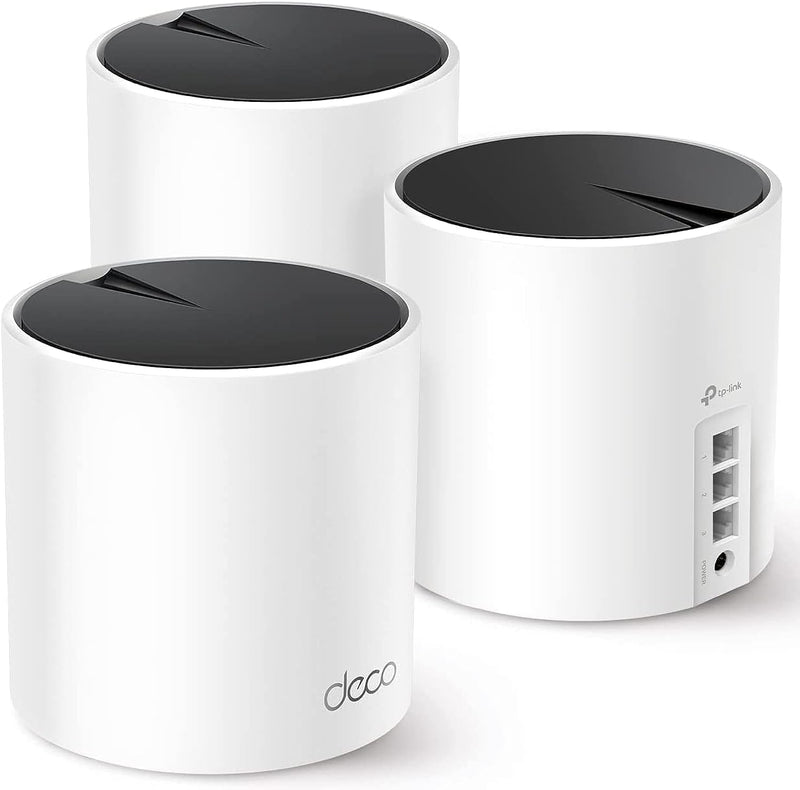


TP-Link Deco X55 (3-Pack) — Editorial Review & Independent Findings
The Deco X55 3-pack is positioned as a mid-range WiFi 6 mesh system for 4,000-6,500 sq ft homes. The findings below aggregate published testing from independent technology publications, with citations to the original sources. Per TP-Link's product page the system pairs AX3000 (574 Mbps on 2.4 GHz + 2,402 Mbps on 5 GHz) capability with three gigabit Ethernet ports per unit and Ethernet backhaul support.
Real-World Throughput from Independent Testing
HighSpeedInternet.com's hands-on review tested the Deco X55 against three other mesh systems. An iPhone 12 Pro Max connecting to the primary unit at close range reached up to 739 Mbps, placing the Deco X55 second in the test set — behind Amazon's Eero Pro 6 at 802 Mbps but ahead of two other competing mesh systems. The publication notes the Deco X55 is the most affordable option in the test set, narrowing the price-per-performance gap considerably.
On a 2-3 story home, real-world testing consistently maintained usable speeds in every room. The same publication recorded never dropping below 200 Mbps anywhere in a typical 2,500-3,500 sq ft home, including basements and previously-troublesome corner rooms. On gigabit fiber service, single-device throughput in best-case positioning was measured at over 800 Mbps.
Coverage and Mesh Density
Per TP-Link's published specifications, a 3-pack covers up to 6,500 sq ft, a 2-pack covers 4,500 sq ft. Independent verification by TP-Link's published coverage map and the testing referenced above confirms the 3-pack as appropriate for multi-story homes with thick interior walls or unusual layouts. For apartments and townhouses with single-story or simple two-story layouts, the 2-pack is the correct sizing tier.
Ethernet Backhaul Materially Improves Performance
Dong Knows Tech's review of the Deco X55 Pro (the same family at a higher-tier price point) emphasises that wired Ethernet backhaul between mesh nodes substantially improves both throughput and latency compared to wireless backhaul. The base Deco X55 supports wired backhaul on its three gigabit Ethernet ports per unit. Homes with existing Cat5e/Cat6 between rooms, or homes using MoCA over coaxial wiring, will see meaningfully better mesh-hop performance than wireless-only configurations.
WiFi 6 Feature Set in Practical Terms
Per the Wi-Fi Alliance's WiFi 6 specification, the meaningful end-user gains over WiFi 5 are OFDMA (more efficient handling of many simultaneous devices), TWT (target wake time, which extends battery life on supported IoT devices), and 1024-QAM (higher peak throughput in strong-signal conditions). The Deco X55 supports all three. Practical implications:
- Smart homes with 30-60 simultaneous devices benefit most from OFDMA — the X55 supports up to 150 concurrent device connections per TP-Link's specifications, well above typical residential density
- Phones, laptops, and tablets from 2020 onward (which support WiFi 6) gain the largest throughput improvements
- Older WiFi 5 (802.11ac) devices still connect but cap at WiFi 5 speeds — for those devices, the mesh's coverage advantage matters more than peak throughput
Honest Trade-offs vs Competing Mesh Systems
- Single gigabit WAN port limits — for buyers with 1.5+ Gbps internet service, the Deco X55 caps incoming bandwidth at gigabit. The Deco X55 Pro (2.5 Gbps WAN) or higher-tier WiFi 7 mesh families address this
- No WiFi 6E (6 GHz band) — the X55 is WiFi 6 only. Recent flagship phones, laptops, and consoles that support WiFi 6E with 6 GHz spectrum cannot use that band on this system
- Consumer-tier feature set — VLANs, advanced QoS, and pro-grade network segmentation aren't supported. For those features, prosumer hardware (Unifi, pfSense) is the better path
- Apartment / single-story buyers don't need the 3-pack — for sub-3,500 sq ft homes the 2-pack delivers the same per-unit performance at lower cost
Where the 3-Pack Specifically Fits
- Multi-story homes (4,000-6,500 sq ft) where signal needs to traverse multiple interior walls or floors
- Homes with a previously-weak-signal area (basement, far bedroom, detached garage workshop) where adding a third mesh node closes the gap
- Smart-home deployments with 30+ WiFi devices benefiting from OFDMA's multi-device efficiency
- Buyers on standard gigabit (or sub-gigabit) internet service — the X55's gigabit WAN cap doesn't bottleneck
Sources & Citations
- TP-Link, "Deco X55 AX3000 product page," tp-link.com (accessed 2026-05-17)
- HighSpeedInternet.com, "TP-Link Deco X55 Review," highspeedinternet.com (accessed 2026-05-17)
- Dong Knows Tech, "TP-Link Deco X55 Pro Review: A Fine Wi-Fi 6 Mesh for a Wired Home," dongknows.com (accessed 2026-05-17)
- Wi-Fi Alliance, "Wi-Fi CERTIFIED 6 overview," wi-fi.org (accessed 2026-05-17)
Last verified: 2026-05-17


