

TP-Link
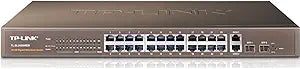
TP-Link TL-SL2428WEB Gigabit Ethernet Web Smart Switch
★★★★★
Optimize Your Network with Enhanced ManagementThe TP-LINK TL-SL2428WEB is a web smart switch that offers a blend of performance and manageability for small to medium-sized businesses. With Gigabit uplink ports and advanced features, it ensures smooth data transmission and network scalability. Po...
Check availability
Affiliate Disclosure: Studio Supplies may earn a commission from qualifying purchases made through links on this page, at no additional cost to you. This helps support our editorial team.
Notice a mistake? Let Us Know
Overview
Optimize Your Network with Enhanced Management
The TP-LINK TL-SL2428WEB is a web smart switch that offers a blend of performance and manageability for small to medium-sized businesses. With Gigabit uplink ports and advanced features, it ensures smooth data transmission and network scalability.
- Ports: 24 10/100Mbps ports, 2 10/100/1000Mbps ports, 2 Gigabit SFP Slots
- Management: Web smart management interface
- QoS: Quality of Service for enhanced traffic management
- Scalability: Supports Mini GBIC modules
Key Features
24+4G Gigabit-Uplink Web Smart Switch.
Quick and easy setup with Web-based management.
Supports Port-Based VLAN and IEEE 802.1Q Tag VLAN.
Supports Static MAC address and filtering MAC address management
Rack-mountable steel case.
Specifications
Type
Web Smart Switch
Ethernet Ports
24
Gigabit Uplink Ports
4
VLAN Support
Port-Based VLAN, IEEE 802.1Q Tag VLAN
MAC Address Management
Static MAC address, Filtering MAC address
Mounting
Rack-mountable
Case Material
Steel
Pros & Cons
👍 Pros
- Equipped with 24 Ethernet ports and 4 Gigabit-Uplink ports, offering extensive connectivity for numerous devices.
- Features web-based management, providing a quick and easy setup process without complex command-line interfaces.
- Supports Port-Based VLAN and IEEE 802.1Q Tag VLAN, allowing for efficient network segmentation and traffic management.
- Offers Static MAC address and filtering MAC address management, enhancing network security and control.
- Comes in a rack-mountable steel case, ensuring secure installation and durability in network racks.
👎 Cons
- As a Web Smart Switch, it may lack the advanced feature set and deep customization options found in fully managed switches.
- The "Gigabit-Uplink" ports suggest the standard 24 ports might be Fast Ethernet (10/100 Mbps), which can be a bottleneck for high-speed local network transfers.
- The web-based management, while easy, might be slower to navigate or less feature-rich compared to CLI for advanced users.
- Lacks Power over Ethernet (PoE) capabilities, meaning separate power sources are needed for PoE-dependent devices like IP cameras or access points.
- Does not include fanless operation, which could mean some operational noise in quiet environments.
Frequently Asked Questions
How many devices can I connect to the TP-Link TL-SL2428WEB switch?
You can connect up to 24 Ethernet devices to the standard ports, plus an additional 4 devices to the Gigabit-Uplink ports, for a total of 28 devices.
Is this switch difficult to set up for someone without extensive networking experience?
No, the TP-Link TL-SL2428WEB features web-based management, making the setup process quick and easy for users of varying technical expertise.
What is the benefit of VLAN support on this switch?
VLAN (Virtual Local Area Network) support, including Port-Based VLAN and IEEE 802.1Q Tag VLAN, allows you to segment your network, improving security and managing network traffic more efficiently.
Can this switch be installed in a server rack?
Yes, the TP-Link TL-SL2428WEB comes in a rack-mountable steel case, designed for secure and organized installation in standard network racks.
Does this switch provide Power over Ethernet (PoE) for devices?
The product features do not indicate support for Power over Ethernet (PoE), meaning connected devices will require their own power adapters.
How does the MAC address management feature work?
The switch supports Static MAC address and filtering MAC address management, allowing administrators to control which specific devices are permitted to connect to certain ports, enhancing network security.
Are the 24 standard Ethernet ports also Gigabit speed?
The product is described as a "Gigabit-Uplink Web Smart Switch," implying that the 4 uplink ports are Gigabit, while the 24 main Ethernet ports are typically Fast Ethernet (10/100 Mbps).
Related Products


