

WD Blue SN580 vs SN550 vs SN770 vs SN850X — Lineup Explained
The WD Blue SN580 is positioned as the mainstream value tier in WD's current NVMe lineup. Choosing among the SN580, the older SN550, the gaming-line SN770, and the flagship SN850X comes down to the host platform's PCIe generation, sustained-write requirements, and target use case rather than a simple "faster is better" ranking.
Lineup at a Glance
| Drive | Interface | Seq Read (1TB) | Seq Write (1TB) | Target Use |
|---|---|---|---|---|
| WD Blue SN550 | PCIe 3.0 x4 | up to 2,400 MB/s | up to 1,950 MB/s | Budget / older systems (discontinued) |
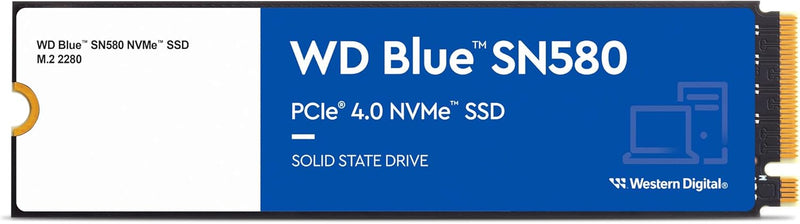
| WD Blue SN580 (this drive) | PCIe 4.0 x4 | up to 4,150 MB/s | up to 4,150 MB/s | Mainstream value |
| WD_Black SN770 | PCIe 4.0 x4 | up to 5,150 MB/s | up to 4,900 MB/s | Gaming / creator |
| WD_Black SN850X | PCIe 4.0 x4 | up to 7,300 MB/s | up to 6,600 MB/s | Flagship gaming / PS5 |
Numbers from WD's official product pages; 1TB tier shown for direct comparison.
How the SN580 Differs from the SN550 It Replaces
Tom's Hardware's SN580 review notes the SN580 jumps the Blue line to a PCIe 4.0 interface and adds WD's nCache 4.0 hybrid caching scheme. The review characterises the improvement as a solid incremental upgrade — sequential read and write both push to roughly 4,150 MB/s, ahead of the SN550's ~2,400 MB/s read ceiling — but emphasises that the gain is largely from the Gen4 interface itself rather than from a controller or NAND-architecture redesign.
KitGuru's SN580 1TB review reaches similar conclusions, finding the drive well-suited to general-purpose desktop and laptop use without standing out in benchmark contests.
Why You'd Pick the SN580 Over the SN770
The SN770 is faster on paper (5,150 MB/s read vs 4,150 MB/s) and on benchmark workloads. For everyday computing — OS, applications, browser, light gaming, photo library, document workflows — the difference is rarely user-visible because real-world workloads are bottlenecked by 4K random I/O rather than sequential throughput. Per Tom's Hardware's SN580 review, the SN580 wins on the metric most non-enthusiast buyers actually care about: price per gigabyte at a competitive 4.0 performance tier. The SN770 is the better pick for buyers who specifically value gaming load times or sustained-write capacity for creator workflows.
Why You'd Pick the SN850X Over Either
The SN850X is WD's flagship and targets PS5 internal-expansion duty and high-end gaming PC primary drives. The 7,300 MB/s sequential read and 1,200,000 IOPS random read make it visibly faster on the largest game loads, and the optional heatsink variant satisfies PS5 thermal requirements without an aftermarket part. Use case is the differentiator — for desktop OS-drive duty or general application loads, the SN580's price advantage outweighs the SN850X's headline numbers.
The SN550 Caveat
The original SN550 was very well-reviewed at launch, but Tom's Hardware notes WD later changed the flash, altering performance negatively on later production batches. Buyers seeking the SN550 specifically for its original-batch performance need to verify the production date, and for almost all use cases the SN580 is the better current choice.
Form Factor and Warranty
All four drives are M.2 2280 single-sided NVMe; physical fitment is identical. All four carry a 5-year limited warranty bounded by the published TBW endurance figure (per WD's product specifications).
Sources & Citations
- Tom's Hardware, "WD Blue SN580 SSD Review: More of the Same," tomshardware.com (accessed 2026-05-16)
- KitGuru, "WD Blue SN580 1TB SSD Review," kitguru.net (accessed 2026-05-16)
- Tom's Hardware, "WD Black SN770 SSD Review," tomshardware.com (accessed 2026-05-16)
- Western Digital, "WD Blue SN580 NVMe SSD product page," westerndigital.com (accessed 2026-05-16)
- Western Digital, "WD_BLACK SN770 product page," westerndigital.com (accessed 2026-05-16)
Last verified: 2026-05-16