



ASRock
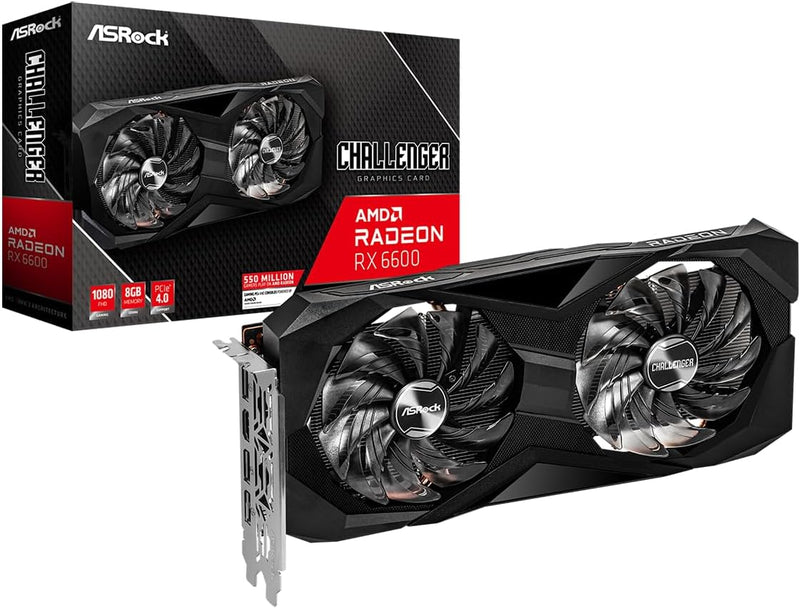
ASRock 90-GA2RZZ-00UANF RX 6600 Challenger D 8GB Graphics Card
1080pHDMI 2.1DisplayPort
RDNA 2 architecture and 8GB of GDDR6 memory deliver high-frame-rate 1080p gaming at a power and thermal budget that mid-range builds can sustain.
$219.99*$425.00Save 48%
View on Amazon
✓ In Stock on Amazon.com
*Price sourced from Amazon.com. Last updated:Sep 13, 2026.Price and availability are subject to change — details.
Affiliate Disclosure: As an Amazon Associate, Studio Supplies earns from qualifying purchases made through links on this page, at no additional cost to you. This helps support our editorial team.
Notice a mistake? Let Us Know
Overview
Key Features
***Not compatible with all built-in computers or systems
AMD Radeon RX 6600 GPU: Built on RDNA 2 architecture, delivering excellent 1080p gaming performance with high efficiency.
8GB GDDR6 Memory: Provides smooth gameplay and multitasking with fast data transfer rates.
Challenger D Cooling: Features a dual-fan design for effective heat dissipation and quiet operation.
PCIe 4.0 Support: Ensures high bandwidth for improved gaming and productivity performance.
Multiple Display Outputs: Includes 1x HDMI 2.1 and 3x DisplayPort 1.4 for versatile connectivity.
AMD FidelityFX Super Resolution (FSR): Enhances performance and image quality in supported games.
Durable Build: High-quality components ensure reliability and longevity for gaming and creative workloads.
Dimensions: 10.59 x 5.20 x 1.61 inches
If any questions about the product, contact us on amazon.
Specifications
GPU
AMD Radeon RX 6600
Architecture
RDNA 2
Memory
8GB GDDR6
Cooling
Challenger D dual-fan design
PCIe Support
PCIe 4.0
HDMI Outputs
1x HDMI 2.1
DisplayPort Outputs
3x DisplayPort 1.4
Image Enhancement
AMD FidelityFX Super Resolution (FSR)
Dimensions
10.59 x 5.20 x 1.61 inches
Similar Products
Other products from the same family that visitors often consider:
 ✓ Available
ASRock 90-GA2TZZ-00UANF Radeon RX 6600 XT 8GB Graphics Card
$525.00
View on Amazon → ✓ Available
ASRock 90-GA2SZZ-00UANF Radeon RX 6600 XT Challenger Pro 8GB
$575.00
View on Amazon → ✓ Available
ASRock RX7600 CL 8GO AMD Radeon RX 7600 Challenger 8GB OC Graphics Card
$339.99
View on Amazon → Currently Unavailable
ASRock 90-GA3RZZ Radeon RX 6650 XT Challenger OC 8GB Graphics
Check on Amazon → Currently Unavailable
ASRock 90-GA29ZZ-00UANF RX 6800 Challenger Pro 16GB Graphics Card
Check on Amazon →Frequently Asked Questions
What PCIe slot does this card require, and will it work in a PCIe 3.0 system?
The RX 6600 Challenger D uses a PCIe 4.0 x8 interface. It is backward compatible with PCIe 3.0 slots — the card will operate in older systems, but at PCIe 3.0 bandwidth. At 1080p, the bandwidth difference between PCIe 3.0 and 4.0 for this card is negligible in most gaming workloads.
What is the 0dB Silent Cooling feature and when does it activate?
The dual-fan cooling system switches to passive mode (fans completely off) when the GPU temperature is below a threshold during light workloads or desktop use. Fans spin up automatically when the GPU reaches a set temperature under gaming or rendering load. This eliminates fan noise entirely during idle and light tasks.
Does the Challenger D cooling design keep the RX 6600 within safe thermal limits under sustained gaming?
Yes. The dual-fan design with the metal backplate manages thermals adequately for the RX 6600's TDP. Under sustained 1080p gaming loads, reported temperatures typically land in the 65–75°C range depending on case airflow — well within AMD's operating limits for this chip.
How does AMD FidelityFX Super Resolution (FSR) work on this card, and does it require specific hardware?
FSR is an open-source spatial upscaling algorithm that runs on the GPU shader cores. It is not hardware-locked — it works on this card and on competing GPUs. In supported games, FSR renders at a lower resolution and upscales the output, increasing frame rates at a modest image quality trade-off. It does not require a dedicated tensor core or proprietary hardware block.
Can this card drive four monitors simultaneously?
The card has four outputs — 1× HDMI 2.1 and 3× DisplayPort 1.4. AMD's display engine supports up to four simultaneous displays on this architecture, so yes, all four outputs can be active at once within that limit.
Related Products


