



ASRock
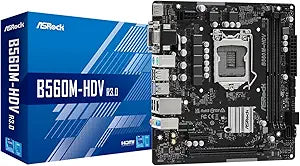
ASRock 90-MXBLC0-A0UAYZ B560M-HDV R3.0 Intel 10th/11th Gen Motherboard
The B560 chipset unlocks DDR4 memory overclocking on 10th and 11th Gen Intel platforms in a Micro ATX footprint that doesn't sacrifice essential I/O.
$49.99*
View on Amazon
✓ In Stock on Amazon.com
*Price sourced from Amazon.com. Last updated:Sep 13, 2026.Price and availability are subject to change — details.
Affiliate Disclosure: As an Amazon Associate, Studio Supplies earns from qualifying purchases made through links on this page, at no additional cost to you. This helps support our editorial team.
Notice a mistake? Let Us Know
Overview
Key Features
90-MXBLC0-A0UAYZ
4710483942549
Specifications
Chipset
Intel B560
CPU Socket
LGA1200
CPU Support
Intel 10th Gen (Comet Lake) / 11th Gen (Rocket Lake)
Memory Support
DDR4, up to 4000+ MHz (OC)
Form Factor
Micro ATX
Display Outputs
D-Sub (VGA), DVI-D, HDMI
USB (Rear)
2x USB 3.2 Gen 1, 4x USB 2.0
Network
1x RJ-45 Gigabit LAN
Legacy I/O
1x PS/2
OS Support
Windows 10 / 11 (64-bit)
Color
Matte Black and Copper
Similar Products
Other products from the same family that visitors often consider:
Frequently Asked Questions
What processors are compatible with the B560M-HDV R3.0?
This board uses the LGA1200 socket and supports Intel 10th Gen (Comet Lake) and 11th Gen (Rocket Lake) Core processors. It does not support 12th Gen or later Intel CPUs, which moved to the LGA1700 socket — this is a platform-specific constraint, not a board limitation.
Does the B560 chipset allow CPU overclocking?
No. The B560 chipset locks CPU multiplier overclocking to Intel K-series paired with a Z-series board. What B560 does allow — unlike H510 — is memory overclocking (XMP profiles and manual DDR4 tuning up to 4000+ MHz). If your workload benefits from memory bandwidth rather than raw clock speed, B560 is the correct chipset tier.
What display outputs are available, and can I run dual monitors?
The board provides three independent display outputs: D-Sub (VGA), DVI-D, and HDMI. All three connect to the processor's integrated graphics. Multi-monitor capability depends on your CPU's iGPU support for simultaneous outputs — check Intel's spec sheet for your specific processor. If using a discrete GPU, these onboard outputs are typically disabled.
Is the Micro ATX form factor a limitation for expansion?
Micro ATX (244mm x 244mm) supports fewer PCIe and RAM slots than full ATX, but for a single-GPU build with standard storage, it provides all necessary expansion. The primary trade-off is if you need multiple discrete PCIe cards — in that case, full ATX is the correct form factor.
Will this board support NVMe SSDs?
The available product specifications do not detail M.2 slot count or NVMe support explicitly. Buyers planning NVMe storage should verify M.2 slot availability with ASRock's official spec sheet for this model before purchasing.
Related Products


