
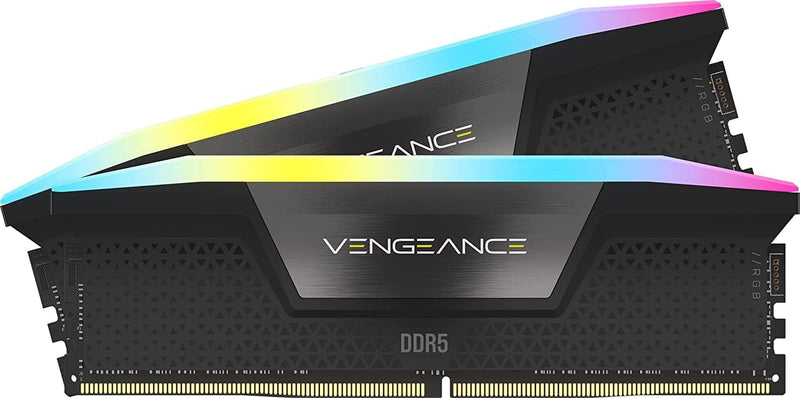


Corsair Vengeance DDR5 Desktop Memory (16GB / 32GB / 64GB Kits) — Editorial Review & Compatibility Guide
The Corsair Vengeance DDR5 family (CMK16GX5M2B5200C40, CMK64GX5M2B5200C40, CMH32GX5M2D6000C36, CMH64GX5M2B6400C32, plus the RGB CMH variants and SODIMM CMSX laptop variants) is Corsair's mainstream-to-enthusiast DDR5 desktop memory line — targeting Intel 12th/13th/14th gen + AMD Ryzen 7000+ AM5 + Threadripper 7000 platforms that moved to DDR5. Per Corsair's official Vengeance DDR5 product family page, the line ships at 4800MHz baseline JEDEC speed, with overclocked XMP 3.0 / Intel XMP / AMD EXPO profiles for 5200MHz, 6000MHz, 6400MHz, and faster speeds depending on SKU.
What Vengeance DDR5 Specifically Wins
- DDR5 architecture — 2x DDR4 bandwidth per module — each module has two independent 32-bit channels (vs DDR4's single 64-bit). Modern CPUs benefit from improved parallelism
- On-die ECC — DDR5 spec includes error correction inside the module (different from server ECC, but improves data integrity)
- 5200MHz CL40 / 6000MHz CL30 / 6400MHz CL32 XMP/EXPO profiles — one-click BIOS enable for overclocked speeds. AMD EXPO profiles work natively on Ryzen 7000+ for optimal Infinity Fabric ratios
- 1.1V operating voltage — DDR5 standard, lower than DDR4's 1.2V. Lower power draw + lower heat
- Low-profile heatspreader on standard Vengeance — clears tower coolers (Noctua NH-D15, be quiet! Dark Rock 5, Deepcool AK620). RGB variants are slightly taller; verify cooler clearance
- Lifetime warranty
- Wide motherboard compatibility — Intel Z690/Z790/Z890, AMD X670/B650/X870, Threadripper TRX50/WRX90
- SODIMM laptop variant (CMSX*GX5M*) for DDR5 laptops
- Power Management IC (PMIC) on module — more sophisticated power delivery than DDR4 (which relied on motherboard voltage regulation)
Where Vengeance DDR5 Specifically Fits
- Intel 12th/13th/14th gen + Ryzen 7000+ gaming desktop builds — 32GB sweet spot for current games
- Content creator workstations on current platforms — Premiere/After Effects/DaVinci Resolve benefit from 32-64GB DDR5
- AM5 / Z890 motherboards built 2024-2025 — DDR5 is the default for modern motherboards
- Compact ITX DDR5 builds — low-profile fits under tower cooler in small chassis
- Streaming PCs — DDR5 bandwidth helps with OBS + game + browser + Discord workflow
- VR gaming systems — bandwidth headroom for high-refresh-rate VR rigs
- Higher-end home office workstations
- Server / NAS upgrades on DDR5-supporting motherboards
- AI/ML development workstations — 64GB+ DDR5 for small LLM training
- Threadripper 7000 high-end workstation — server-tier memory for VFX / rendering
Honest Limits Buyers Should Know
- NOT backward compatible with DDR4 motherboards. DDR5 has different keyway position than DDR4 — physically WON'T install. Verify motherboard memory generation before purchase. DDR4 buyers need Vengeance LPX DDR4 (see [[pdp-corsair-vengeance-lpx-ddr4-3200-review]])
- 5200MHz JEDEC vs higher XMP/EXPO speeds. Faster speeds (6000+/6400+) only enable via XMP/EXPO profile in BIOS. Verify motherboard CPU memory controller supports the speed (Ryzen 7950X3D supports up to 6000MHz natively; higher speeds may require manual subtiming)
- RGB Vengeance is taller than standard Vengeance. RGB variants ~50mm vs standard ~34mm. Tall RAM with large CPU coolers may have clearance issues. Verify before buying RGB tier
- AMD AM5 + DDR5 may need BIOS update for highest speeds. Early AM5 BIOS releases capped at 5200MHz; current BIOS versions support 6400+. Update before assuming highest speeds work
- SODIMM laptop variants (CMSX) are different SKU. Desktop Vengeance DDR5 modules DO NOT fit laptop SODIMM slots. For DDR5 laptop SODIMM, use CMSX*GX5M* (or Crucial DDR5 SODIMM family)
- Premium pricing vs DDR4. DDR5 is 30-50% more expensive than DDR4 at the same capacity tier. Pays for newer architecture; some users wait for prices to drop
- Memory training takes longer on cold boot. DDR5 has more complex training procedures; 15-30 seconds cold boot vs DDR4's 5-10 seconds. Subsequent boots are normal speed
- 4-stick configurations sometimes downclock. Most AM5 / Intel motherboards lose speed when populating all 4 DIMM slots vs 2. For maximum speed, 2-stick configuration with higher-capacity modules is preferred
- Memory controller is the gate, not the modules. Even with 6400MHz modules, if the CPU's integrated memory controller is rated to 6000MHz, modules will run at 6000MHz max
Where Buyers Should Look Elsewhere
- Premium / enthusiast DDR5 with tighter timings → G.SKILL Trident Z5 / Z5 Neo at CL30-32, Kingston Fury Renegade DDR5
- RGB aesthetic → Corsair Vengeance RGB DDR5 (in this family) or G.SKILL Trident Z5 RGB
- DDR4 motherboards (older platforms) → Corsair Vengeance LPX DDR4 (see linked article)
- DDR5 SODIMM laptop memory → Crucial DDR5 SODIMM family (see [[pdp-crucial-ddr5-sodimm-family-review]])
- Server / ECC workstation → Corsair Server Premier DDR5, Kingston Server Premier DDR5
- Highest possible speed (6800+ MHz) → G.SKILL Trident Z5 Neo / Royal Neo (AMD-tuned at extreme speeds)
- Pure budget DDR5 → Crucial Pro DDR5, Kingston Fury Beast DDR5 (slower XMP speeds but cheaper)
Sources & Citations
- Corsair, "Vengeance DDR5 product family page," corsair.com (accessed 2026-05-18)
- AMD, "Ryzen 7000+ AM5 memory documentation," amd.com (accessed 2026-05-18)
- Intel, "Intel 12th-14th gen platform memory documentation," intel.com (accessed 2026-05-18)
- Tom's Hardware, "DDR5 memory comparison and benchmarks," tomshardware.com (accessed 2026-05-18)
Last verified: 2026-05-18

