

Corsair
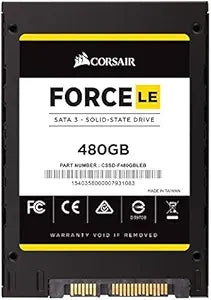
Corsair CSSD-F480GBLEB Force LE 480GB SSD
480GB SSD
The Corsair Force LE 480GB delivers SATA 6Gbps sequential performance over a 2.5" TLC NAND platform with SmartECC error correction — a direct, no-overhead upgrade from spinning storage.
$280.49*
Check availability
*Price sourced from Amazon.com. Last updated:Sep 15, 2026.Price and availability are subject to change — details.
Affiliate Disclosure: As an Amazon Associate, Studio Supplies earns from qualifying purchases made through links on this page, at no additional cost to you. This helps support our editorial team.
Notice a mistake? Let Us Know
Overview
Key Features
Boot and shut down your PC faster, start your applications in the blink of an eye, and find your files and documents and instantly.
It's easier than ever to upgrade to the speed and reliability of solid-state drive technology.
Lots of storage to satisfy your everyday needs - work, play, create, and keep all your videos, music, documents and more.
Uses dramatically less power than traditional hard drives, for better power efficiency for desktops and longer battery life for laptops.
SmartECC and Smart Refresh for reliable data retention and error correction.
Improves drive lifespan, reliability, and performance.
A powerful suite of tools for getting the most out of your SSD.
Long-term reliability from a brand you can trust
Specifications
Capacity
480GB
Technology
Solid-State Drive (SSD)
Features
SmartECC, Smart Refresh
Power Consumption
Lower than traditional hard drives
Frequently Asked Questions
What interface does the Force LE use, and is it compatible with my existing system?
The Force LE uses a SATA 6Gbps (SATA III) interface in a 2.5" form factor, compatible with any system that has a SATA III or SATA II port — virtually all desktops and laptops produced after 2009. SATA II limits practical throughput to ~300 MB/s; full SATA III sequential speeds require a SATA III controller on the host side.
What NAND technology does the Force LE use, and how does TLC endurance compare to MLC?
The Force LE uses TLC (Triple-Level Cell) NAND, storing 3 bits per cell. TLC has lower per-cell write endurance than MLC (2 bits/cell), but modern TLC drives mitigate this through over-provisioning, error correction, and firmware-level cell health management. For standard consumer and prosumer workloads, TLC endurance is more than sufficient across the drive's useful lifespan.
What do SmartECC and Smart Refresh actually do for data integrity?
SmartECC is error correction code that identifies and corrects bit errors in NAND cells before they accumulate into data loss events. Smart Refresh monitors cell health over time and proactively rewrites data stored in cells showing degradation. Together, these firmware features extend functional TLC reliability well beyond its raw per-cell write endurance rating.
How much faster will my system feel after replacing an HDD with the Force LE?
A mechanical hard drive delivers 100–150 MB/s sequential reads with 10–20ms seek latency. A SATA SSD delivers sequential reads in the hundreds of MB/s with sub-0.1ms latency. In practical terms: OS boot drops from 30–60 seconds to under 15, and application launches that took 5–10 seconds on HDD become near-instant.
Does the Force LE work in a laptop as well as a desktop?
Yes — the 2.5" form factor is the standard drive bay size for laptops produced in the last decade, as well as desktops with a 2.5" bay or 3.5" bay with an adapter bracket. It fits both without modification to the drive itself.
Related Products
