



Dell
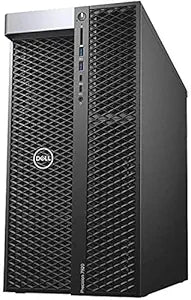
Dell Intel Xeon Precision T7920 2X Gold 5118 768GB 500GB SSD M2000 Win 11 (Renewed)
Dual Xeon Gold 5118 processors and 768GB of ECC RAM deliver server-grade parallel compute in a certified-renewed workstation chassis.
View price on Amazon
Affiliate Disclosure: As an Amazon Associate, Studio Supplies earns from qualifying purchases made through links on this page, at no additional cost to you. This helps support our editorial team.
Notice a mistake? Let Us Know
Overview
Unleash Server-Grade Performance with the Dell Precision T7920 Workstation (Renewed)
The Dell Precision T7920 is a renewed powerhouse workstation designed for demanding professional applications. Featuring dual Intel Xeon Gold processors, massive memory, and dedicated graphics, this workstation delivers exceptional performance for content creation, engineering, and scientific computing. Each unit has been thoroughly tested and certified to ensure it functions like new.
Specifications:
- Processors: 2x Intel Xeon Gold 5118 12C 2.3Ghz
- Memory: 768GB RAM
- Storage: 500GB SSD + 2TB HDD
- Graphics: M2000
- Operating System: Windows 11
- Condition: Renewed
Frequently Asked Questions
What does 768GB of RAM actually unlock that a standard workstation with 64GB or 128GB cannot do?
At 768GB, the T7920 can hold entire large datasets — genomics reference databases, full financial models, multi-gigabyte simulation state — entirely in RAM, eliminating disk I/O as a bottleneck. It also enables running multiple large VMs simultaneously without memory overcommit, and supports in-memory databases like SAP HANA or Redis at production scale.
How do the dual Xeon Gold 5118 processors divide workloads between themselves?
Each Xeon Gold 5118 is a 12-core, 24-thread processor running at 2.3 GHz base with 16.5MB L3 cache. In a dual-socket configuration, the system presents 24 physical cores and 48 threads to the OS. NUMA (Non-Uniform Memory Access) topology means each CPU has faster access to its directly attached memory channels — workloads that are NUMA-aware (most HPC and professional simulation software) extract maximum throughput; workloads that are not may experience cross-socket latency.
What is the NVIDIA Quadro M2000, and is it suitable for modern GPU-accelerated workloads?
The M2000 is a Maxwell-architecture professional GPU with 4GB of GDDR5 ECC memory, designed for stable, verified OpenGL and compute output in professional applications. It supports CAD, moderate 3D visualization, and multi-display output reliably. However, it predates CUDA compute architectures used in modern AI/ML frameworks and lacks Tensor Cores — for deep learning inference or training, a newer GPU would need to be installed.
Is the 500GB SSD + 2TB HDD storage configuration expandable in the T7920 chassis?
The Dell Precision T7920 tower chassis supports multiple 3.5-inch and 2.5-inch drive bays plus M.2 slots depending on the specific configuration. There is significant expansion room for additional NVMe, SATA SSD, or HDD drives — the T7920 was designed as a workstation platform where storage expansion is expected.
What does "renewed" certification mean for a workstation at this specification level?
The unit has been tested and certified to function as specified. For a system with 768GB of RAM and dual CPUs, this certification process should include memory stress testing, CPU burn-in, and storage integrity verification. The renewed condition offers the T7920's substantial hardware capability at reduced cost, with a 90-day warranty period as the trade-off versus new-unit coverage.
Related Products


