



Dell
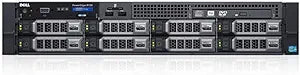
Dell PowerEdge R730 2X E5-2650 V3 Server (Renewed)
The renewed PowerEdge R730 delivers 20 Xeon cores, 768GB of DDR4 ECC RAM, and hot-swap storage in a proven 2U chassis engineered for sustained enterprise workloads.
View price on Amazon
Affiliate Disclosure: As an Amazon Associate, Studio Supplies earns from qualifying purchases made through links on this page, at no additional cost to you. This helps support our editorial team.
Notice a mistake? Let Us Know
Overview
High-Performance Server for Demanding Workloads
Specifications:
- Model: Dell PowerEdge R730
- Drive Bays: 8 x 3.5 Hot Plug
- Processors: 2X E5-2650 V3 Ten Core 2.3Ghz
- Memory: 768GB RAM
- Storage: 2X 600GB
- RAID Controller: H730
Frequently Asked Questions
What workloads does the dual E5-2650 v3 configuration handle well, and where is the CPU ceiling?
The dual E5-2650 v3 configuration provides 20 physical cores (40 threads) at a 2.3GHz base clock across the Haswell-EP architecture. This is well-suited for virtualization hosts (VMware ESXi, Hyper-V), database servers (SQL Server, MySQL), CI/CD build infrastructure, and containerized workloads. The ceiling appears in frequency-sensitive single-threaded tasks — modern workloads that depend on high boost clocks will find Haswell-EP's IPC and 2.3GHz base limiting compared to current-generation server CPUs. For parallelized, multi-threaded enterprise workloads, the 20-core count is the relevant metric.
What does 768GB of ECC RAM enable that a workstation-class machine cannot match?
768GB of registered ECC DDR4 is the defining capability of this configuration. It enables large in-memory database instances (SQL Server with full buffer pool in RAM), high-density VM consolidation (30–50+ VMs depending on per-VM memory allocation), and memory-intensive analytics workloads that would require disk paging on any workstation platform. ECC (Error-Correcting Code) memory also detects and corrects single-bit memory errors in real time — a non-negotiable reliability requirement for production servers.
What does the H730 RAID controller deliver, and what RAID levels does it support?
The Dell PERC H730 is a 1GB cache RAID controller supporting RAID 0, 1, 5, 6, 10, 50, and 60 across SAS and SATA drives. The 1GB write-back cache with battery-backed unit (BBU) provides a meaningful write throughput improvement over host-based software RAID. For the included 2x 600GB SAS drives, RAID 1 (mirrored) provides redundancy; RAID 0 provides maximum throughput at the cost of fault tolerance.
What should I verify before purchasing a renewed PowerEdge R730?
Key verification points: confirm the iDRAC license level (Express vs. Enterprise — the Enterprise license enables full remote KVM and virtual media), verify the RAID controller BBU is functional (a dead BBU forces the H730 into write-through mode, eliminating the cache performance benefit), confirm drive health via SMART data, and check that all DIMM slots are populated with functional modules (768GB across the R730's 24 DIMM slots means 32GB RDIMMs throughout).
What is the maximum storage capacity this chassis supports?
The R730 with 8x 3.5-inch hot-plug bays supports up to 8 drives. With the included 2x 600GB SAS drives, 6 bays remain open. The H730 controller supports SAS and SATA drives; the maximum per-drive capacity depends on available 3.5" SAS/SATA options at time of purchase, with modern 3.5" SATA HDDs available up to 18–20TB per drive for maximum capacity configurations.
Related Products


